If you drove a car sixty miles per hour straight up, would you reach the Moon in six months
Forget rockets—could a simple road trip at highway speeds actually land you on the lunar surface in just six months? Buckle up for a mind-bending calculation that reveals exactly how close our celestial neighbor really is.

Too Long; Didn't Read
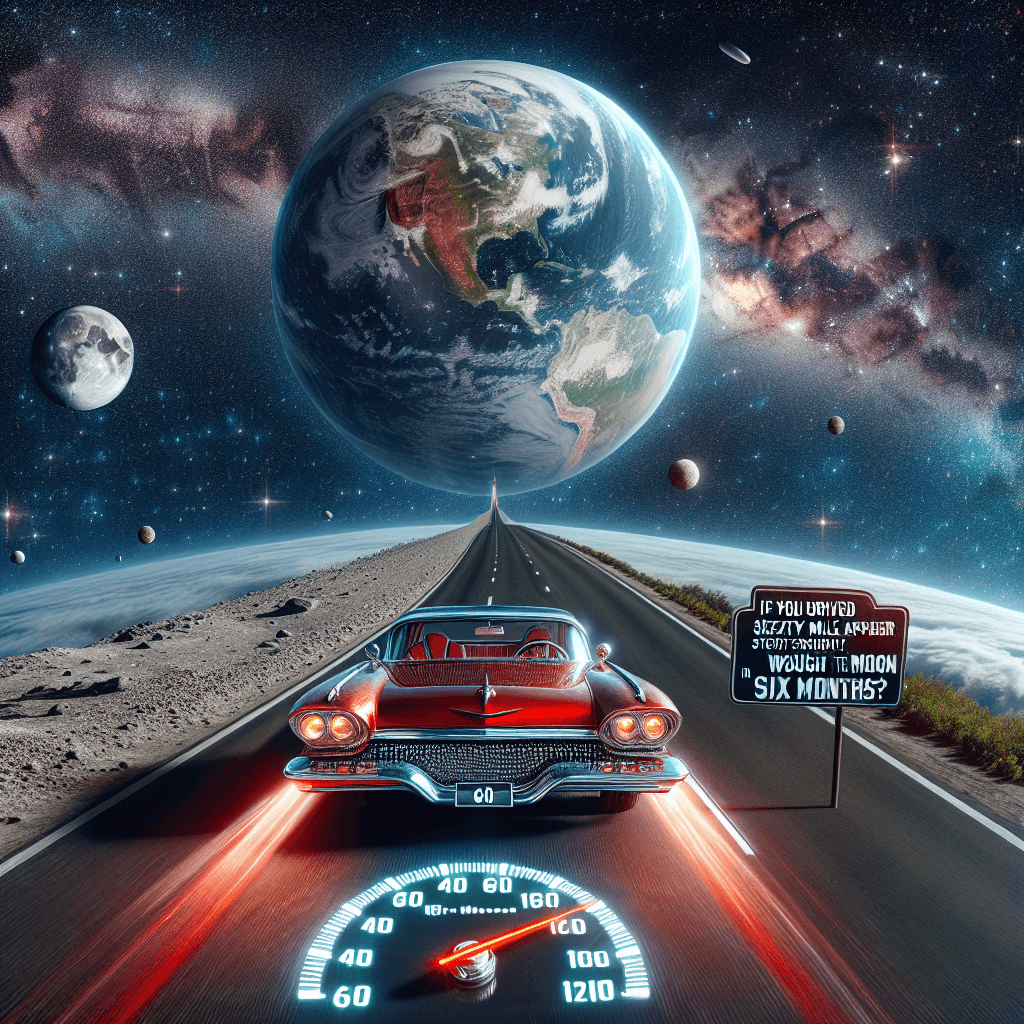
Driving at 60 mph straight up, you would reach the Moon in approximately 166 days, or about five and a half months. Thus, you would indeed arrive in under six months.
Highway to the Heavens: Could You Reach the Moon in Six Months at 60 MPH?
Imagine pulling out of your driveway, clicking your seatbelt, and instead of turning toward the grocery store, you point your steering wheel straight up into the sky. It is a classic childhood "what if" scenario: if we had a vertical highway stretching from Earth to the lunar surface, could a standard family sedan actually make the trip? We often think of space as being infinitely far away, but in the grand scale of the cosmos, the Moon is practically our next-door neighbor.
In this thought experiment, we will set our cruise control to a steady 60 miles per hour (mph) and ignore the minor inconveniences of road construction or traffic jams. By applying the principles of kinematics, celestial mechanics, and atmospheric science, we can determine if this six-month lunar road trip is a mathematical reality or a physical impossibility.
Doing the Math: The Ultimate Commute
To find out if we arrive within our six-month deadline, we first need to look at the odometer. The average distance from the Earth to the Moon is approximately 238,855 miles. Because the Moon’s orbit is elliptical rather than a perfect circle, this distance fluctuates, but we will use the average for our calculations.
If you maintain a constant speed of 60 mph, the math is surprisingly straightforward:
- Total Travel Time: 238,855 miles ÷ 60 mph = 3,980.9 hours.
- Days on the Road: 3,980.9 hours ÷ 24 hours/day ≈ 165.87 days.
- Months Elapsed: 165.87 days ÷ 30 days (average month) ≈ 5.53 months.
Mathematically speaking, you would reach the Moon with nearly two weeks to spare! If you left on New Year’s Day, you would be pulling into the lunar parking lot by mid-June. Compared to the Apollo 11 mission, which took only about three days to reach the Moon, your car trip is leisurely, but it certainly fits within the six-month window.
The Vertical Speed Bumps: Physics vs. Fiction
While the math checks out, the "road" itself presents several scientific hurdles. In the real world, driving straight up isn't just a matter of steering; it’s a battle against the fundamental laws of nature.
1. The Gravity Tax
On a flat highway, your engine works to overcome friction and air resistance. On a vertical highway, your car must constantly fight Earth’s gravitational pull. To truly leave Earth behind without a continuous road, a vehicle must reach "escape velocity"—roughly 25,000 mph. At a mere 60 mph, the moment you took your foot off the gas, gravity would pull you back toward Earth like a ball tossed in the air.
2. The Engine’s Breath
Internal combustion engines require a specific mixture of fuel and oxygen to create the miniature explosions that turn your wheels. As you climb:
- The Troposphere: Within the first 10 miles, the air becomes too thin for standard engines to "breathe."
- The Vacuum of Space: Once you pass the Kármán line (62 miles up), there is no oxygen at all. Without a specialized pressurized oxidizer system—similar to what rockets use—your car would stall long before you saw the stars clearly.
3. Thermal Extremes and Radiation
Space is not a climate-controlled environment. Without the Earth's atmosphere to insulate you, the side of your car facing the sun would bake at temperatures over 250°F, while the side in the shade would plummet to -250°F. Additionally, your windshield provides zero protection against cosmic radiation and solar winds, which are much more intense once you leave our planet’s protective magnetic envelope.
Conclusion: A Long Road Ahead
So, would you reach the Moon in six months? If you had a magical, oxygen-independent engine and a literal highway to drive on, the answer is a resounding yes. You would arrive in about five and a half months, proving that the Moon is much closer than our minds often perceive.
However, the laws of physics—specifically gravity and thermodynamics—dictate that a standard car is better suited for a trip to the coast than a trip to the cosmos. This thought experiment highlights the incredible energy required to overcome Earth's "gravity well." It reminds us that while the distance to the Moon is manageable at highway speeds, the environment of space remains one of the most challenging frontiers ever explored by science. Moving 60 mph is easy; moving 60 mph straight up is a feat of universal proportions.