If you drove a car straight up at highway speeds, how long would it take to reach space
If you could point your car toward the stars and hit highway speeds, you’d reach the edge of space faster than your average morning commute. Discover why the "final frontier" is actually much closer than you think.

Too Long; Didn't Read
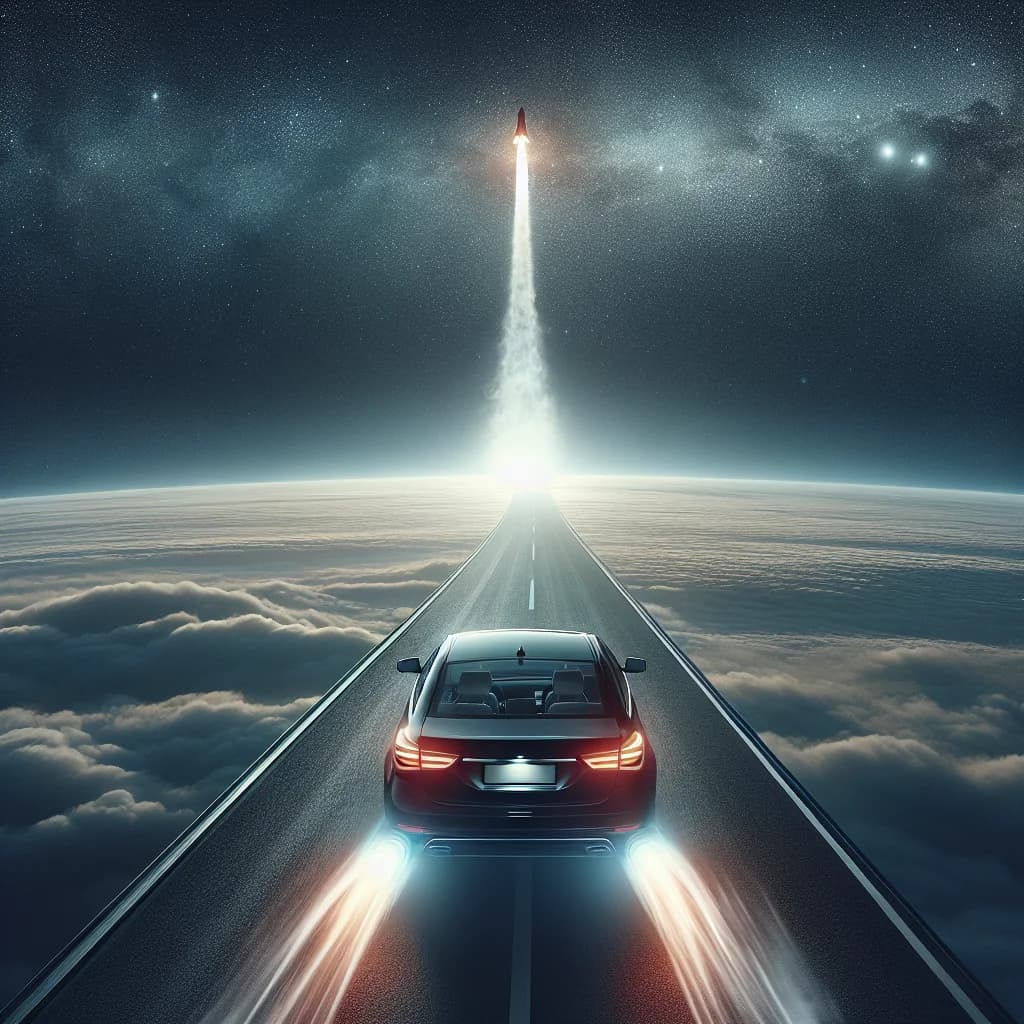
Driving a car straight up at typical highway speeds would get you to the edge of space in approximately one hour.
Vertical Commute: How Long Would It Take to Drive a Car into Space?
Have you ever sat in bumper-to-bumper traffic and found yourself wishing you could simply pull back on the steering wheel and fly over the gridlock? While flying cars remain a staple of science fiction, it raises a fascinating scientific question: if you could drive your car perfectly straight up at highway speeds, how long would it take to leave Earth behind? This thought experiment strips away the complexities of orbital mechanics and replaces them with the familiar metrics of a Sunday drive. To answer this, we must define where "space" actually begins, establish our cruising velocity, and apply the principles of kinematics and atmospheric science to determine the feasibility of a vertical road trip.
Defining the Destination: The Kármán Line
Before we put the pedal to the metal, we need a finish line. In the scientific community, the most widely accepted boundary between Earth’s atmosphere and outer space is the Kármán Line. Located at an altitude of 100 kilometers (approximately 62 miles) above mean sea level, this line represents the point where the atmosphere becomes too thin to support aeronautical flight using conventional wings.
To put that distance into perspective, a 62-mile trip is shorter than the drive between Philadelphia and New York City. While space feels infinitely distant, it is physically closer to us than many major metropolitan suburbs are to their respective downtowns.
The Math of the Upward Drive
If we assume our hypothetical "Space Highway" allows us to maintain a steady highway speed without the interference of traffic or stoplights, the calculation is surprisingly straightforward. For this analysis, we will use a standard American highway speed of 60 miles per hour (mph), which is roughly 96.5 kilometers per hour (km/h).
- Distance to Space: 62 miles (100 km)
- Cruising Speed: 60 mph (96.5 km/h)
- Formula: Time = Distance ÷ Speed
Using these figures, the duration of your trip to the stars would be approximately one hour and two minutes. In the time it takes to watch a single episode of a prestige television drama, you could technically transition from sea level to the vacuum of space.
The Physics of the Ascent
While the math suggests a quick trip, the physics of a vertical climb present several significant challenges. In a standard car, several mechanical and environmental factors would shift as you gain altitude:
- Atmospheric Pressure: As you ascend, the air pressure drops exponentially. By the time you reach 10 kilometers (the cruising altitude of a commercial jet), the pressure is already less than a third of what it is at sea level.
- Combustion Constraints: Internal combustion engines require oxygen to burn fuel. As the air thins, the engine would eventually experience "combustion cessation." Without a specialized oxygen intake system, a standard car engine would likely stall long before reaching the Kármán Line.
- Gravitational Resistance: Driving vertically means working directly against Earth's gravitational pull. On a flat road, your engine only needs to overcome friction and air resistance. In a vertical climb, the engine must constantly exert enough force to lift the entire mass of the vehicle, requiring significantly more energy and fuel.
Environmental Transitions
As you "drive" upward, the environment outside your window would undergo a rapid, clinical transformation.
- The Troposphere (0–12 km): You would pass through the clouds and the majority of Earth's weather.
- The Stratosphere (12–50 km): The sky would begin to deepen from a bright blue to a dark navy. You would pass the ozone layer, where the temperature actually begins to rise slightly.
- The Mesosphere (50–85 km): The air becomes incredibly thin. This is the region where most meteors burn up upon entry.
- The Thermosphere (85 km+): You cross the Kármán Line. The sky turns pitch black, and the curvature of the Earth becomes strikingly visible.
Conclusion
Ultimately, if you could maintain a steady 60 mph on a vertical track, you would reach space in just about an hour. This conclusion is dictated by the simple kinematic relationship between distance and time, framed by the 100-kilometer definition of the Kármán Line. While the mechanical realities of oxygen deprivation and gravitational potential energy make such a trip impossible for a standard Ford or Toyota, the thought experiment highlights a startling reality: space is not far away in terms of distance; it is simply difficult to reach because of the energy required to get there. We live our lives under a thin veil of atmosphere, with the vast expanse of the cosmos waiting just an hour's drive away.