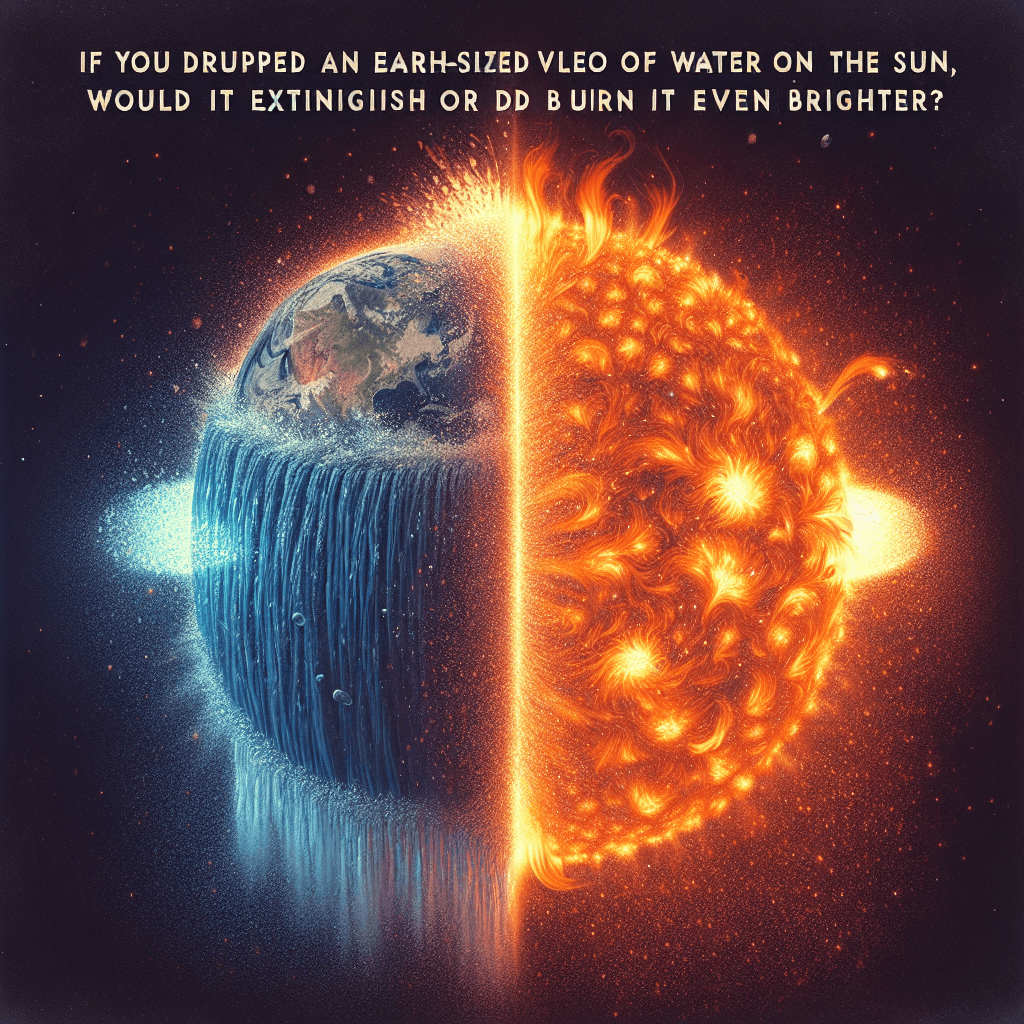
If you dumped an Earth-sized volume of water onto the Sun, would it extinguish or burn even brighter
Think an Earth-sized splash of water would douse the Sun’s fire? The reality is far more explosive: instead of extinguishing the flames, you’d actually be feeding the nuclear furnace and making our star burn hotter than ever before.

Too Long; Didn't Read
Adding an Earth-sized volume of water would make the Sun burn brighter rather than extinguish it. Since the Sun is powered by nuclear fusion instead of chemical combustion, the extra mass increases gravitational pressure, accelerating the fusion process and making the star hotter and more luminous.
Water vs. Star: Would an Earth-Sized Splash Extinguish the Sun?
Imagine a cosmic bucket brigade organized on a galactic scale. Your mission: to extinguish the Sun by dumping an Earth-sized sphere of water directly into its glowing heart. On Earth, water is the ultimate enemy of fire, capable of dousing campfires and structural blazes with ease. However, when we transition from the chemistry of a backyard grill to the physics of a medium-sized G-type main-sequence star, the rules of the game change entirely. To understand what happens next, we must look past the steam and delve into the worlds of celestial mechanics, nuclear fusion, and gravitational pressure.
In this thought experiment, we will analyze the interaction between liquid water ($H_2O$) and the solar plasma to determine if our star would fizzle out or find a new gear.
A Matter of Scale: The "Drop" in the Bucket
To understand the outcome, we first need to appreciate the staggering difference in scale between our "bucket" and the "fire." While an Earth-sized ball of water sounds massive to us, it is practically a rounding error to the Sun.
- Mass Comparison: The Sun contains approximately 99.8% of all the mass in our solar system. It is about 333,000 times more massive than Earth.
- The Splash: If you dumped an Earth’s volume of water onto the Sun, you would be adding only about 0.0003% to the Sun's total mass.
In clinical terms, this isn't like throwing a bucket of water on a campfire; it is more akin to a single mist-sized droplet hitting a roaring industrial furnace. The sheer scale ensures the Sun wouldn't even "notice" the impact in terms of its structural integrity.
Fuel, Not a Fire Extinguisher
On Earth, water puts out fire because it absorbs heat and, more importantly, cuts off the supply of oxygen. However, the Sun is not "burning" in the traditional chemical sense. It is a giant nuclear fusion reactor. It doesn't need oxygen to stay lit; it needs mass and pressure.
Water is composed of two hydrogen atoms and one oxygen atom ($H_2O$). To a star, hydrogen isn't a cooling agent—it’s the primary fuel source. By dumping water onto the Sun, you are essentially handing it a fresh delivery of fuel. Once the water enters the solar atmosphere, the intense heat will immediately strip the molecules into their constituent atoms. The hydrogen atoms will eventually migrate toward the core to participate in the proton-proton chain reaction, the very process that powers the Sun.
The Gravity Paradox: More Mass Equals More Heat
The most counter-intuitive part of this scenario involves gravity. In the vacuum of space, the behavior of a star is dictated almost entirely by its mass.
- Increased Pressure: Adding an Earth’s worth of mass increases the Sun’s total gravitational pull.
- Core Compression: This extra gravity squeezes the Sun’s core more tightly.
- Accelerated Fusion: When the core is compressed, it becomes denser and hotter. This causes the hydrogen atoms already present to fuse at a faster rate.
Instead of cooling the Sun, the addition of water increases the internal pressure, which forces the Sun to burn through its fuel more aggressively. The result is a Sun that actually burns brighter and hotter than it did before the "extinguishment" attempt.
The Chemical Aftermath
While the hydrogen provides fuel, the oxygen in the water also plays a role. In stars more massive than our Sun, oxygen is a key component in the CNO (Carbon-Nitrogen-Oxygen) cycle, another type of fusion process. While our Sun is currently powered primarily by the proton-proton chain, the introduction of a massive amount of oxygen would slightly shift the internal chemistry, potentially making the CNO cycle a more significant contributor to the Sun's energy output.
Furthermore, the Sun’s luminosity would increase. From our perspective on Earth, the Sun wouldn't look any different in color, but the "solar constant"—the amount of solar energy reaching us—would tick upward.
Conclusion
The ultimate scientific verdict is clear: dumping an Earth-sized volume of water onto the Sun would only serve to make the star more energetic. Rather than extinguishing the solar fire, the water would be broken down into its elemental components and repurposed as nuclear fuel. The Sun's increased mass would lead to greater gravitational pressure, resulting in a hotter, more luminous star.
This outcome is dictated by the fundamental laws of stellar evolution, where mass is the ultimate regulator of a star’s life and intensity. It serves as a fascinating reminder that in the vastness of the cosmos, common sense derived from our small, rocky planet often evaporates in the face of the extreme physics governing the stars. The universe doesn't play by the rules of our kitchen sinks; it plays by the rules of gravity and nuclear force.