If you filled a cup with superfluid helium, would the liquid spontaneously climb the walls and escape
Imagine a liquid so strange that it ignores gravity, scales walls, and flows with zero friction. Step inside the mind-bending world of superfluid helium to see why this "ghostly" substance refuses to stay in its cup.

Too Long; Didn't Read
Yes, superfluid helium would escape. Due to its zero viscosity, the liquid forms a microscopic Rollin film that coats the entire surface of the container. This lack of internal friction allows the helium to spontaneously creep up the walls and over the rim, flowing out until the cup is empty.
The Great Quantum Escape: Why Superfluid Helium Spontaneously Climbs Walls
Imagine pouring a refreshing drink into a glass, only to watch the liquid crawl up the sides, over the rim, and drip off the bottom until the glass is completely empty. While this sounds like a scene from a low-budget sci-fi movie, it is a documented reality in the world of low-temperature physics. When helium is cooled to near absolute zero, it transforms into a "superfluid," a state of matter that seems to treat the laws of classical physics as mere suggestions.
To analyze this phenomenon, we must step away from the familiar world of friction and gravity and enter the realm of quantum mechanics and fluid dynamics. By examining the unique properties of Helium-II—the superfluid phase of helium—we can determine exactly how and why this "liquid ghost" manages its daring escape from any open container.
The Zero-Viscosity Wonder: What is Helium-II?
To understand the escape act, we first need to define the character of our liquid. When Helium-4 is cooled below a specific temperature known as the "Lambda point" (approximately 2.17 Kelvin or -455.76°F), it undergoes a phase transition. It stops behaving like a normal liquid (Helium-I) and becomes a superfluid (Helium-II).
The defining characteristic of a superfluid is zero viscosity. Viscosity is essentially "internal friction"—it is what makes honey pour slowly and water pour quickly. A fluid with zero viscosity can flow through microscopic cracks and pores without any resistance. In a superfluid state, the atoms are so cold that they begin to overlap and behave as a single quantum entity, moving in perfect coordination without losing kinetic energy to friction.
The Rollin Film: The Mechanics of the Escape
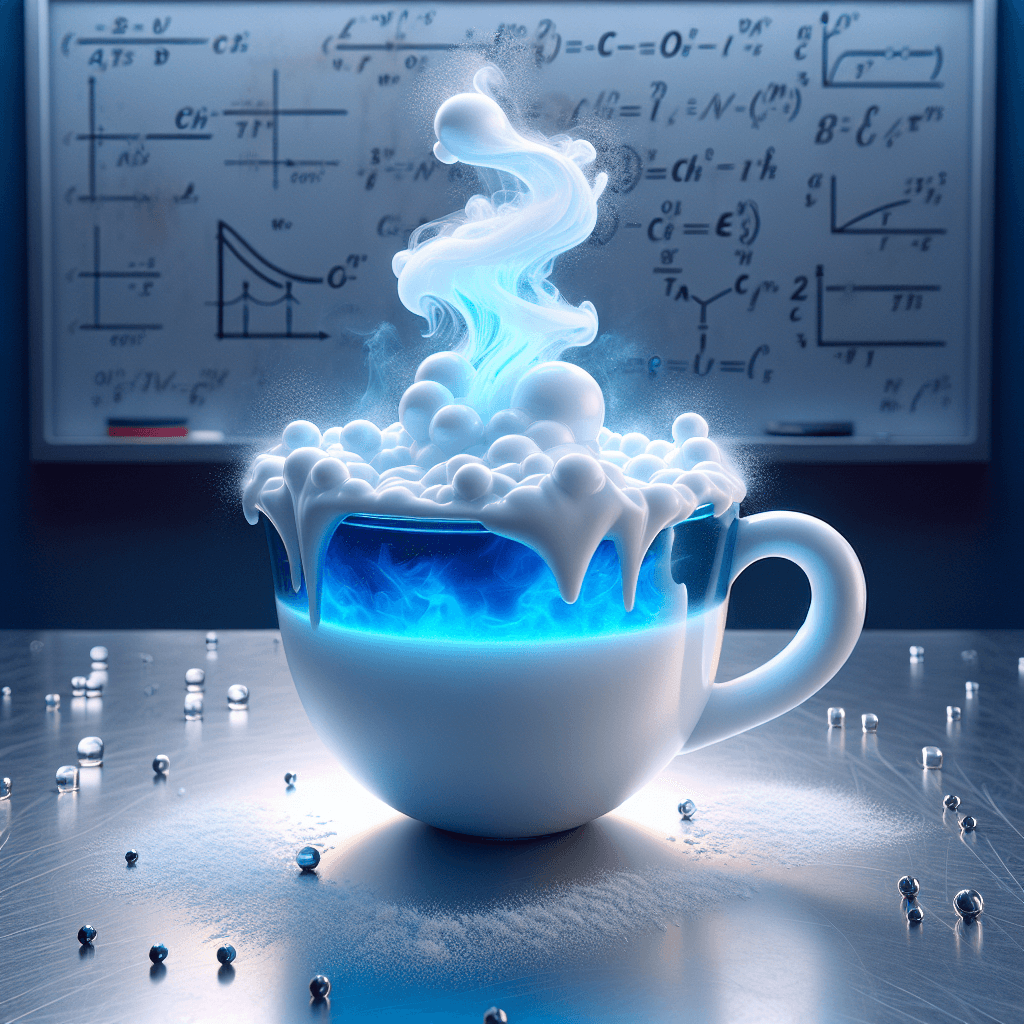
If you fill a cup with Helium-II, it does indeed spontaneously climb the walls. This occurs because of a phenomenon known as the Rollin film, named after the physicist Bernard Rollin.
How the Film Forms
Superfluids have a high "wetting" ability. Because they have no viscosity and are driven by Van der Waals forces—the weak attractive forces between atoms—the helium atoms are drawn to the surface of the container.
- The Coating: A thin film of helium, only about 30 nanometers thick (roughly the width of a few hundred atoms), coats every interior surface of the cup.
- The Movement: In a normal liquid, friction would stop this thin film from moving very far. But because Helium-II has zero viscosity, the film acts like a frictionless highway.
- The Siphon Effect: The liquid is driven to find the lowest possible energy state. If the level of liquid inside the cup is higher than the surface the cup is sitting on, the helium will move along the film, over the rim, and down the outside of the cup to reach that lower point.
Metrics of the "Climb"
To put the scale of this behavior into perspective, consider these physical metrics:
- Thickness: The Rollin film is incredibly thin—about 1/3,000th the thickness of a human hair.
- Velocity: The liquid moves along this film at a typical velocity of about 20 to 40 centimeters per second.
- Volume: While the film is thin, the flow is constant. A small beaker of superfluid helium can empty itself in a matter of minutes depending on the temperature and surface area.
Gravity vs. Quantum Mechanics
You might wonder why gravity doesn't simply pull the liquid back down. In the macroscopic world, gravity usually wins. However, at the quantum level, the chemical potential and the attractive forces between the helium and the glass walls are strong enough to overcome gravity for that incredibly thin layer.
Once the helium "walks" over the rim and begins its descent down the outside of the cup, gravity actually helps the process. It creates a "quantum siphon." As long as there is a continuous film and the destination is lower than the source, the superfluid will continue its journey, effectively "leaking" out of a perfectly solid, crack-free container.
Atmospheric and Physical Consequences
If this experiment were conducted in a standard room, the consequences would be quiet but fascinating:
- Emptying the Vessel: The cup would gradually empty, appearing to leak from the bottom even though there are no holes.
- Thermal Equilibrium: As the helium escapes and eventually evaporates, it would absorb heat from the surroundings, maintaining its ultra-cold state as long as possible.
- A "Dry" Spill: Because the helium evaporates into a gas almost immediately upon reaching a warmer surface, there would be no puddle—just a very cold cup and a slightly higher concentration of helium gas in the air.
Conclusion
The answer to our hypothetical scenario is a resounding yes: if you filled a cup with superfluid helium, it would spontaneously climb the walls and escape. This behavior is dictated by the transition to a zero-viscosity state and the formation of the Rollin film, driven by quantum mechanical forces that override our everyday experiences with friction.
This "great escape" serves as a stunning visual bridge between the microscopic world of quantum mechanics and the macroscopic world we can see with our eyes. It reminds us that the universe still holds bizarre, counterintuitive secrets that only reveal themselves when we push the boundaries of temperature and pressure. While we may never serve superfluid tea, understanding these "slippery" atoms helps scientists develop everything from hyper-sensitive sensors to advanced cooling systems for the world's most powerful telescopes.