If you filled a pool with superfluid helium, why would the liquid spontaneously climb up and over the walls
Imagine a liquid that ignores the laws of gravity to literally crawl out of its container. Dive into the mind-bending world of superfluid helium, where zero friction allows a substance to stage a spontaneous "great escape" right before your eyes.

Too Long; Didn't Read
Superfluid helium has zero viscosity, allowing it to form an extremely thin layer called a Rollin film over any surface it touches. Driven by surface tension and the complete absence of internal friction, the liquid flows effortlessly up and over container walls to reach a lower point of potential energy.
The Great Escape: Why Would Superfluid Helium Spontaneously Climb Out of Your Swimming Pool?
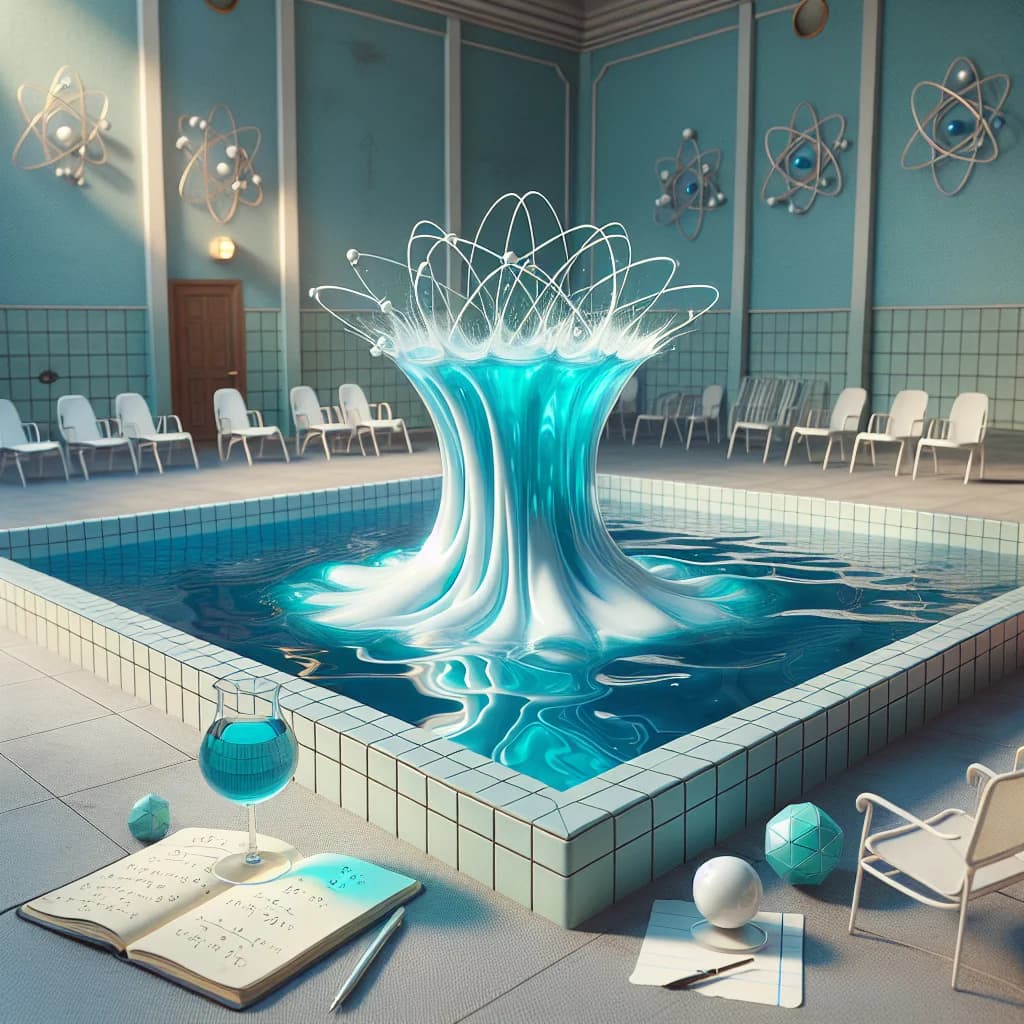
Imagine, for a moment, the ultimate high-tech swimming pool. Instead of chlorine and lukewarm water, this pool is filled with liquid helium cooled to a staggering -271°C (about 2 Kelvin). As you stand by the edge, you notice something impossible: the liquid isn't just sitting there. It begins to crawl up the tiled walls, crest the lip of the pool, and drip onto the deck, seemingly defying gravity. This isn't a magic trick or a movie special effect; it is a macroscopic demonstration of quantum mechanics in action.
To understand this "great escape," we must look at the transition of Helium-4 into a superfluid state. By applying the principles of fluid dynamics and quantum Bose-Einstein statistics, we can analyze how a substance with zero viscosity ignores the traditional "rules" of friction and gravity.
The Lambda Point: Entering the Quantum Realm
In everyday life, fluids have viscosity—a sort of internal friction. Honey has high viscosity, while water has low viscosity. However, when Helium-4 is cooled below 2.17 Kelvin (known as the Lambda Point), it undergoes a phase transition into Helium II.
In this state, a significant portion of the atoms drop into the lowest possible energy state, forming a Bose-Einstein Condensate. At this point, the liquid becomes a superfluid. The most striking feature of a superfluid is that its viscosity drops exactly to zero. There is no internal "rubbing" between atoms and no friction between the liquid and the container walls.
The Rollin Film: The Infinite Creep
So, why does it climb? The answer lies in a phenomenon called the Rollin film, named after physicist Bernard Rollin.
- Van der Waals Forces: All surfaces have a slight atomic attraction to nearby molecules. In a normal pool, water wants to climb the walls slightly (capillary action), but its own weight and internal friction pull it back down.
- The Frictionless Ascent: Because superfluid helium has zero viscosity, it encounters no resistance as it interacts with the pool's surface. The Van der Waals forces between the helium atoms and the pool wall are strong enough to pull a thin layer of atoms upward.
- The 30-Nanometer Highway: This layer, the Rollin film, is incredibly thin—typically only about 30 nanometers (roughly 300 atoms thick). Despite its size, this film acts as a frictionless highway.
Because the liquid is a superfluid, the atoms in the pool "follow" the atoms in the film to maintain chemical potential balance. The liquid effectively "creeps" up the wall in a continuous, unstoppable flow.
Calculating the Exit: Scale and Flow
If we filled an Olympic-sized swimming pool (approximately 2.5 million liters) with superfluid helium, how fast would it empty?
- Film Speed: Superfluid films typically move at a critical velocity of about 20 to 30 centimeters per second.
- Massive Surface Area: While a 30nm film is microscopic, the perimeter of an Olympic pool is 150 meters.
- The Siphon Effect: Once the film crests the edge of the pool and begins to move down the outer wall, it acts like a siphon. Gravity now pulls on the "downward" side of the film, accelerating the process.
While it wouldn't empty the pool in seconds, the process is relentless. To the naked eye, the walls would appear perpetually "wet," with a steady, silent dripping from the underside of the pool's rim.
Environmental Consequences: A Quest for the Lowest Point
In our hypothetical scenario, the helium is on a mission to reach the lowest potential energy state possible.
- The Puddle Effect: As the helium climbs out, it would coat every available surface in a frictionless layer until it found a lower reservoir or evaporated.
- Thermal Conductivity: Superfluids are also "super-conductors" of heat. If one part of the pool warms up, the entire volume of liquid reaches the same temperature almost instantly. This means that as the escaped liquid hits the "warm" (comparatively) ground, it would rapidly boil back into a gas, creating a mesmerizing, low-lying fog across the deck.
Conclusion
The sight of a pool emptying itself would be a startling reminder that the laws of physics we experience daily are just one part of a much stranger story. Superfluid helium climbs walls because, in the absence of friction, the tiny atomic attractions we usually ignore become the dominant forces of motion.
Ultimately, this "gravity-defying" behavior is a result of zero viscosity and the formation of the Rollin film, driven by the liquid’s drive to minimize its energy. While we likely won't be building superfluid swimming pools anytime soon, this thought experiment highlights the incredible bridge between the tiny world of quantum particles and the massive world we can see with our own eyes. Nature, it seems, always finds a way to move.