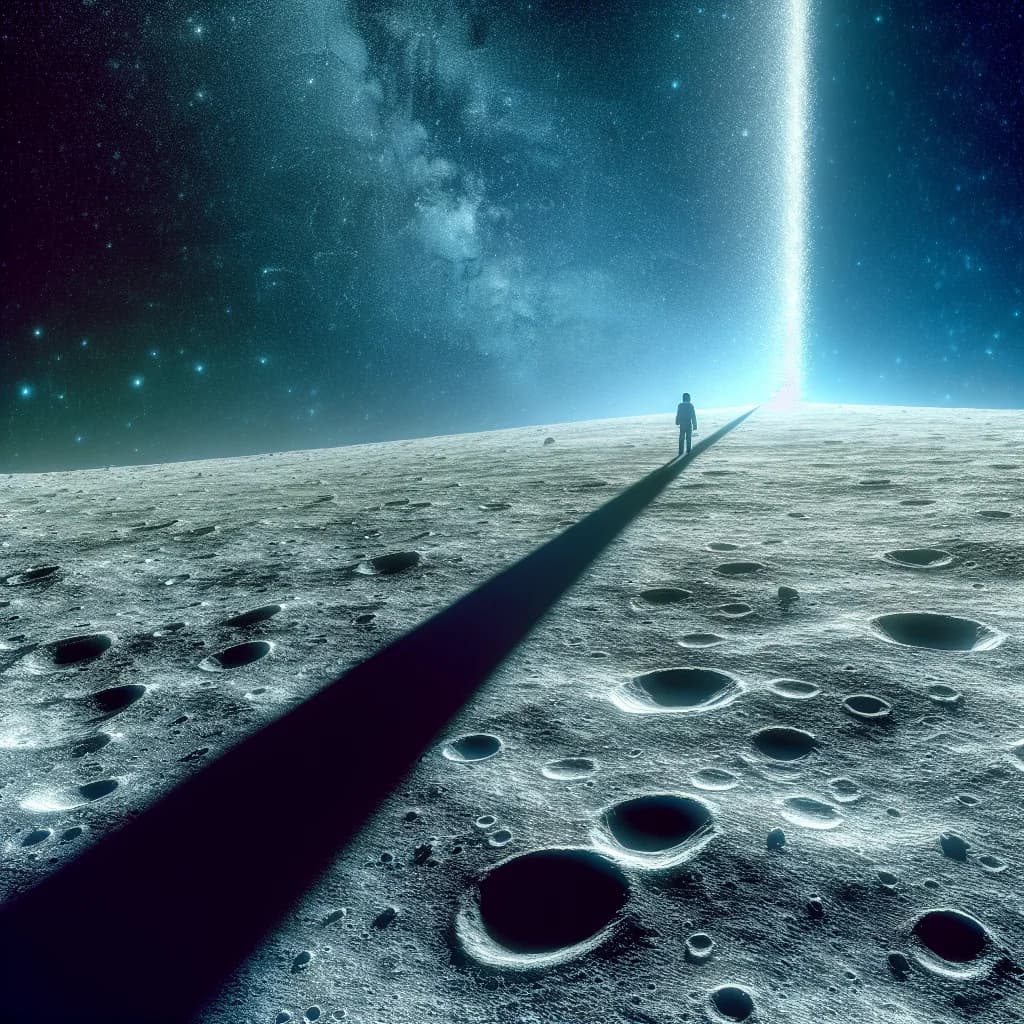
If you flicked a laser pointer across the Moon, would the dot travel faster than the speed of light
Think the universal speed limit is unbreakable? Discover the mind-bending physics that could allow a simple flick of your wrist to send a laser dot racing across the lunar surface faster than light itself.


Too Long; Didn't Read
Yes, the laser dot can move across the Moon faster than the speed of light. This is possible because the dot is not a physical object but a sequence of photons hitting different spots. Since no actual matter or information is traveling between those points, it does not violate the laws of physics.
Breaking the Universal Speed Limit? What Happens When You Flick a Laser Across the Moon
Imagine standing in your backyard on a clear night, pointing a high-powered laser at the glowing orb of the Moon. With a simple, casual flick of your wrist—a movement taking a mere fraction of a second—you sweep the laser beam from one side of the lunar surface to the other. In that instant, the red dot travels thousands of miles across the craters and plains. But here is the mind-bending question: did that dot just travel faster than the speed of light?
According to Albert Einstein’s theory of special relativity, nothing can travel faster than light ($c$), which clocks in at approximately 299,792 kilometers per second. However, this thought experiment suggests a scenario where a "point" appears to shatter that universal speed limit. To understand how this works, we must dive into the mechanics of angular velocity, the nature of photons, and the crucial scientific distinction between "things" and "shadows."
The Mathematics of the Lunar Flick
To determine if the dot breaks the speed limit, we first need to look at the scale of the experiment. The Moon is located approximately 384,400 kilometers away from Earth. Its diameter is about 3,474 kilometers.
If you flick your wrist quickly, you are exerting angular velocity. Let’s look at the math:
- The Distance ($r$): 384,400 km.
- The Speed of Light ($c$): ~300,000 km/s.
- The Calculation: The speed of the dot ($v$) is calculated by the formula $v = r \times \omega$ (where $\omega$ is the angular velocity in radians per second).
If you rotate your laser pointer at just 1 radian per second (which is a relatively lazy flick of about 57 degrees per second), the dot on the Moon would move at 384,400 km/s. That is already 1.28 times the speed of light. If you flicked your wrist with more vigor, the dot could theoretically "travel" across the lunar surface at many times the speed of light.
Why Einstein Isn’t Worried
If the dot is moving faster than light, why hasn't the universe collapsed? The answer lies in the definition of a "thing." In physics, the law that nothing can exceed light speed applies to mass and information.
The Garden Hose Analogy
Think of a laser beam not as a solid, rigid sword, but as a stream of water from a garden hose.
- When you swing the hose, the individual droplets of water are still traveling outward at their original speed.
- The "stream" hitting the ground might move very quickly from left to right, but no single drop of water is moving sideways at that speed.
- Similarly, a laser is a stream of individual particles called photons.
The dot on the Moon isn't a single physical object moving from Point A to Point B. Instead, it is a sequence of different photons hitting different spots in rapid succession. Because no individual photon is traveling faster than $c$, and no physical mass is being accelerated across the Moon's surface, no laws of physics are being broken.
The Information Paradox
One might wonder: "If I can move the dot faster than light, can I use it to send a faster-than-light (FTL) message to a Moon base?"
The answer is a definitive no. Even if you flicked your wrist to move the dot across the Moon at $2c$, an observer at the "start" of the flick could not signal an observer at the "end" of the flick any faster than light could travel between them. The photons forming the dot still have to travel from Earth to the Moon at the standard speed of light. There is a "lag time" of about 1.3 seconds for the light to reach the Moon. By the time the dot arrives, the "flick" has already happened in the past.
Visual and Environmental Impact
If you were standing on the Moon watching this happen, the experience would be surreal but safe.
- Sequential Illumination: You would see a flash of light hit the ground.
- No Sonic Boom: Because the dot has no mass, it doesn't displace the lunar regolith or create a "photonic boom" in the vacuum of space.
- A "Broken" Beam: To a lunar observer, the beam might actually look curved or disconnected because the photons hitting the Moon at the end of your flick started their journey from Earth slightly later than the ones at the beginning.
Conclusion
In the grand celestial theater, flicking a laser across the Moon creates a fascinating optical illusion that technically "travels" faster than the speed of light. However, this phenomenon—known as a superluminal spot—is a geometric trick rather than a violation of special relativity. It reminds us that while our eyes can perceive motion that seems to defy the heavens, the universe's ultimate speed limit remains firmly in place.
This experiment highlights the beautiful complexity of our universe: it is a place where a simple flick of the wrist can span the cosmos, yet the fundamental laws of physics remain perfectly intact, ensuring that information and matter respect the boundaries of time and space.