If you flicked a laser pointer across the Moon, would the red dot move faster than light
Could a simple flick of your wrist break the ultimate speed limit of the universe? Discover the mind-bending physics of how a laser dot can race across the lunar surface faster than light itself without breaking a single law of nature.

Too Long; Didn't Read
Yes, the red dot can move across the Moon faster than the speed of light because it is not a physical object. It is a sequence of different photons hitting the surface rather than a single thing moving from point A to point B, so no physical matter or information actually travels faster than light.
Breaking the Universal Speed Limit: Can a Laser Dot Outrun Light?
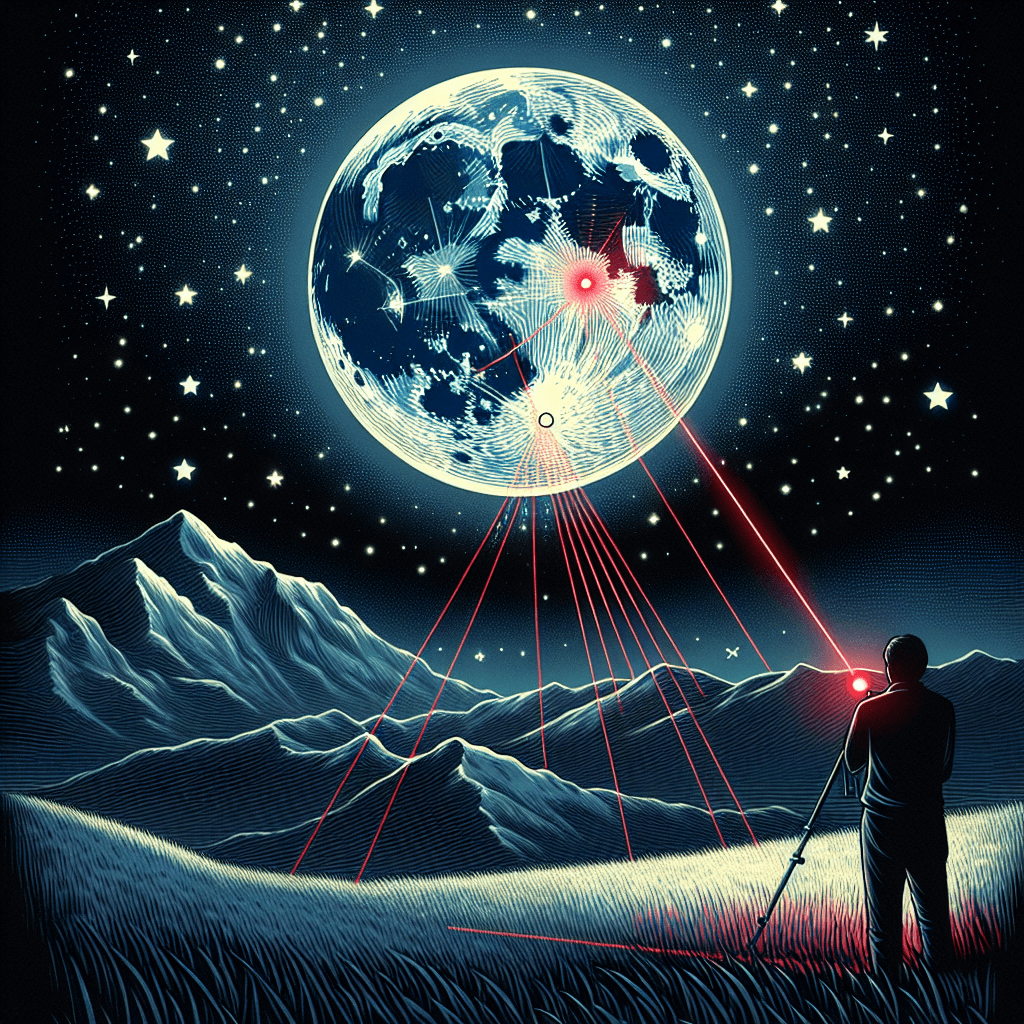
Imagine standing in your backyard on a clear night, pointing a standard laser pointer at the glowing orb of the Moon. With a simple, swift flick of your wrist, you sweep the beam from the left edge of the lunar disc to the right. In that fraction of a second, the tiny red dot travels thousands of miles across the cratered surface. But here is the mind-bending question: if you flick your wrist fast enough, does that red dot actually move across the Moon’s surface faster than the speed of light?
To answer this, we must navigate the fascinating intersection of classical geometry and Einstein’s Special Relativity. This thought experiment requires us to define our boundaries: we are looking at the "speed" of a geometric point versus the speed of physical particles (photons). By analyzing the math of angular velocity and the physics of information transfer, we can determine if we’ve truly discovered a loophole in the laws of the universe.
The Geometry of a Cosmic Sweep
To understand how fast the dot moves, we first need to look at the scale of our lunar stage. The Moon is approximately 384,400 kilometers (238,855 miles) away from Earth. When you rotate your wrist, you are creating an angular velocity. Because the distance to the Moon is so vast, even a tiny movement at the source (your hand) translates into a massive distance at the destination.
Let’s look at the numbers:
- The Distance ($r$): 384,400,000 meters.
- The Speed of Light ($c$): ~299,792,458 meters per second.
- The Calculation: The tangential velocity ($v$) of the dot is calculated by the formula $v = \omega \times r$, where $\omega$ is the angular velocity in radians per second.
If you flick your wrist at a relatively modest speed of about 0.8 radians per second (less than a quarter-turn per second), the dot on the Moon would already be traveling at roughly 307,520,000 meters per second. This exceeds the speed of light! If you were to give your wrist a truly spirited snap, that red dot could theoretically zip across the lunar plains at many times the speed of light.
Einstein’s Rules and the "Shadow" Loophole
If Albert Einstein famously stated that nothing can travel faster than light, why doesn't the universe intervene when you flick your laser pointer? The answer lies in the definition of a "thing."
Einstein’s Special Relativity dictates that no mass and no information can travel faster than $c$ (the speed of light). The red dot on the Moon, however, is not a physical object. It is not made of atoms, nor is it even the same group of photons from one millisecond to the next.
Think of it like a row of lightbulbs:
- If you have a mile-long row of bulbs and flip a switch that turns them all on simultaneously, the "glow" appears to move down the line instantly.
- However, nothing physical moved from bulb A to bulb B.
- The "dot" is simply the point where a stream of photons is currently hitting the surface.
Because the dot carries no mass and cannot be used to send a signal from one side of the Moon to the other faster than light could travel that same distance, it doesn't violate any laws of physics. It is a "geometric effect," much like a shadow or the point where two blades of giant scissors meet.
The "Garden Hose" Effect and Visual Lag
While the point of impact moves faster than light, the individual photons are still obediently cruising at $c$. This creates a "curving" effect in space, often compared to a garden hose. If you spin while spraying water, the stream appears to curve through the air. Each drop of water is moving straight outward, but the pattern of the water forms a spiral.
Similarly, there is a significant time delay. It takes light about 1.28 seconds to reach the Moon. If you flick your wrist, the dot on the Moon won’t even begin to move until over a second later. Furthermore, since the light has to bounce back to your eyes for you to see it, you wouldn't observe the dot moving until roughly 2.56 seconds after your flick. The "superluminal" speed is a mathematical reality on the lunar surface, but it remains physically "hollow" because it lacks substance.
Conclusion
Ultimately, the answer is a resounding yes: the red dot can move across the Moon faster than light. However, this cosmic speed-run comes with a major scientific asterisk. While the geometric point of intersection breaks the universal speed limit, it does so only because it isn't a physical object and carries no information.
This thought experiment relies on the principle that the universe's speed limit applies only to the "actors" (matter and energy), not to the "stage directions" (geometric patterns). It serves as a fascinating reminder of the scale of our solar system and the elegant, sometimes counterintuitive ways that light behaves. While we might not be able to send a physical spaceship to the stars at warp speed, we can at least enjoy the intellectual thrill of breaking the speed limit with nothing more than a flick of the wrist.