If you folded a piece of paper fifty-one times, why would it be thick enough to reach the Sun
It sounds like a mathematical myth, but a single sheet of paper folded just 51 times would create a stack tall enough to bridge the 93-million-mile gap to the Sun. Discover the mind-bending power of exponential growth and why your intuition is about to be proven wrong.

Too Long; Didn't Read
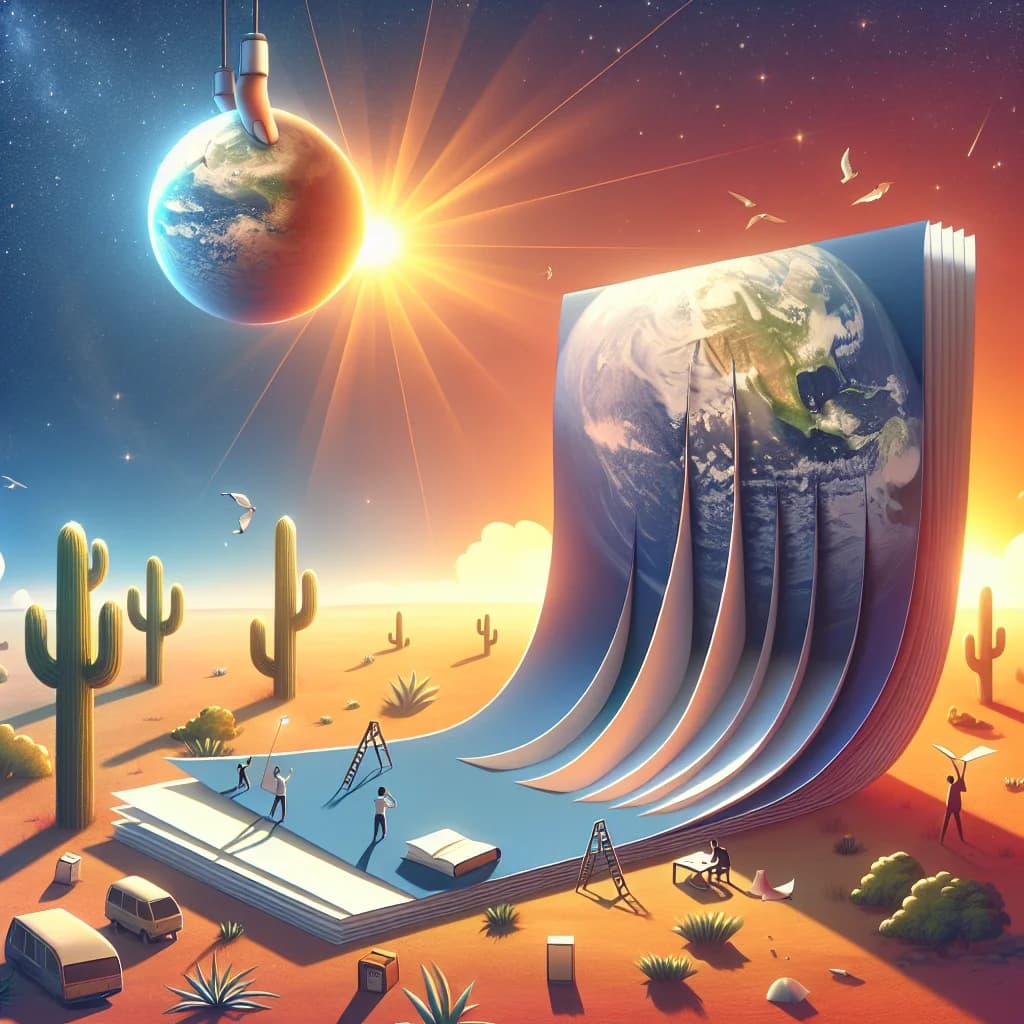
Folding a piece of paper fifty-one times illustrates the power of exponential growth. Because the thickness doubles with every fold, the cumulative height increases at an accelerating rate, eventually reaching over 140 million kilometers, which exceeds the distance from Earth to the Sun.
From Desktop to Deep Space: Why Would Folding a Paper 51 Times Reach the Sun?
Imagine holding a standard sheet of office paper. It is thin, fragile, and measures roughly 0.1 millimeters in thickness. Now, imagine a simple task: fold it in half. Then fold it again. It seems like a mundane exercise, yet if you could somehow repeat this process just fifty-one times, you would create a tower of paper so tall it would stretch past the Sun. This classic thought experiment highlights the staggering, almost magical power of exponential growth.
While the laws of physics and the physical dimensions of paper make this impossible in reality, the mathematical journey is entirely factual. By applying the principles of geometric progressions and logarithmic scaling, we can peel back the layers of this mystery to understand how small, repeated actions can result in astronomical consequences.
The Magic of Doubling: Understanding Exponential Growth
The reason a piece of paper reaches the stars so quickly lies in the nature of exponential growth. Most of our daily lives are governed by linear growth—if you add one brick to a wall every minute, the wall grows at a steady, predictable rate. However, folding paper follows a "doubling" pattern, expressed mathematically as $2^n$, where $n$ is the number of folds.
When you fold a paper once, it is two layers thick. Fold it twice, and it is four layers thick. By the third fold, you have eight layers. While the first few folds feel insignificant, the numbers begin to compound at an accelerating rate. This is the same principle that governs population growth in biology or compound interest in finance. In this scenario, the thickness of the paper ($T$) after $n$ folds can be calculated using the formula: $T_n = T_{initial} \times 2^n$
The Journey Through the Folds
To visualize this scale, let’s look at how the paper "grows" at various milestones, assuming a starting thickness of 0.1 millimeters (0.0001 meters):
- 10 Folds: Your paper is now about 10.24 centimeters thick. This is roughly the width of a large coffee mug.
- 20 Folds: The paper tower reaches over 104 meters. You have officially surpassed the height of the Statue of Liberty.
- 30 Folds: The stack is now 107 kilometers high. You have left the Earth's atmosphere and entered the "edge of space" (the Kármán line).
- 42 Folds: With just twelve more doublings, the paper reaches approximately 439,000 kilometers. You have successfully passed the Moon.
- 51 Folds: The thickness explodes to approximately 225 million kilometers. Since the average distance from the Earth to the Sun is about 149.6 million kilometers, you haven't just reached the Sun—you have overshot it by 75 million kilometers!
The Physical Constraints: Why We Can’t Actually Do It
While the math holds up, the physical world presents significant hurdles. Most people find they cannot fold a standard piece of paper more than seven or eight times. This is due to two primary factors: structural integrity and surface area.
- Geometric Shrinkage: Every time you fold a paper, the thickness increases, but the surface area of the "face" decreases. By the time you reach the 20th fold, the paper would need to be miles wide to accommodate the bend radius of the fold. To reach 51 folds, you would require a sheet of paper roughly the size of the known universe.
- Energy and Pressure: As the stack becomes thicker, the energy required to create a new fold increases exponentially. The outer layers must stretch significantly to wrap around the inner layers. By the later folds, the paper would behave more like a solid steel pillar than a flexible sheet, eventually reaching a density that would challenge the structural limits of the cellulose fibers.
Summary of the Cosmic Scale
To put these massive numbers into context, consider these comparisons:
- Fold 42: Earth to Moon (~384,400 km).
- Fold 51: Earth to the Sun and nearly halfway to Mars (~225,000,000 km).
- The Power of One More: If you folded it just one more time (52 folds), you would reach a distance of 450 million kilometers, covering the round trip back to the Sun with room to spare.
Conclusion
The thought experiment of folding a paper 51 times serves as a profound lesson in the mechanics of our universe. It demonstrates that the human brain, which is wired to perceive the world through linear changes, often struggles to grasp the sheer velocity of exponential increases. The core scientific principle at play—geometric progression—dictates that repeated doubling creates a scale that quickly transcends our physical reality and enters the realm of the cosmic.
While we may never actually build a paper bridge to the Sun, understanding the math behind it allows us to appreciate the hidden complexities of the world around us. Whether it is the spread of a virus, the processing power of computers, or the growth of a star, the "magic" of doubling is a fundamental force that shapes the very fabric of science and technology.