If you lit a candle in zero gravity, would the flame become a ghostly blue sphere
Forget everything you know about flickering flames; in the weightless void of space, fire transforms into a haunting, perfect blue orb that defies earthly physics. Dive into the mesmerizing science of how microgravity rewrites the rules of combustion and creates a light like nothing on Earth.

Too Long; Didn't Read
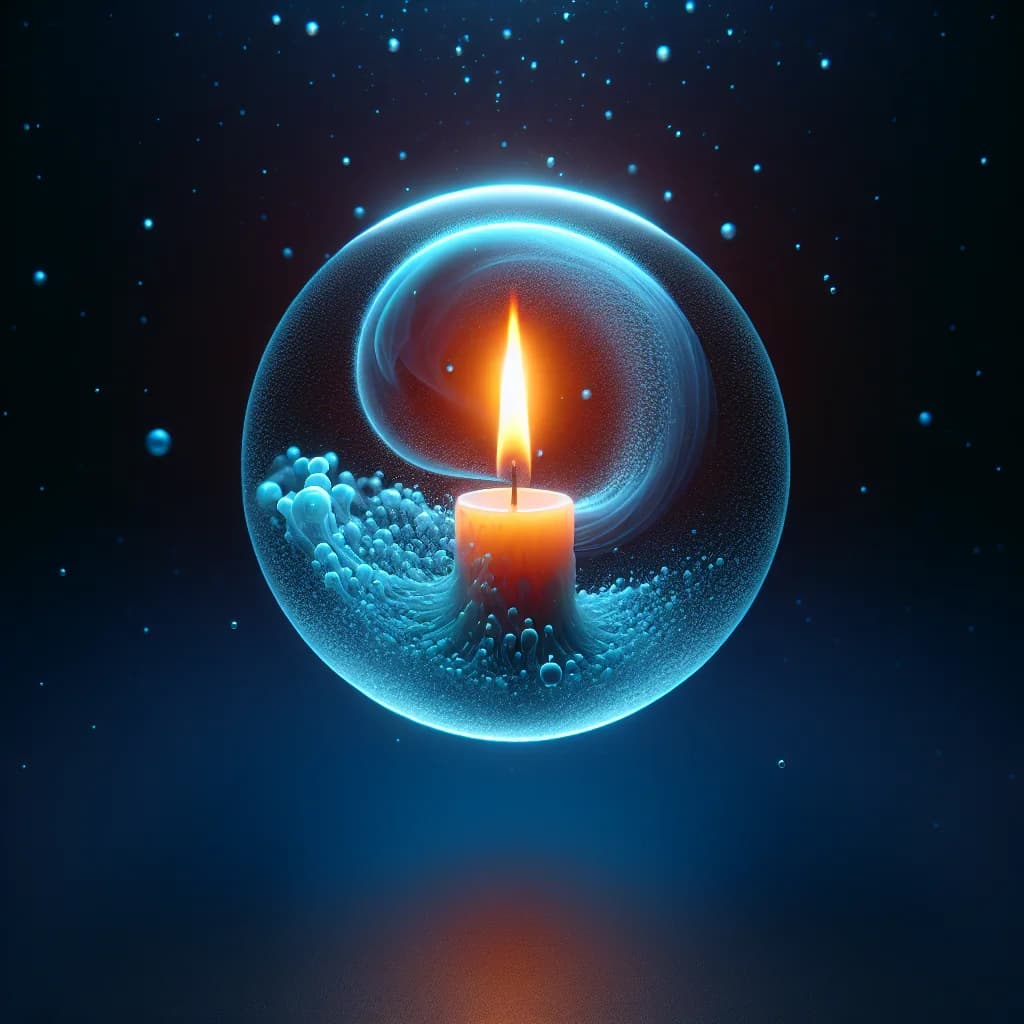
Yes, a candle flame becomes a blue sphere in microgravity. Without gravity to drive convection, hot air does not rise, and oxygen reaches the wick through slow diffusion from all directions. This results in a cooler, soot-free, and perfectly round flame.
A Ghostly Blue Sphere? Investigating the Curious Case of Candles in Zero Gravity
Imagine drifting silently aboard a space station, hundreds of miles above the Earth. You strike a match to light a birthday candle, expecting the familiar, flickering orange teardrop we see on Earth. Instead, you are met with a sight that feels more like science fiction than physics: a perfectly round, eerily still, ghostly blue orb. This isn't a trick of the light; it is the fascinating result of how fire behaves when the shackles of gravity are removed. To understand why a flame transforms from a dancing yellow spike into a serene azure bubble, we must explore the intersection of fluid dynamics, molecular diffusion, and combustion chemistry.
The Gravity of the Situation: Why Earthly Flames Are Pointy
On Earth, the shape of a flame is dictated by a process called buoyant convection. When you light a candle, the chemical reaction heats the surrounding air. Because hot air is less dense than cold air, it rises rapidly, pushed upward by the heavier, cooler air sinking below it.
- The Velocity of Fire: On Earth, this rising air can move at speeds of about 1 meter per second.
- The Teardrop Effect: As the hot gases rush upward, they pull the flame into its iconic elongated shape.
- Fresh Oxygen: This "conveyor belt" of air provides a constant stream of fresh oxygen to the wick, keeping the fire burning brightly and vigorously.
Entering the Sphere: Fire in Microgravity
In the microgravity environment of the International Space Station (ISS), the concept of "up" or "down" disappears because there is no buoyant force. Without gravity to pull denser air downward, the "conveyor belt" of convection stops entirely.
The Dominance of Diffusion
Since hot air no longer rises, the movement of molecules is governed solely by molecular diffusion. This is a much slower process where oxygen molecules simply drift randomly toward the wick, and combustion byproducts (like carbon dioxide and water vapor) drift away. Because diffusion happens equally in every direction, the flame naturally organizes itself into a perfect, three-dimensional sphere.
The Scale of the Orb
While an Earthly candle flame might be 10 to 20 millimeters tall, a microgravity flame sphere is often much smaller, typically only 2 to 4 millimeters in diameter. Without the rush of convective air, the chemical reaction slows down significantly. In this low-energy environment, the flame doesn't flicker; it sits like a tiny, celestial marble at the tip of the wick.
Why the Ghostly Blue?
Perhaps the most striking change is the color. On Earth, candles are famous for their warm yellow glow. This yellow light is actually "soot," or tiny particles of unburnt carbon that become so hot they glow (a phenomenon called blackbody radiation).
In zero gravity, the "blue" takes over for two primary reasons:
- Lower Temperatures: Microgravity flames burn at a lower temperature than Earth flames. This prevents the formation of large amounts of soot.
- Chemiluminescence: Because there is no glowing soot to mask it, we see the natural color of the chemical reaction itself. This is called chemiluminescence—specifically, the light emitted by excited molecules like CH and C2, which radiate in the blue and violet spectrum.
The Consequences of a Weightless Burn
The behavior of a zero-G flame leads to several unique physical outcomes:
- Oxygen Deprivation: Because diffusion is slow, the flame often "chokes" on its own exhaust. Without a fan to move the air, the sphere may eventually flicker out as carbon dioxide builds up around it.
- Extremely Low Energy Output: A microgravity flame produces significantly less heat than its Earthly counterpart—often as little as 1/10th the energy.
- Longevity: Surprisingly, because they burn so slowly and efficiently, some microgravity flames can last much longer than those on Earth, provided they have a steady, slow supply of oxygen.
Conclusion
If you lit a candle in zero gravity, it truly would become a ghostly blue sphere. This transformation is driven by the absence of buoyancy, which replaces the chaotic, upward rush of air with the calm, radial symmetry of molecular diffusion. By removing gravity, scientists can strip away the "noise" of convection to study the pure chemistry of combustion. These "cool flames" aren't just beautiful to look at; they provide vital data that helps engineers design safer spacecraft and more efficient internal combustion engines here on the ground. It turns out that to truly understand the fire in our hearths, we had to see it drift peacefully in the void.