If you lived in zero gravity, why would your heart eventually become shaped like a perfect sphere
Without the constant downward pull of Earth's gravity, your heart undergoes a radical transformation that shifts its very geometry into a perfect sphere. Discover the fascinating science behind why life in space turns your most vital organ into a cosmic orb.

Too Long; Didn't Read
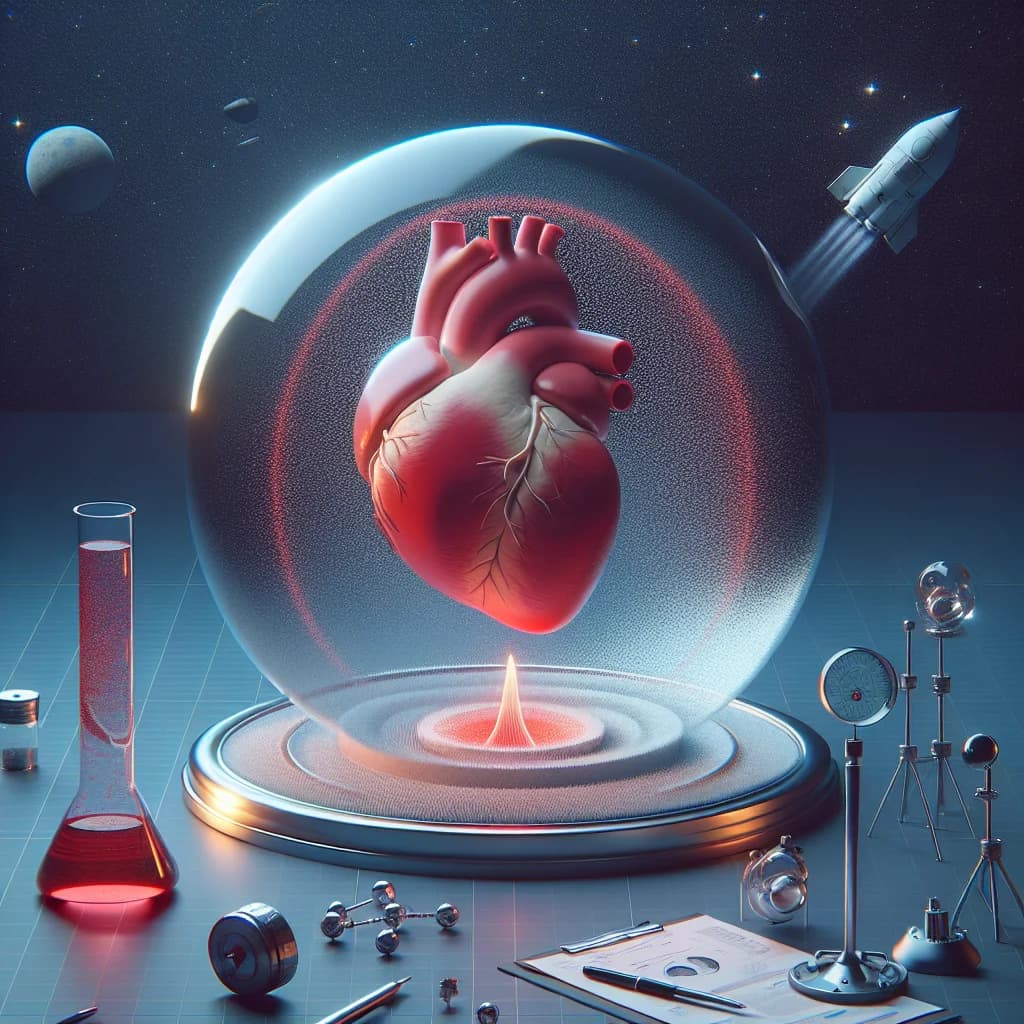
In the absence of Earth's gravitational pull, the heart no longer has to work as hard to pump blood upward. This lack of resistance causes the heart muscle to shrink and relax from its usual elongated shape into a more spherical form.
From Oval to Orb: Why Would Living in Zero Gravity Turn Your Heart Into a Sphere?
Imagine drifting through the silent, weightless expanse of the International Space Station, watching the Earth roll by beneath you. While you might feel like you are on the ultimate vacation, your body is undergoing a radical architectural renovation. Among the most startling changes is the transformation of your heart. On Earth, your heart is a rugged, asymmetrical pump, but in the absence of gravity, it begins to soften and round out, eventually resembling a perfect, fleshy sphere. This transformation isn't science fiction; it is a fascinating result of cardiovascular physiology and fluid dynamics. By examining how the "engine of life" reacts when the burden of weight is lifted, we can uncover the surprising physics of life in orbit.
The Weight of the World: The Heart on Earth
To understand why the heart rounds out in space, we first have to look at why it is shaped the way it is on Earth. Our hearts are roughly the size of a clenched fist and are shaped like an elongated, lopsided cone. This specific geometry is an evolutionary response to gravity.
On Earth, the heart is a tireless worker that must constantly fight a downward pull to propel blood upward to the brain. To maintain this "hydrostatic pressure," the left ventricle—the heart’s primary pumping chamber—develops thick, muscular walls. This creates a powerful, directional force required to move approximately 5 to 6 liters of blood through the body every single minute. The heart’s elongated shape is essentially a "high-pressure" design, optimized for vertical efficiency in a 1G environment.
The Great Fluid Shift
The moment an astronaut enters microgravity, the physics of their circulatory system changes. Without gravity to pull blood toward the feet, fluids undergo what scientists call a "cephalad shift."
- Fluid Migration: Approximately 2 liters of fluid move from the lower extremities toward the chest and head.
- The "Puffy Face" Effect: This shift causes the legs to thin out (often called "bird legs") and the face to appear swollen.
- Pressure Equalization: Because the heart no longer has to fight to pull blood up from the ankles or push it against gravity to the brain, the internal pressure gradients change.
In this environment, the heart realizes it no longer needs to be a heavy-duty, high-pressure pump.
Atrophy and the Spherical Shift
In the realm of physics, a sphere is the most efficient shape for containing internal pressure with the least amount of surface tension. When the heart’s workload decreases in space, two primary factors drive it toward this spherical form:
1. Muscle Loss (Cardiac Atrophy)
Just as an astronaut’s leg muscles shrink because they aren't walking, the heart muscle begins to weaken because it isn't "lifting" blood against gravity. Studies of astronauts who spent long durations on the International Space Station showed that the heart loses muscle mass at a rate of about 1% per week in some cases. As the muscular walls of the left ventricle thin out, the heart loses the structural rigidity that maintains its oval shape.
2. Geometric Optimization
As the heart becomes less muscular and more "flabby," it behaves more like a balloon filled with liquid. In a weightless environment, a flexible container filled with fluid naturally seeks a state of equilibrium. According to NASA-funded research, the heart becomes about 9.4% more spherical after long-term exposure to microgravity. Without the tug of gravity to stretch it into an elongated shape, the heart settles into the mathematically "laziest" and most symmetrical shape possible: the sphere.
The Consequences of the Cosmic Orb
While a spherical heart sounds like a poetic transformation, it has real-world physical consequences for astronauts returning to Earth.
- Reduced Stroke Volume: A more spherical, less muscular heart is less efficient at pumping blood.
- Orthostatic Hypotension: Upon returning to Earth’s gravity, astronauts often feel lightheaded or faint because their "spherical" heart lacks the immediate power to push blood back up to the brain against 1G of force.
- Rapid Re-adaptation: Fortunately, the heart is incredibly resilient. Once back on Earth, the renewed demand for high-pressure pumping usually coaxes the heart back into its familiar, oval-shaped "workhorse" geometry within a few weeks.
Conclusion
The transformation of the human heart into a sphere in zero gravity is a masterclass in biological adaptability. It demonstrates that our very anatomy is a dialogue with the forces of our planet. When the constant "tug" of Earth is removed, our cardiovascular system sheds its heavy-duty design in favor of a simpler, more symmetrical geometry dictated by fluid dynamics and energy conservation. While the spherical heart is a temporary adaptation to the stars, it serves as a powerful reminder of how deeply we are tethered to the physics of our home world. Even in the vastness of space, our bodies never stop trying to find the perfect balance with the environment around them.