If you placed a giant straw into the ocean from orbit, could you actually suck the water into space
Ever wondered if the vacuum of space could turn our oceans into a celestial milkshake? Discover the mind-bending physics that dictate whether a giant straw could actually drain the Earth—or if gravity would win the ultimate tug-of-war.

Too Long; Didn't Read
No, it is impossible. Sucking water through a straw relies on atmospheric pressure, which can only lift water to a maximum height of about 10 meters. Because orbit is hundreds of kilometers away, the weight of the water and the limits of air pressure would prevent it from ever reaching space.
The Ultimate Sip: Could a Straw from Orbit Actually Drain the Earth's Oceans?
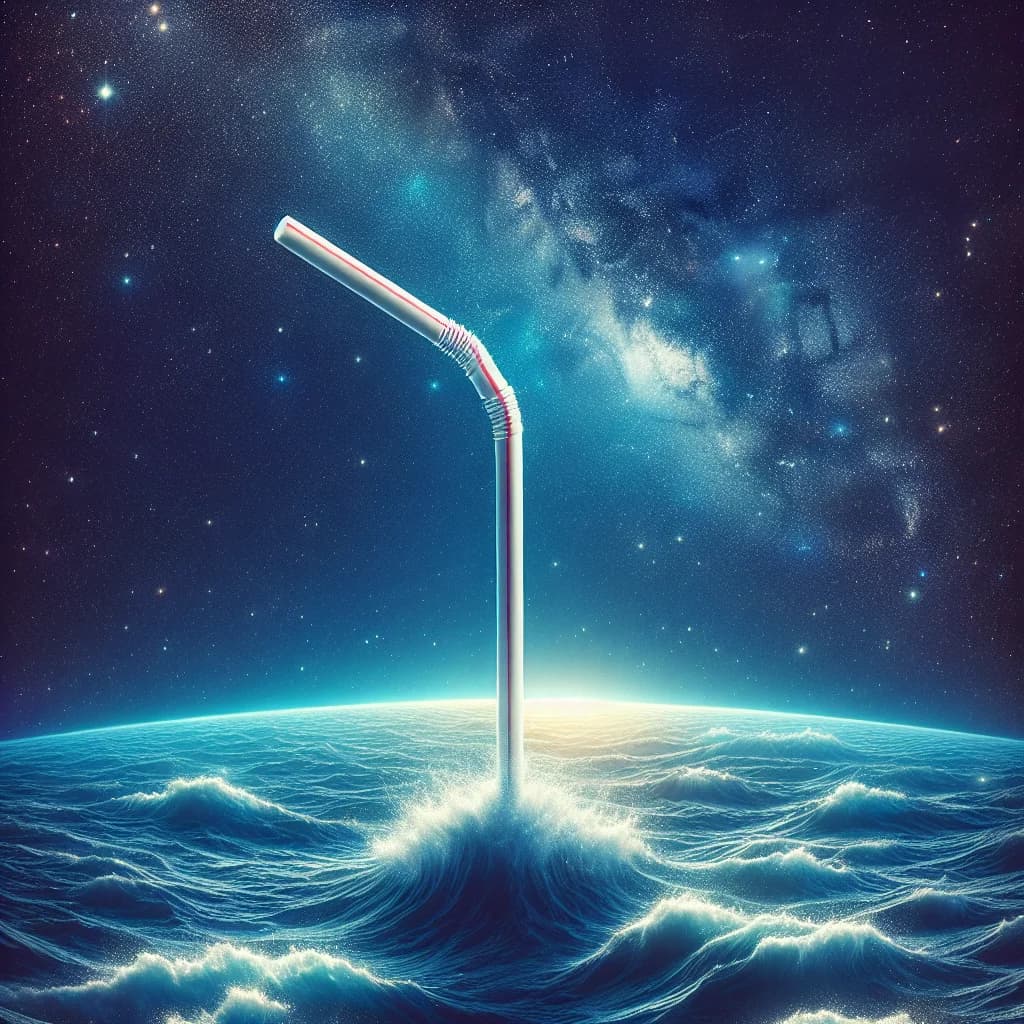
Imagine a straw of impossible proportions—a rigid, indestructible tube stretching from the cargo bay of a spacecraft in low Earth orbit all the way down into the center of the Pacific Ocean. It is the ultimate scientific "what if." If a cosmic giant decided to take a sip, would the Earth’s oceans travel up the tube and out into the void of space? While it sounds like the plot of a surreal sci-fi comedy, the answer lies in the rigid laws of fluid mechanics, atmospheric pressure, and thermodynamics. To understand why this experiment fails (or succeeds in unexpected ways), we must look at the invisible forces that keep our world—and its water—exactly where they belong.
The Illusion of "Suction"
To understand a straw in space, we first have to understand a straw on Earth. Most people believe that when they sip a drink, they are "pulling" the liquid upward. In reality, you are doing something much more subtle: you are lowering the air pressure inside your mouth.
Once the pressure in the straw drops, the heavy weight of the Earth’s atmosphere (roughly 14.7 pounds per square inch at sea level) pushes down on the surface of the liquid outside the straw, forcing the drink up into the area of lower pressure. You aren't pulling; the atmosphere is pushing.
The 10-Meter Limit
Physics places a strict "height limit" on this process. Because atmospheric pressure has a finite strength, it can only push water up a straw to a certain height before the weight of the water column becomes too heavy for the air to support.
- The Magic Number: 10.3 meters (about 33.8 feet).
- The Result: Even with a perfect vacuum at the top of a straw, Earth’s atmosphere can only lift water about three stories high. Since "orbit" begins at roughly 100 kilometers (the Kármán line), your straw is about 99.9% too long for traditional suction to work.
The Vacuum of Space vs. Gravity
But what if the straw is already in the vacuum of space? Space is a much better vacuum than anything you can create with your lungs. However, opening the top of the straw to the void doesn't change the fundamental math.
The water in the straw is subject to Earth's gravity. To get the water to orbit, you have to lift it against a constant downward pull. A column of water reaching from the ocean to a height of 400 kilometers (the altitude of the International Space Station) would be incredibly heavy. Specifically, a straw with a cross-section of just one square inch would contain a column of water weighing approximately 570 pounds. Without an external force vastly more powerful than our atmosphere to "push" that weight up, the water will simply sit at the bottom of the straw, reaching that 10.3-meter mark and stopping.
Phase Changes: Boiling and Freezing
If we move beyond simple pressure and look at the chemistry of the water itself, the scenario becomes even more complex. Water's state—solid, liquid, or gas—depends on both temperature and pressure.
- Vacuum Boiling: As water rises into a vacuum, the boiling point drops. Even at room temperature, water in a vacuum will begin to boil violently.
- The Ice Plug: As the water boils, it loses energy through evaporative cooling. In the cold environment of the upper atmosphere and space, this water would quickly turn into a mixture of vapor and ice.
- The Result: Instead of a smooth flow of liquid, your straw would likely become clogged with a chaotic "slushy" of ice crystals and gas, effectively ending the experiment.
The Energy Requirement
If we truly wanted to move the ocean into space, we wouldn't use a straw; we would need a massive, high-powered pump. To move just one cubic meter of water (about the size of a large washing machine) from the ocean to orbit would require approximately 4 million Joules of energy—roughly the energy found in a liter of gasoline, assuming 100% efficiency. To drain even a tiny fraction of the ocean, you would need more energy than humanity currently produces.
Conclusion
The scientific reality is clear: you cannot "slurp" the ocean into space. The 10.3-meter limit imposed by our atmospheric pressure acts as a natural "fail-safe" that keeps our hydrosphere intact. While the vacuum of space is powerful, it is no match for the combined forces of Earth's gravity and the weight of the water itself.
This thought experiment highlights the incredible balance that makes life on Earth possible. Our atmosphere doesn't just provide us with oxygen; it provides the physical pressure necessary to keep our oceans in liquid form and pinned to the planet's surface. So, while a straw to orbit makes for a fascinating mental exercise, the Earth’s water is staying right where it is—safely tucked under the protective blanket of our atmosphere.