If you placed a massive mirror light-years away, could you use a telescope to see Earth's past
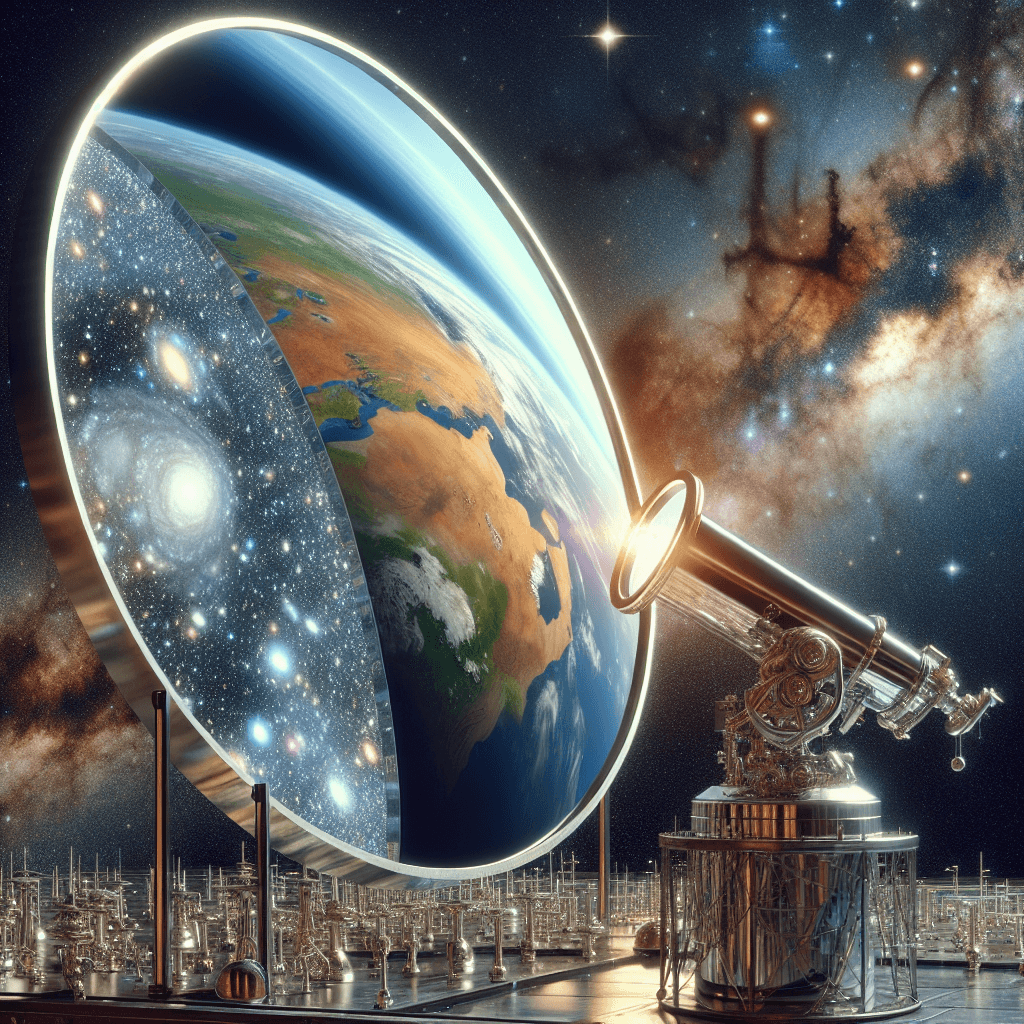
Imagine looking through a telescope and witnessing the pyramids being built or dinosaurs roaming in real-time. By harnessing the speed of light and a massive mirror placed light-years away, we could potentially turn the cosmos into the ultimate window into Earth’s own history.

Too Long; Didn't Read
Theoretically yes, because light takes time to travel to the mirror and back, meaning a mirror 10 light-years away would show Earth 20 years in the past. However, it is practically impossible because it would require an impossibly large mirror and a telescope far beyond current technology to resolve any visible details.
Mirror, Mirror in the Stars: Could We Use a Deep-Space Telescope to Glimpse Earth’s Past?
The concept of a "time machine" has long been relegated to the realm of science fiction, usually involving spinning chrome capsules or glowing portals. However, physics offers a more natural, albeit mind-bending, alternative. Because light travels at a finite speed—approximately 300,000 kilometers per second—whenever we look at the stars, we are seeing them as they existed years, centuries, or even millennia ago. This raises a fascinating hypothetical: If we could somehow place a massive, perfectly flat mirror light-years away and point a powerful telescope at it, could we watch historical events on Earth unfold in real-time? By applying the principles of special relativity, classical optics, and the inverse-square law, we can determine whether this cosmic "rewind" button is scientifically plausible.
The Physics of Light-Time Travel
To understand how this would work, we must first look at the cosmic speed limit. Light does not move instantaneously; it takes time to traverse the vast emptiness of space. If you were to place a mirror 10 light-years away from Earth, light reflecting off our planet today would take 10 years to reach that mirror. Once reflected, that same light would take another 10 years to travel back to our telescopes.
The result? You would see Earth as it was exactly 20 years ago. This creates a fascinating lag where the "now" we perceive through the telescope is actually a "then" from the history books. Theoretically, if the mirror were placed 33 million light-years away, you might catch a glimpse of the ancestors of modern mammals.
The Engineering Challenge: How Big is "Massive"?
While the math of light-time travel is straightforward, the physical reality of optics introduces a monumental hurdle: the Rayleigh Criterion. This is a formula used to determine the smallest detail a telescope can "resolve" or see clearly.
The Resolution Problem
To see an object clearly, your telescope’s aperture (the size of its opening) must be proportional to the distance of the object and the wavelength of light. Let’s look at the numbers:
- Distance: 10 light-years (roughly 95 trillion kilometers).
- Target: A recognizable feature, like a city or a large building.
- Required Mirror Size: To resolve a 100-meter structure from 10 light-years away, you would need a telescope with a primary mirror roughly the diameter of the Earth’s orbit around the Sun—approximately 300 million kilometers wide.
For context, the James Webb Space Telescope has a mirror only 6.5 meters across. To see the past with any detail, our "massive" mirror would need to be larger than the largest planetary bodies in our solar system.
The Problem of Photon Starvation
Even if we could build a mirror the size of a solar system, we would face the "Inverse Square Law." As light travels away from Earth, it spreads out in all directions. By the time Earth’s reflected light reaches a mirror light-years away, the number of photons (light particles) hitting that mirror is incredibly small.
To create a clear image, a telescope needs to collect enough photons to distinguish the target from the background noise of space. A mirror at such distances would receive so little light from Earth that the resulting image would likely be a blurry, dark smudge, indistinguishable from the surrounding darkness.
The Time-Travel Paradox: Deployment Speed
There is one final catch that governed by the laws of causality. To see 20 years into the past, the mirror must already be 10 light-years away. If we launched a mirror today at the speed of light (which is physically impossible for matter), it would take 10 years to get there. By the time it was set up and we looked through our telescope, we would only see the Earth as it was on the day we launched the mirror.
Essentially, you can never use this method to see a time before you began the project. You cannot outrun the light that has already left Earth unless you possess "faster-than-light" travel, which violates our current understanding of physics.
Conclusion
In the strictest theoretical sense, the answer is yes: a mirror placed light-years away would reflect the past. However, the practical application requires engineering on a scale that defies our current capabilities. We would need mirrors the size of star systems and a way to circumvent the inevitable thinning of light over trillions of miles.
While we may not be able to watch the construction of the Pyramids via a deep-space mirror, the experiment reminds us of a beautiful truth: the universe is its own archive. Every time we look up at the night sky, we are already looking into the past, witnessing the ancient history of the cosmos written in the light of the stars.