If you released a helium balloon on the Moon, would it float away or fall to the ground
Would a helium balloon drift into the stars or plummet to the lunar dust? Discover the surprising, counterintuitive physics that turn everything you know about buoyancy upside down.

Too Long; Didn't Read
A helium balloon would fall to the lunar surface. Because the Moon lacks an atmosphere, there is no air to provide the buoyancy required for a balloon to float. Instead, gravity pulls the balloon downward, though it falls much slower than it would on Earth.
Up, Down, or Somewhere In-Between? The Surprising Physics of a Helium Balloon on the Moon
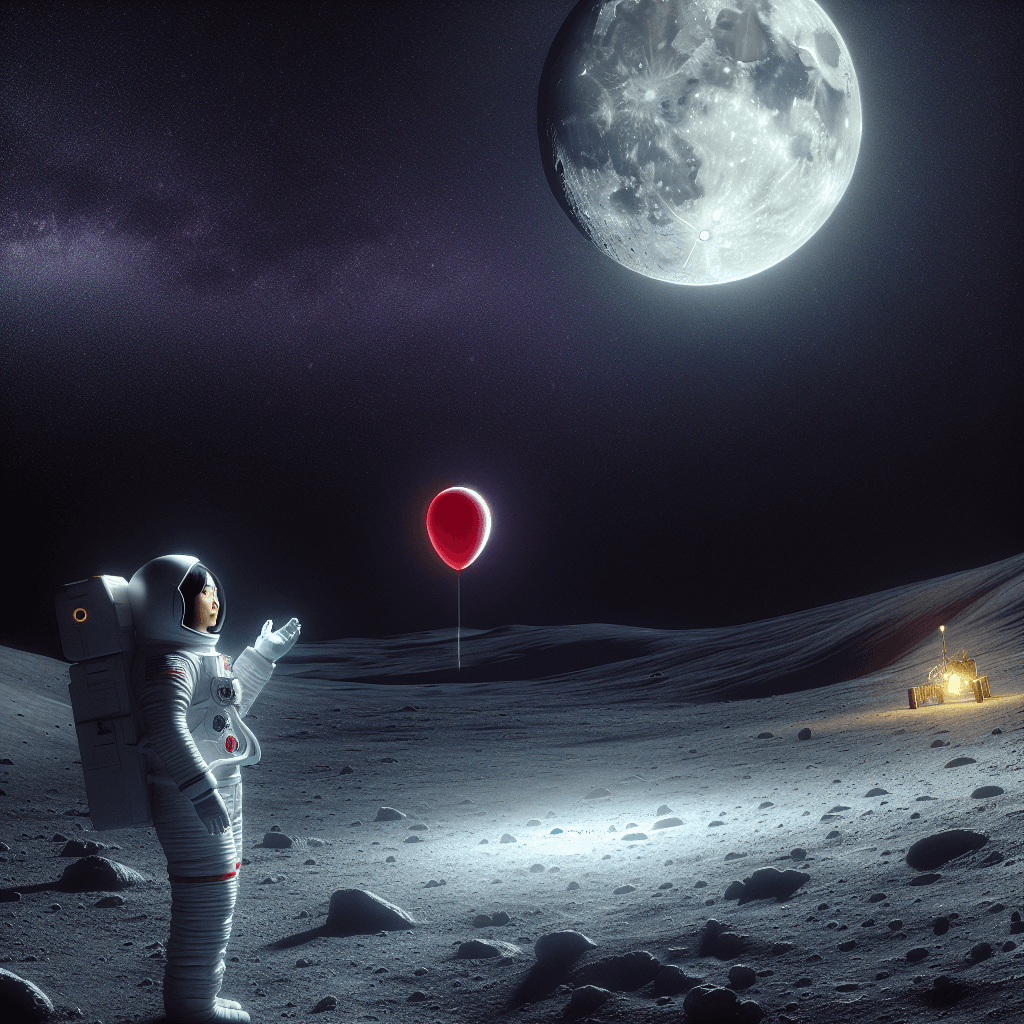
Imagine you are standing on the dusty, desolate plains of the Mare Tranquillitatis, clad in a bulky spacesuit. In your gloved hand, you hold a single, vibrant red helium balloon, a strange splash of color against the monochromatic lunar landscape. With a playful flick of your wrist, you let go. On Earth, that balloon would drift joyfully toward the clouds, eventually becoming a tiny speck in the blue sky. But on the Moon, nature follows a different set of rules. Would this festive orb soar into the cosmos, or would it simply tumble into the gray dust at your feet? To solve this cosmic riddle, we must look toward the disciplines of fluid dynamics and gravitational physics to understand how objects behave when the safety net of an atmosphere is stripped away.
The Secret Sauce: How Buoyancy Works on Earth
To understand why a balloon might fail on the Moon, we first have to understand why it succeeds on Earth. The phenomenon that makes a helium balloon "float" is called buoyancy, governed by Archimedes’ Principle. This principle states that any object submerged in a fluid (and yes, air is considered a fluid in physics) is buoyed up by a force equal to the weight of the fluid displaced by the object.
On Earth, our atmosphere is relatively dense—roughly 1.2 kilograms per cubic meter at sea level. Because helium is significantly lighter (less dense) than the nitrogen and oxygen mix of our air, the upward buoyant force exerted by the atmosphere is greater than the downward pull of gravity on the helium and the thin latex of the balloon. The result? A graceful ascent.
The Lunar Reality: A World Without Air
The Moon is a very different stage for our experiment. For all practical purposes, the Moon is a vacuum. While it has an incredibly thin "exosphere" containing trace amounts of gases, its density is about $10^{-14}$ (one hundred-trillionth) that of Earth’s atmosphere. This absence of a surrounding medium changes everything.
- Zero Displacement: Because there is no air to displace, there is no buoyant force.
- The Buoyancy Equation: If the density of the surrounding medium is zero, the upward force is zero.
- The Result: Without an upward force to counteract gravity, the balloon loses its ability to "float" entirely.
Gravity’s Persistent Pull
Many people mistakenly believe that because there is no air on the Moon, there is no gravity. In reality, the Moon has significant gravitational pull—about 1.62 meters per second squared ($m/s^2$), or roughly 1/6th of Earth's gravity. While this is weak enough to allow astronauts to leap like gazelles, it is more than enough to claim our helium balloon.
Once you release the string, the balloon becomes a victim of "free fall." Because there is no air resistance (drag) to slow it down, it won't drift or flutter like a leaf. Instead, it will fall with the exact same acceleration as a hammer or a rock. If you dropped a bowling ball and a helium balloon simultaneously on the Moon, they would strike the lunar surface at the exact same moment.
The "Pop" Factor: Expansion in a Vacuum
There is one more dramatic hurdle for our lunar balloon. On Earth, the 14.7 pounds per square inch (psi) of atmospheric pressure keeps the helium inside the balloon squeezed into a manageable shape. In the vacuum of the Moon, that external pressure vanishes instantly.
As soon as the balloon is exposed to the vacuum, the helium atoms inside would push outward with incredible force. Without any outside air pressure to hold the latex in check, the balloon would rapidly expand to many times its original size. Unless the balloon was made of an incredibly stretchy, specialized material, it would likely reach its elastic limit and pop in a silent explosion of latex shards before it even hit the ground.
Conclusion: The Final Descent
In the grand tally of lunar physics, the verdict is clear: your helium balloon would fall to the ground. Without an atmosphere to provide buoyant lift, the balloon is just another piece of matter subject to the Moon’s gravitational pull. It would ignore its "light" reputation and tumble toward the lunar regolith, though it might burst into pieces during its short journey due to the internal pressure of the gas.
This thought experiment highlights a fundamental truth about our universe: the "properties" we often attribute to objects—like lightness or buoyancy—are not inherent to the objects themselves but are products of how they interact with their environment. On the Moon, the "magic" of a floating balloon disappears, reminding us how precious and unique our own thick, protective atmosphere truly is.