If you removed all empty space from every human atom, would we all fit inside a sugar cube
We perceive ourselves as solid, but the reality is far more ghostly: if you stripped away the vacuum inside our atoms, the entire human race would condense into the size of a single sugar cube. Deep dive into the mind-bending physics of why you are 99.9% nothingness.

Too Long; Didn't Read
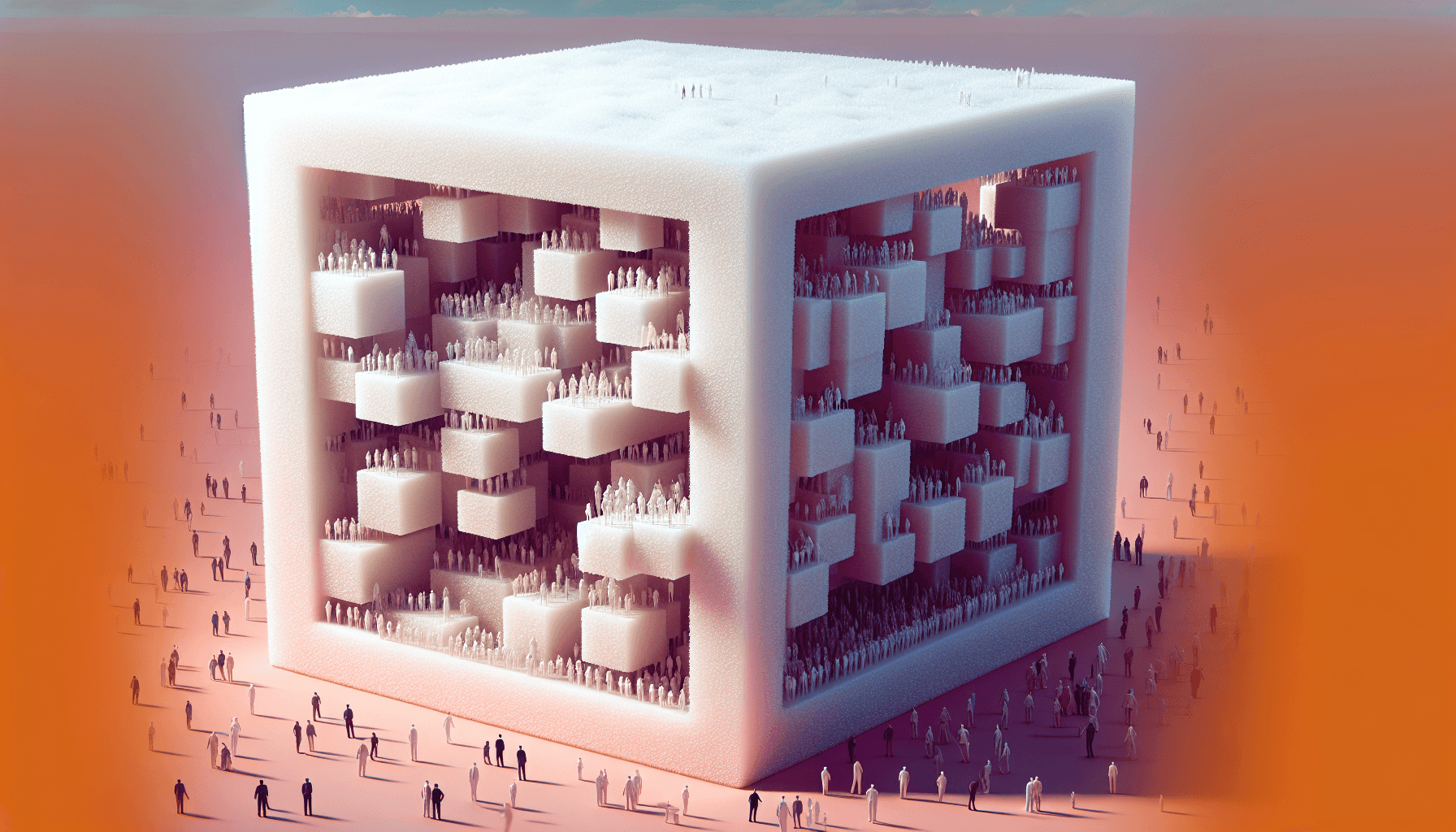
Yes. Because atoms are 99.9999999 percent empty space, removing the gaps between subatomic particles in all 8 billion humans would leave a mass small enough to fit inside a sugar cube. However, this tiny object would be incredibly dense, weighing approximately 5 billion tons.
The Incredible Shrinking Humanity: Could All 8 Billion People Fit Inside a Sugar Cube?
Imagine for a moment that you could reach into the very fabric of reality and hit a "delete" button on the vast, yawning voids within our bodies. It sounds like the plot of a vintage science fiction film, but from a purely physical perspective, humans are remarkably unsubstantial. Despite our solid appearance, we are composed of atoms that are 99.9999999% empty space. This leads to a mind-bending hypothetical: if we removed every bit of that emptiness from every person on Earth, would the entire human race fit inside a single sugar cube?
To answer this, we must dive into the realms of nuclear physics and quantum mechanics. By analyzing the density of the atomic nucleus and the collective mass of the global population, we can determine the physical boundaries of this miniature humanity.
The Vast Emptiness of the Atom
To understand why this experiment is even possible, we first have to look at the architecture of the atom. In the center sits the nucleus, containing protons and neutrons, surrounded by a cloud of electrons. However, the distance between that nucleus and its electrons is proportionally gargantuan.
If an atom were expanded to the size of a massive football stadium, the nucleus would be no larger than a small marble sitting on the 50-yard line. The electrons would be like tiny gnats buzzing around the very top rows of the stands. Everything in between—the seats, the field, the air—is essentially empty space. When you "touch" an object, you aren't actually touching its matter; you are feeling the electromagnetic repulsion of these electron clouds pushing against each other.
Calculating the Collective Mass of Humanity
To see if we fit in a sugar cube, we first need to know how much "stuff" we are working with.
- Global Population: Approximately 8 billion people.
- Average Weight: While it varies by region, the average global adult weight is roughly 62 kilograms (136 pounds).
- Total Human Mass: Multiplying these figures gives us a total collective mass of approximately 496 million metric tons.
In our current state, this mass is spread out across the entire planet. But in our thought experiment, we are stripping away the "stadium" and keeping only the "marbles."
The Density of the Nucleus
The material left over after removing the empty space is essentially "nuclear matter." This substance is incredibly dense. To give you an idea of the scale:
- Nuclear Density: The density of an atomic nucleus is approximately $2 \times 10^{17}$ kg/m³.
- The Resulting Volume: If we take our 496 million metric tons of human mass and compress it to nuclear density, the total volume would be approximately 0.0025 cubic centimeters.
- The Sugar Cube Comparison: A standard sugar cube has a volume of about 1 cubic centimeter.
Mathematically, the entire human race would not just fit inside a sugar cube; we would occupy only about 0.25% of its total volume. We would be a tiny, ultra-dense speck rattling around inside that cube.
Physical Consequences of a Condensed Humanity
While we could technically fit, the physical reality of such an object would be extraordinary. While the volume has decreased, the mass remains the same. You would have a sugar-cube-sized object that weighs nearly 500 million tons—roughly the same weight as 5,000 aircraft carriers.
- Gravitational Pull: If you placed this "Humanity Cube" on the Earth's surface, it wouldn't just sit there. Its extreme density would likely cause it to exert a noticeable (though not world-ending) gravitational pull on nearby objects.
- Structural Integrity: No table or floor could support it. It would immediately exert millions of tons of pressure on a tiny surface area, likely sinking through the crust of the Earth toward the core, much like a hot marble through butter.
- Heat and Energy: At these densities, the material would behave more like the matter found inside a neutron star. Without the massive gravitational pressure of a star to hold it together, the internal repulsion forces would likely result in an immediate and energetic expansion back to a more stable state.
Conclusion
The numbers don't lie: if you removed the empty space from every human atom, the entire population of Earth would indeed fit inside a sugar cube with plenty of room to spare. This experiment highlights the staggering reality that the "solid" world we interact with is mostly an illusion created by fundamental forces and vast distances on a microscopic scale.
Ultimately, this thought experiment teaches us that we are defined not by the "stuff" we are made of, but by the energy and space that allow that matter to interact. We are, quite literally, mostly made of nothing—yet that "nothing" is exactly what gives the universe its shape and beauty.