If you sneezed in microgravity, why would the recoil propel your body backward like a tiny rocket engine
Ever wondered if a single "achoo" could launch you across a space station? Discover the explosive physics of how microgravity turns a common reflex into a high-speed biological rocket engine.

Too Long; Didn't Read
Sneezing in microgravity acts like a miniature thruster due to Newtons Third Law of Motion. When you forcefully expel air forward, the conservation of momentum generates an equal and opposite reaction that pushes your body backward through the environment.
Could a Sneeze Be Your New Propulsion System? The Physics of Microgravity Recoil
Imagine you are floating effortlessly in the center of a module on the International Space Station. There are no walls within arm's reach, no floor to push off from, and no gravity to pull you down. Suddenly, your nose tickles. You inhale deeply and let out a powerful, unrestrained sneeze. While on Earth this might just result in a reach for a tissue, in the weightless environment of orbit, that sneeze becomes a literal propellant. Could a simple biological reflex actually turn your body into a human-sized rocket engine? To understand this whimsical scenario, we must dive into the world of classical mechanics, exploring Newton’s Laws of Motion and the conservation of momentum to see how a burst of air can dictate your trajectory through the stars.
The Nasal Exhaust: Biology Meets Ballistics
To treat a sneeze like a rocket engine, we first have to look at the "exhaust" being produced. A sneeze is a high-speed, involuntary expulsion of air from the lungs, designed to clear the nasal cavity of irritants. When you sneeze, your body acts as a biological pressure vessel.
From a physics perspective, a sneeze is a mass-flow event. You are accelerating a small volume of air from a state of rest to a high velocity in a fraction of a second. In the vacuum-like freedom of microgravity, this isn't just a sneeze; it is a vector. Because you aren't anchored to the ground by friction or gravity, the physical forces involved in this expulsion have nowhere to go but into your own body's momentum.
Newton’s Third Law: The Equal and Opposite Reaction
The primary driver of the "sneeze-rocket" phenomenon is Sir Isaac Newton’s Third Law of Motion: For every action, there is an equal and opposite reaction.
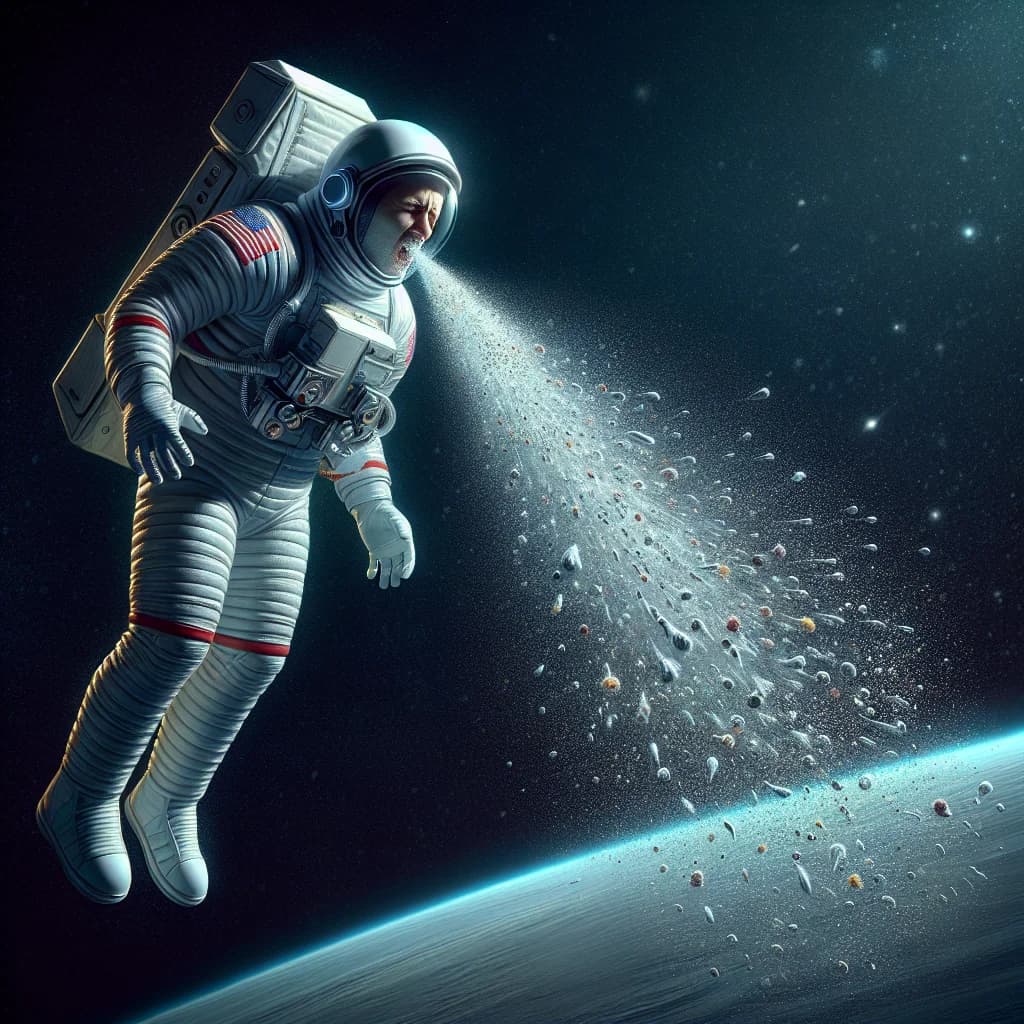
On Earth, when you sneeze, the "reaction" force is transferred through your legs and into the ground. Friction between your shoes and the floor holds you steady, and the Earth's massive gravity keeps you rooted. In microgravity, however, those stabilizing forces vanish. When your lungs project a cloud of air droplets forward, that air exerts an identical amount of force back onto your body.
Calculating the "Sneeze Thrust"
To see how much you would actually move, we can use the Principle of Conservation of Momentum ($p = mv$). In a closed system, the momentum before the sneeze must equal the momentum after the sneeze.
- Mass of Air ($m_{air}$): A typical sneeze might expel about 0.5 liters of air. Given the density of air is roughly 1.225 kg/m³, the mass of the expelled air is approximately 0.0006 kilograms.
- Velocity of Sneeze ($v_{air}$): Sneezes can travel at speeds up to 45 meters per second (approx. 100 mph).
- Mass of the Human ($M_{human}$): Let’s assume an average astronaut mass of 70 kilograms.
Using the formula $M_{human} \times V_{recoil} = m_{air} \times v_{air}$, we can estimate the backward drift. $(70\text{ kg}) \times V_{recoil} = (0.0006\text{ kg}) \times (45\text{ m/s})$ $V_{recoil} \approx 0.00038 \text{ meters per second.}$
While 0.00038 meters per second seems negligible, in the frictionless environment of a space station, this results in a persistent drift of about 1.4 meters per hour. Without an external force to stop you, you would continue to float backward until you eventually bumped into a bulkhead.
Cascading Consequences of a Zero-G Sneeze
The physics of the recoil is only the beginning. Because a sneeze is rarely a perfectly centered event, the result is often more complex than a simple backward slide.
- Rotational Torque: Most sneezes occur slightly off-center from a person's center of mass (the "nasal exhaust" comes from the face, which is forward of the spine). This creates a "moment arm," resulting in torque. Instead of just moving backward, you would likely begin a very slow, graceful backward somersault.
- Environmental Turbulence: In the confined volume of a spacecraft, the air you expel creates a localized high-pressure zone. This tiny "wind" can interact with nearby floating objects, sending a stray pen or a floating water droplet on a journey of its own.
- The "Stationary" Illusion: On Earth, we feel like we are standing still. In space, you are constantly reminded that you are a dynamic object. A sneeze serves as a practical demonstration that even the smallest internal forces can have macroscopic effects on your position in the universe.
Conclusion
While you won't be using a head cold to navigate the International Space Station any time soon, the physics of a microgravity sneeze perfectly illustrates the fundamental laws of our universe. The recoil from a sneeze is a miniature version of the same principles that power the massive RS-25 engines on a moon rocket: mass is expelled in one direction to create motion in the other.
By applying Newton's Third Law and the conservation of momentum, we can see that every breath, movement, and sneeze in space carries a physical consequence. It is a fascinating reminder that in the vast, silent reaches of orbit, even the most mundane human functions are governed by the majestic and uncompromising rules of physics.