If you sneezed in zero gravity, would the recoil force be enough to propel you across the room
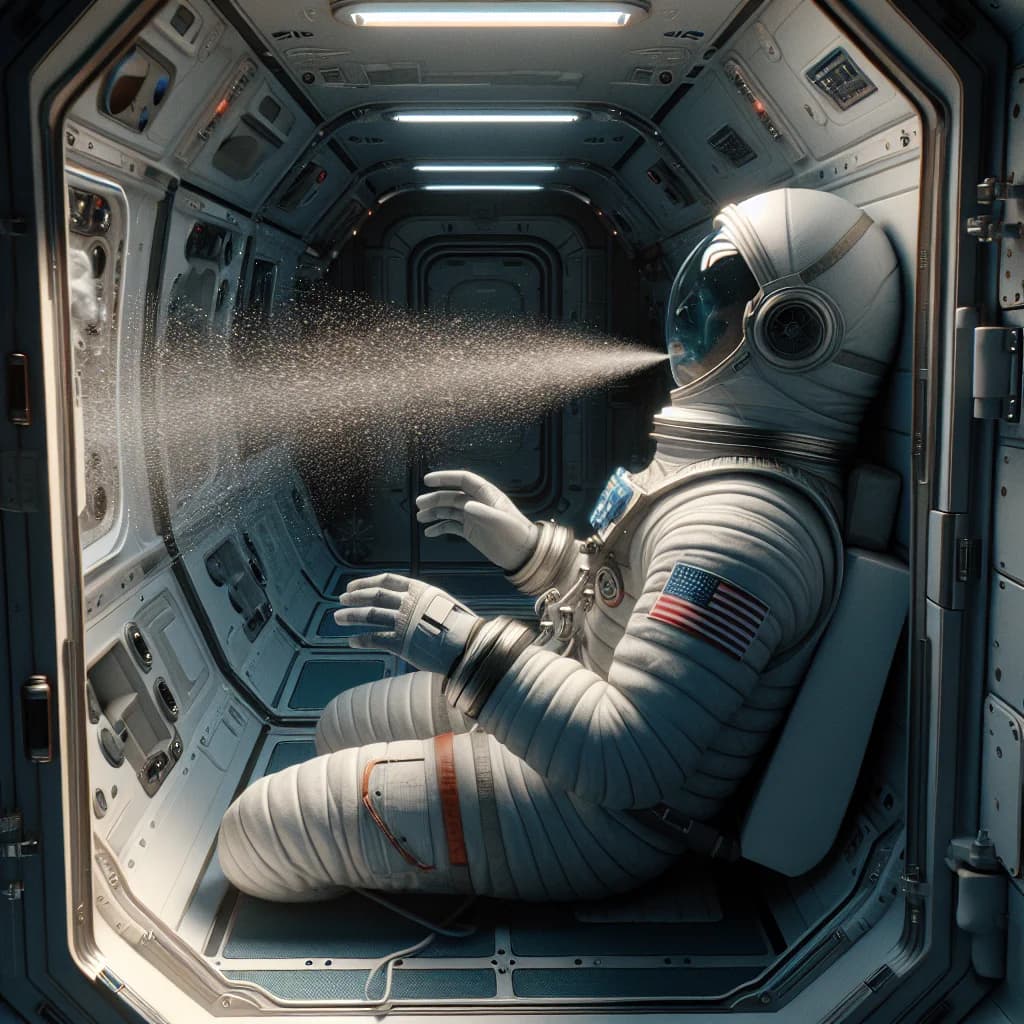
In the weightless silence of space, could a single "achoo" become an accidental propulsion system? Discover the surprising physics of zero-gravity sneezes and find out if your body's most violent reflex is enough to launch you across the room.

Too Long; Didn't Read
While a sneeze produces recoil due to Newtons Third Law, the force is negligible compared to a humans body mass. You would technically drift backward, but only at an incredibly slow pace of a few centimeters per minute, far from being propelled across a room.
The Sneeze Propulsion Theory: Could a Single Sneeze Propel You Across a Room in Zero Gravity?
Imagine you are floating peacefully inside the International Space Station. There is no "up" or "down," only the hum of electronics and the weightless drift of your own body. Suddenly, a stray particle of space dust tickles your nose. You inhale deeply, your eyes close, and then—achoo! In the frictionless environment of microgravity, every action has an equal and opposite reaction. This raises a fascinating scientific question: Is the force of a human sneeze powerful enough to act as a biological thruster, sending you sailing into the opposite bulkhead?
To solve this cosmic mystery, we must dive into the mechanics of human biology and the rigid laws of Newtonian physics. By applying the principles of fluid dynamics, the conservation of momentum, and classical mechanics, we can determine whether a sneeze is a viable mode of transportation or just a minor inconvenience in the void.
Newton’s Third Law: The Physics of the "Gesundheit"
The foundational principle at play here is Sir Isaac Newton’s Third Law of Motion: for every action, there is an equal and opposite reaction. On Earth, when you sneeze, the friction between your feet and the floor absorbs the backward force. In zero gravity, however, that friction is gone.
When you sneeze, you are essentially "launching" a mixture of air and droplets out of your mouth and nose at high speeds. This creates a small amount of thrust. To analyze the result, we use the formula for momentum ($p = mv$), where momentum equals mass times velocity. According to the Law of Conservation of Momentum, the momentum of the expelled air must be balanced by an equal momentum in the opposite direction by your body.
Crunching the Numbers: Mass vs. Velocity
To understand the scale of this reaction, we need to estimate the physical metrics of a typical sneeze.
The "Exhaust" Velocity
A vigorous sneeze can expel air and bio-aerosols at velocities ranging from 30 to 45 meters per second (roughly 100 miles per hour). While that sounds incredibly fast, the "propellant" has very little mass. A single sneeze might involve about 0.5 to 1.0 liters of air. Given that air has a density of approximately 1.225 grams per liter, the total mass being "ejected" is roughly 1 to 2 grams.
The Body’s Inertia
Now, consider the mass of the "astronaut." An average adult might weigh around 70 kilograms (70,000 grams). To find the resulting recoil velocity ($V_r$), we use the conservation of momentum equation:
$$(Mass_{sneeze} \times Velocity_{sneeze}) = (Mass_{person} \times Velocity_{recoil})$$
Using our estimates:
- Sneeze mass: 0.002 kg
- Sneeze velocity: 45 m/s
- Person mass: 70 kg
This gives us a recoil velocity of approximately 0.00128 meters per second.
Environmental Consequences: A Very Slow Drift
To put that number into perspective, a recoil of 1.28 millimeters per second is incredibly slow. To compare this to real-world metrics:
- A garden snail travels at about 13 millimeters per second.
- Your sneeze-induced movement would be roughly ten times slower than a snail’s pace.
While the force would technically move you, the atmospheric consequences within a spacecraft would likely interfere. In a pressurized cabin, the air itself has viscosity. The tiny amount of kinetic energy generated by the sneeze would quickly be dampened by air resistance. If you were perfectly centered in a 10-meter wide room, it would take you over an hour to reach the other side—assuming you didn't drift into a different air current first.
The Verdict on Biological Rocketry
While a sneeze does generate a measurable recoil force, it is not the "biological jetpack" some might imagine. The sheer difference in mass between the expelled air and the human body ensures that the resulting motion is negligible. You wouldn't be "propelled" across the room so much as you would begin a very long, very boring journey toward a wall.
Ultimately, the physics of zero gravity remind us that even our smallest biological functions have a mechanical impact on our environment. While a sneeze won't help you navigate a space station, it beautifully illustrates how the laws of motion govern everything from the smallest droplet to the largest satellite. In the vastness of space, even a simple "achoo" is a lesson in the delicate balance of the universe.