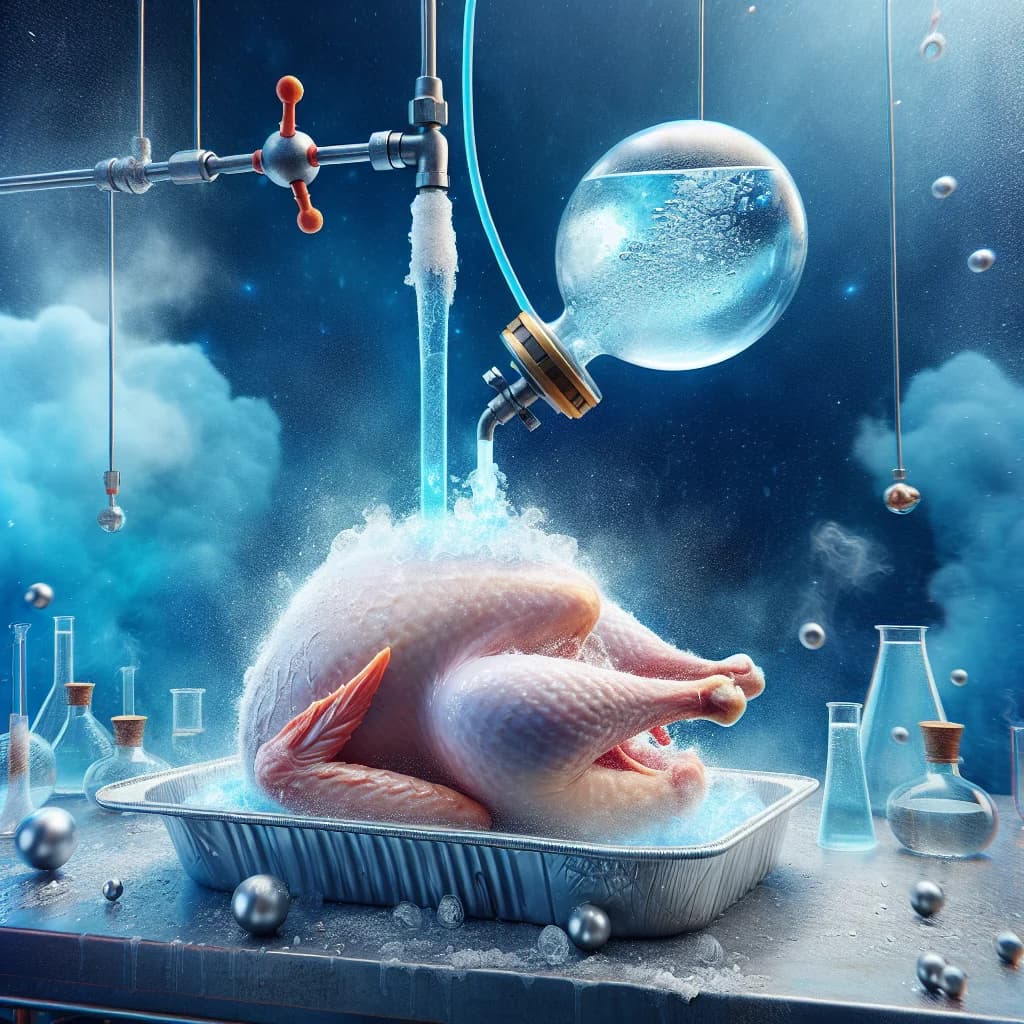
If you soaked a frozen turkey in liquid oxygen, would it explode like dynamite upon impact
It sounds like a mad scientist’s Thanksgiving dare, but the volatile chemistry between liquid oxygen and organic matter could turn your dinner into a literal bombshell. Discover the high-impact science behind whether a frozen turkey can actually explode with the force of dynamite.

Too Long; Didn't Read
Yes, soaking a frozen turkey in liquid oxygen creates a powerful explosive mixture. The porous meat and fat act as fuel while the liquid oxygen serves as a concentrated oxidizer, forming an oxyliquit. Upon impact, the energy can trigger a violent detonation comparable to dynamite.
The Liquid Oxygen Turkey: Would a Frozen Bird Explode Like Dynamite Upon Impact?
Imagine a scenario where the traditional holiday dinner meets the high-stakes world of cryogenic laboratory testing. Instead of a standard oven, you decide to submerge a rock-solid, twenty-pound frozen turkey into a vat of liquid oxygen (LOX) chilled to a staggering -297°F. After a thorough soaking, you drop the bird from a significant height or strike it with a heavy object. The question isn't just whether it breaks, but whether it undergoes a catastrophic energetic failure. To answer this, we must look at the foundational parameters of combustion chemistry, thermodynamics, and materials science to determine if a frozen turkey can truly transition from a centerpiece to a high-velocity propellant.
The Powerful Chemistry of Liquid Oxygen (LOX)
To understand why this experiment is so volatile, we first have to understand the nature of liquid oxygen. Oxygen itself is not flammable; however, it is one of the most powerful oxidizers in existence. In its liquid state, it is highly concentrated. When you submerge an organic material—like a turkey—into LOX, you are essentially saturating a fuel source with a massive amount of concentrated reactant.
A turkey is composed of proteins, fats, and water. Once the water is frozen solid, the fats and carbon-based structures remain. In the presence of LOX, these organic molecules are "primed." This combination creates a mixture remarkably similar to "oxyliquits," a class of explosives used in mining during the early 20th century, which consisted of porous combustible materials soaked in liquid oxygen.
Turning Poultry into an Explosive Mixture
For an explosion to occur, we need the "Fire Triangle": fuel, an oxidizer, and an ignition source.
- The Fuel: The carbon and hydrogen bonds in the turkey's fat and muscle.
- The Oxidizer: The liquid oxygen saturating the turkey’s surface and seeping into its microscopic pores and the central cavity.
- The Ignition: This is where the "impact" comes in.
When the LOX-soaked turkey hits the ground, the mechanical energy of the impact is converted into thermal energy. In a process known as adiabatic compression, tiny pockets of gaseous oxygen trapped within the turkey’s tissues are squeezed so rapidly that their temperature spikes instantly. Because the turkey is now a hyper-oxygenated fuel source, this tiny spark of heat is enough to trigger a rapid oxidation-reduction reaction.
The Physics of the "Boom"
While it might not have the exact chemical yield of a stick of dynamite (which uses nitroglycerin), a LOX-soaked turkey could undergo a "deflagration-to-detonation transition."
The Scale of Energy Release
If we estimate the caloric energy of a twenty-pound turkey, we are looking at roughly 20,000 to 30,000 kilocalories. In a standard digestive process, this energy is released over days. In a LOX-impact scenario, a significant portion of that energy is released in a few milliseconds.
- Expansion Ratio: Liquid oxygen expands to 860 times its volume when it turns into a gas.
- Pressure Wave: The rapid conversion of liquid to gas, combined with the heat of the flash-combustion of turkey fats, creates a high-pressure shockwave.
The result would not be a simple "splat." Instead, the turkey would undergo a rapid energetic disassembly. Clinically speaking, the bird would be reduced to a cloud of fine carbonized particulate and rapidly expanding gases, creating a visible flash and a significant audible report similar to a large firework or a low-grade industrial blast.
Safety and Environmental Consequences
In this hypothetical scenario, the immediate vicinity would experience a "pressure excursion." The surrounding air would be pushed away by the rapidly expanding gas. Because the reaction is so efficient in an oxygen-rich environment, there would be very little smoke, but rather a clean, bright flash of energy. The thermal output would be intense but brief, quickly dissipated by the extreme cold of any remaining unreacted liquid oxygen.
Conclusion
The scientific verdict is clear: if you soak a frozen turkey in liquid oxygen and subject it to a sharp mechanical impact, it will indeed behave like an explosive. The combination of concentrated oxidizer and organic fuel, triggered by the heat of adiabatic compression, leads to a rapid release of energy that mirrors the behavior of early industrial explosives. This thought experiment highlights the incredible energy stored in everyday objects and the transformative power of chemical oxidizers. While the holiday turkey is best left to the oven, the physics behind its potential "kaboom" reminds us that the laws of chemistry are always ready to serve up something exciting.