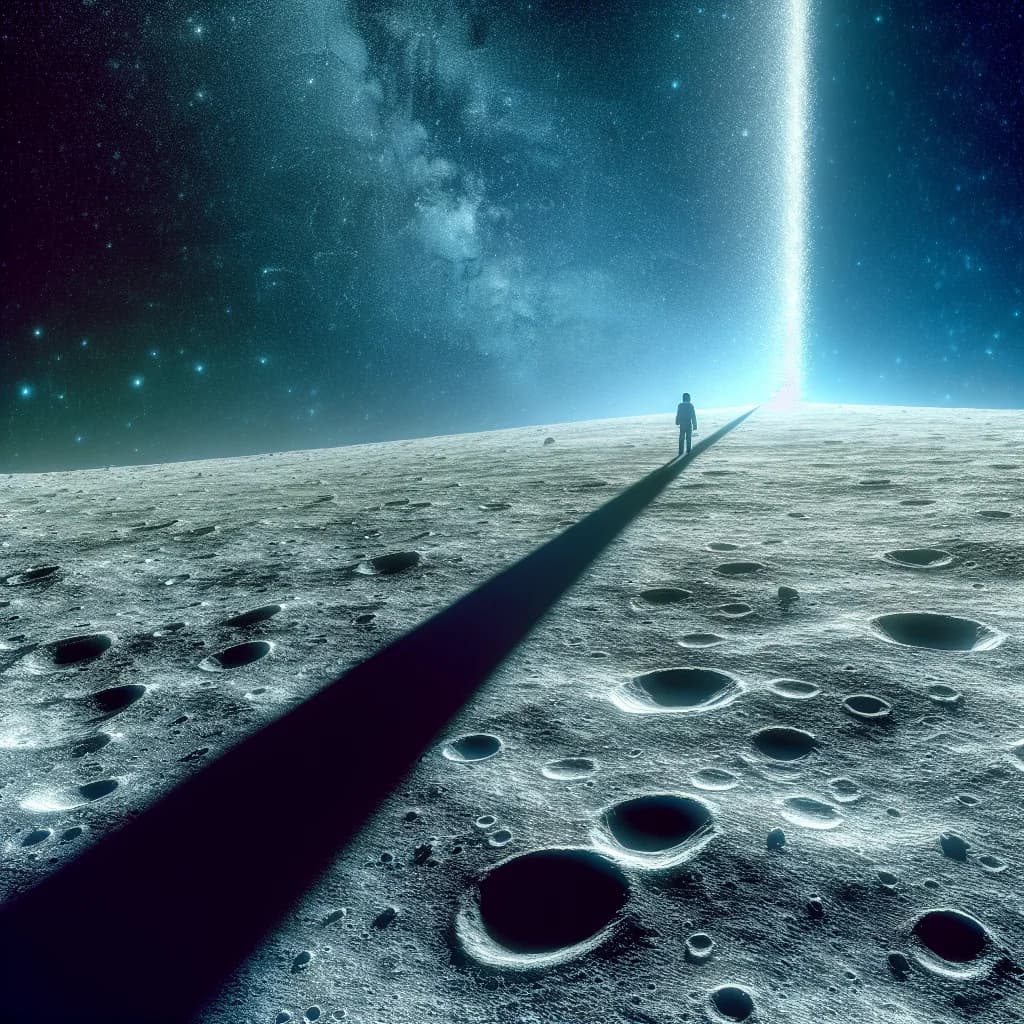
If you stood on a neutron star, would you be instantly crushed into a single atom-thick layer
Imagine gravity so intense it doesn't just crush you; it obliterates the very space between your atoms. Dive into the terrifying reality of the universe's most extreme environment to see what really happens when you step onto a neutron star.


Too Long; Didn't Read
Yes, the extreme gravity of a neutron star would instantly pulverize your body and flatten your remains into a layer thinner than a single atom, effectively merging your subatomic particles with the star's surface.
The Ultimate Compression: Would You Really Become a Single-Atom Layer on a Neutron Star?
Imagine a celestial object so dense that a single teaspoon of its material would weigh about a billion tons—roughly the weight of Mount Everest. This is the reality of a neutron star, the collapsed core of a massive sun that has reached the end of its life. If you were to somehow teleport to the surface of one of these cosmic remnants, you wouldn't just be "heavy"; you would encounter physical forces that defy our everyday understanding of reality. This thought experiment asks a compelling question: would the gravity of a neutron star truly compress a human being into a single-atom-thick layer? By applying the principles of general relativity, classical mechanics, and nuclear physics, we can analyze the structural fate of matter in the most extreme laboratory the universe has to offer.
The Gravity Gap: Earth vs. The Ultimate Weight Room
To understand what happens on a neutron star, we first have to look at the numbers. On Earth, we experience a comfortable gravitational acceleration of 9.8 meters per second squared ($m/s^2$). A neutron star, however, packs about 1.4 to 2 times the mass of our Sun into a sphere only about 12 miles (20 kilometers) in diameter.
The resulting surface gravity is approximately 200 billion times stronger than Earth's. To put this in perspective:
- Weight Comparison: If you weigh 150 pounds on Earth, you would weigh roughly 30 trillion pounds on a neutron star.
- Acceleration: If you stepped off a curb just one meter high, you would hit the surface at a speed of several million miles per hour in a fraction of a microsecond.
- Escape Velocity: To leave Earth, a rocket must travel 11 km/s. To leave a neutron star, you would need to travel at nearly half the speed of light.
Defining "Flat": The Mechanics of Compression
Would you become a single-atom-thick layer? In short: yes, and then some. On Earth, the space between atoms and the internal structure of the atoms themselves are maintained by electromagnetic forces. However, the gravitational pressure on a neutron star is so immense that it overcomes these electromagnetic bonds entirely.
The Breakdown of Molecular Structure
As you approached the surface, the tidal forces—the difference in gravity between your feet and your head—would begin a process of structural reorganization. Because the gravity is so much stronger at the surface than even a few feet above it, any three-dimensional object is immediately pulled into a vertical "string." Upon contact, the following physical consequences occur:
- Molecular Disassembly: The chemical bonds holding your molecules together would be instantly overpowered. You would no longer be composed of water, proteins, or calcium.
- Atomic Flattening: Even atoms themselves cannot maintain their shape. Electrons are crushed into the nuclei, merging with protons to form neutrons.
- The "Pancake" Effect: The resulting material is spread across the surface with such intensity that it becomes part of the star's "atmosphere"—a layer of plasma and degenerate matter only a few centimeters thick.
The Energy of the Impact
It isn’t just the weight that flattens you; it is the energy. Falling onto a neutron star is an incredibly efficient way to convert mass into energy. Because the acceleration is so high, the kinetic energy released upon impact would be comparable to a massive nuclear explosion. In clinical terms, the observer is not just compressed; they undergo a total phase transition into the "nuclear pasta" or neutron-degenerate matter that makes up the star’s crust.
The Environment of the Neutron Star
Beyond the gravity, the environment itself is hostile to any form of complex structure.
- Magnetic Fields: Neutron stars often possess magnetic fields trillions of times stronger than Earth’s. These fields are so powerful they can distort the shape of atoms into long, thin cylinders.
- Heat: The surface temperature of a young neutron star can be roughly 1,000,000 degrees Celsius.
- Smoothness: Because the gravity is so high, the "mountains" on a neutron star are only a few millimeters tall. Anything added to the surface is instantly smoothed out into the existing topography.
Conclusion
The scientific reality of standing on a neutron star is a definitive confirmation of the "atom-thick" hypothesis. Due to the extreme gravitational acceleration and the collapse of electromagnetic atomic bonds, any complex object would be instantly redistributed into a microscopic layer of subatomic particles. The core principles of density and gravitational pressure dictate that on such a star, there is no room for the empty space that exists within atoms.
While this thought experiment highlights a scenario of extreme physical reorganization, it also reminds us of the incredible diversity of our universe. Neutron stars serve as the ultimate limit-test for the laws of physics, showing us that under the right conditions, even the most solid objects can become something entirely new. We may never stand on their surfaces, but by studying them, we gain a deeper appreciation for the delicate balance of forces that allows life to exist here on our own, much gentler, planet.