If you stood on a planet with a neon atmosphere, why would every lightning strike be bright red
Step onto a world where every storm bleeds crimson, trading traditional flashes for blinding bolts of electric ruby. Discover the otherworldly science that transforms a neon atmosphere into a sky of flickering red fire.

Too Long; Didn't Read
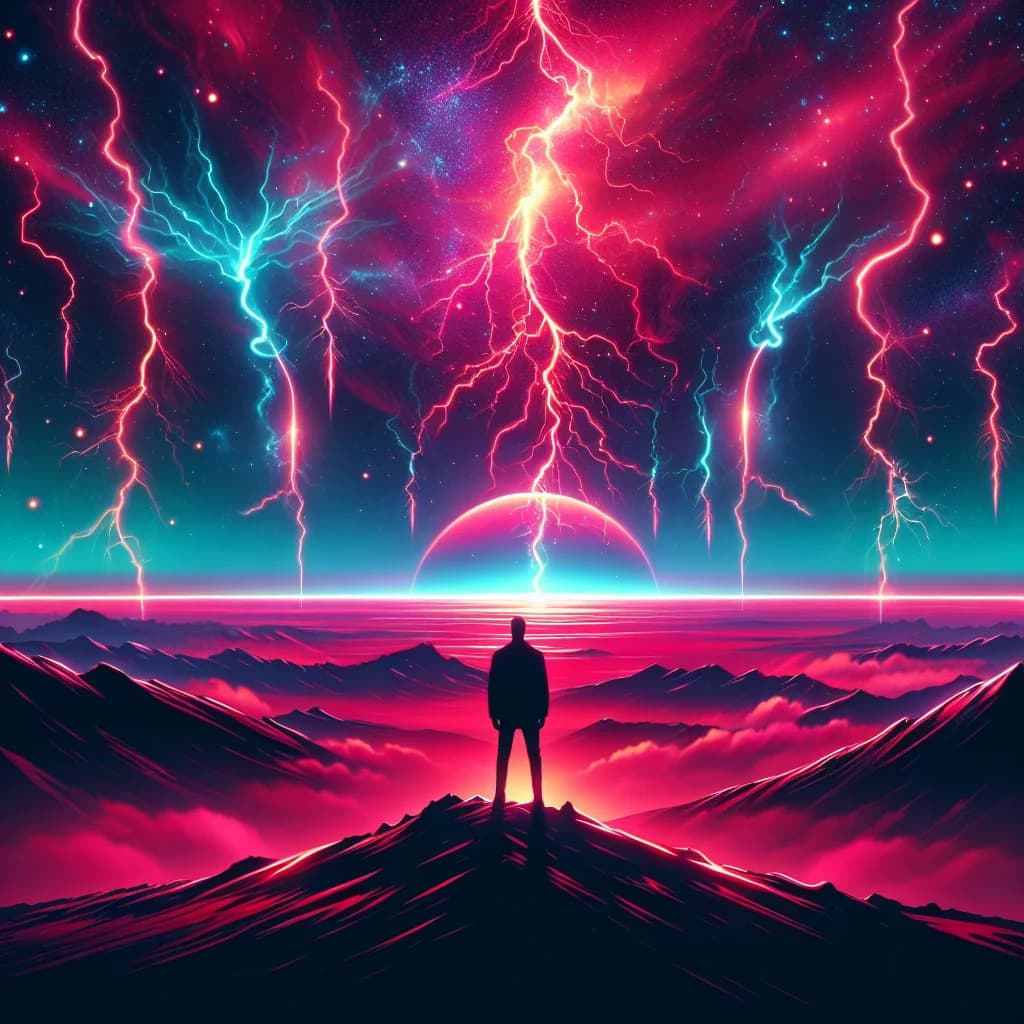
Lightning in a neon atmosphere appears bright red because the electrical discharge excites neon atoms, causing them to emit their signature reddish-orange glow, the same physical process that powers neon signs on Earth.
Beyond the Blue Bolt: Why Would Lightning Strike Bright Red on a Planet Filled with Neon?
Imagine standing on the surface of a distant, rocky exoplanet where the air isn't a mix of nitrogen and oxygen, but a heavy, shimmering blanket of pure neon. As a storm gathers overhead, the clouds don't flicker with the familiar white-blue cracks of Earthly lightning. Instead, the sky erupts in a jagged, mesmerizing display of brilliant crimson and fiery orange. While this sounds like the cover of a vintage science fiction novel, the phenomenon is rooted deeply in the laws of atomic physics.
To understand why a neon world would host a red-tinted electrical light show, we must look at the scenario through the lenses of spectroscopy and plasma physics. By analyzing how noble gases react to high-voltage discharges, we can determine the exact visual "fingerprint" of a neon-fueled thunderstorm.
The Anatomy of an Atomic Glow
On Earth, lightning appears white or blue-white because the air is composed mostly of nitrogen (78%) and oxygen (21%). When a bolt of electricity tears through the atmosphere, it heats the air to approximately 30,000 Kelvin—five times hotter than the surface of the sun. This intense heat causes the gases to emit a broad spectrum of light, but the specific electron transitions in nitrogen and oxygen lean heavily toward the shorter, blue, and violet wavelengths.
On our hypothetical neon planet, the "rules of the glow" change entirely due to the following principles:
- Electron Excitation: When a lightning strike occurs, it sends a surge of high-energy electrons through the neon atoms. These electrons collide with the neon atoms, "exciting" them and pushing their electrons to higher energy levels.
- The Spectral Fingerprint: As those electrons return to their stable "ground state," they release energy in the form of photons. Every element has a unique set of energy levels. Neon’s most prominent "forbidden transitions" and standard emissions are clustered almost exclusively in the 600 to 700-nanometer range, which our eyes perceive as vivid red and orange.
- The "Neon Sign" Effect: Essentially, a lightning strike in a neon atmosphere is a massive, uncontained version of a neon tube. In a standard neon light, high voltage passes through a vacuum tube filled with neon gas; the resulting plasma glows red for the exact same reason our hypothetical lightning bolt would.
Plasma Channels and Energy Transfer
A lightning bolt is not just a spark; it is a channel of plasma. On a neon planet, the physical properties of this plasma would differ slightly from Earth’s. Neon is a noble gas, meaning it is chemically inert and has a higher first ionization energy than oxygen or nitrogen.
- Ionization Metrics: It takes approximately 21.56 electron volts (eV) to strip an electron from a neon atom, compared to only 13.6 eV for oxygen.
- Voltage Requirements: Because neon "holds onto" its electrons more tightly, the electrical potential (voltage) required to initiate a lightning strike might need to be significantly higher than on Earth to achieve a similar breakdown of the atmosphere.
- Energy Density: Once the dielectric breakdown occurs, the resulting plasma channel would be an incredibly efficient conductor. Because neon doesn't readily form molecules (like $N_2$ or $O_2$), the energy of the bolt isn't wasted on breaking chemical bonds. Instead, nearly all the energy goes directly into thermal excitation and light production.
Environmental Consequences of a Crimson Storm
The transition from blue to red lightning wouldn't just be a visual change; it would alter the entire atmospheric environment. Because neon is chemically "lazy," the cascading effects of a strike would be quite different from what we experience on Earth:
- No Ozone Production: On Earth, lightning breaks apart $O_2$ molecules, leading to the creation of $O_3$ (ozone). On a neon planet, the lightning would be "clean." You wouldn't smell the sharp, metallic scent of ozone after a storm.
- Enhanced Visibility: Red light has a longer wavelength than blue light. In a dusty or hazy atmosphere, red light undergoes less Rayleigh scattering. This means a red lightning strike would be visible from much further away than a blue one, as the light can navigate through atmospheric particles more effectively.
- Thermal Radiation: While the bolt itself would be incredibly hot, the dominant red light carries less energy per photon than blue or ultraviolet light. However, the sheer volume of photons would create a pervasive, warm glow that could illuminate the landscape for miles.
Conclusion
If you were to stand on a planet with a neon atmosphere, every lightning strike would be bright red because of the specific, unchangeable electron configuration of the neon atom. The physics of spectroscopy dictate that when neon is transformed into a high-energy plasma, it prefers to speak in the language of long-wave red light.
This thought experiment highlights a beautiful truth about our universe: the same fundamental laws of physics that power the humble neon sign in a shop window also govern the meteorological wonders of distant worlds. While our own blue-white lightning is a product of our life-sustaining oxygen and nitrogen, the crimson bolts of a neon world remind us that the cosmos is a vast laboratory where even a simple change in chemistry can paint the sky in entirely new colors.