If you stood on a planet with three suns, why would you cast three differently colored shadows
Step into a world where your shadow isn't just a dark silhouette, but a vibrant spectrum of shifting colors. Discover the mind-bending physics that transform an alien landscape into a masterpiece of light and geometry.

Too Long; Didn't Read
On a planet with three distinct colored suns, blocking one star allows light from the other two to fill the space. This results in shadows that appear as the secondary colors formed by the remaining light sources rather than black.
A Dance of Light and Color: Why Would You Cast Three Different Shadows on a Triple-Star Planet?
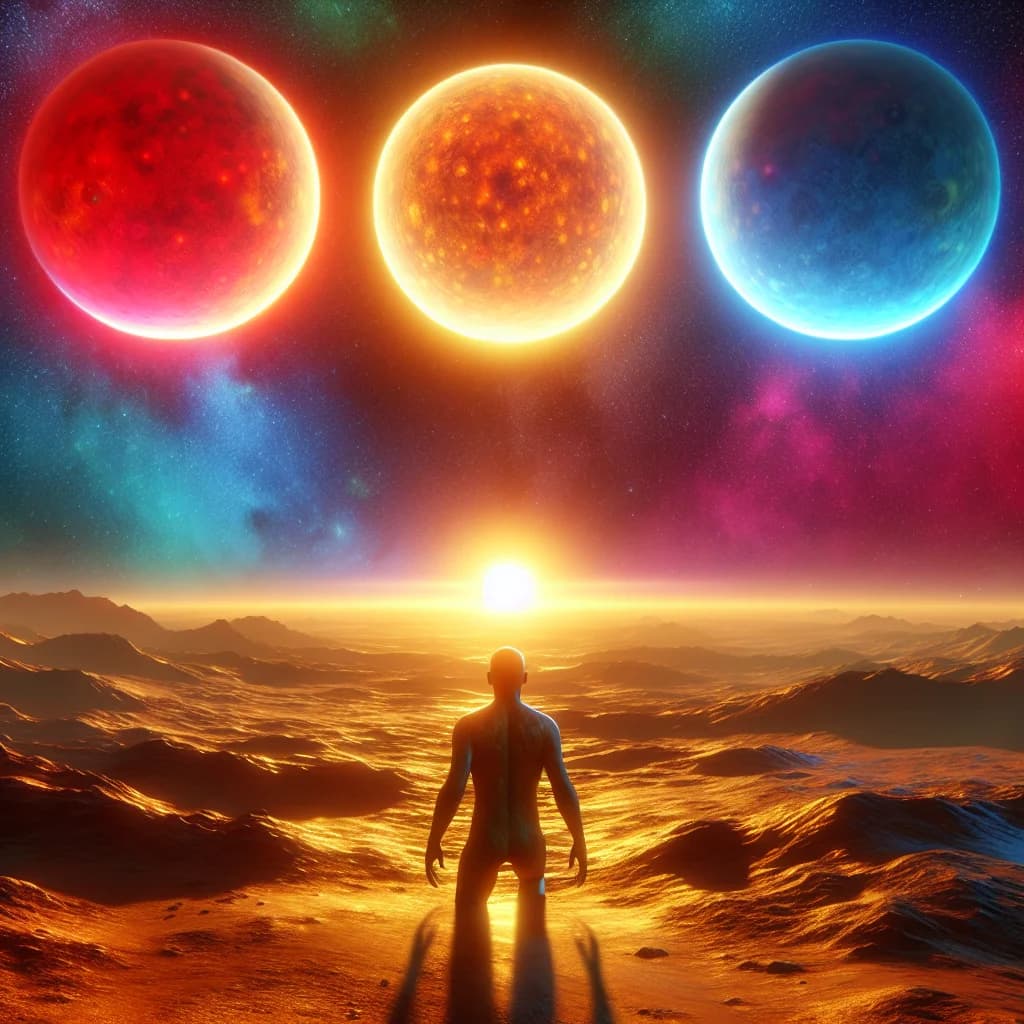
Imagine waking up on a world where the morning sky isn't just a single shade of blue, but a shifting tapestry of amber, azure, and crimson. In a triple-star system—a common arrangement in our galaxy—the simple act of walking outside would result in a surreal optical phenomenon: you would cast three distinct, overlapping shadows, each possessing its own unique hue. This isn't science fiction; it is the inevitable result of how light interacts with matter. By applying the principles of stellar spectroscopy, additive color theory, and the physics of light propagation, we can decode exactly why an alien landscape would be a playground of vibrant, multi-colored shadows.
The Trio of Suns: Defining the Light Sources
To understand the colors of the shadows, we must first look at the stars themselves. Stars are classified by their "spectral type," which is determined by their surface temperature. For our thought experiment, let’s place ourselves on a planet orbiting a stable barycenter between three distinct stars:
- The Red Dwarf (M-class): A cool, long-lived star with a surface temperature of roughly 3,000 Kelvin, emitting primarily red and infrared light.
- The Yellow Sun (G-class): Similar to our own Sun, with a temperature of about 5,800 Kelvin, emitting a balanced white light that peaks in the green-yellow spectrum.
- The Blue Subgiant (B-class): A massive, hot star burning at 15,000 Kelvin, radiating intense blue and ultraviolet light.
On Earth, we have one primary light source, so our shadows are simply the absence of that light, appearing dark or "black." However, on a triple-star planet, a shadow is rarely the total absence of light. Instead, a shadow is an area where the light from one star is blocked, while the light from the other two stars is allowed to fill the space.
The Physics of Subtractive Illumination
The secret to colored shadows lies in additive color theory. This is the same principle used in computer monitors and stage lighting. When you mix red, green, and blue light, you get white. When you stand in front of three different colored light sources, your body blocks one color at a time, leaving the other two to mix in the "shadow" area.
1. The Magenta Shadow
When you block the light from the Yellow Sun, the area behind you is no longer hit by its balanced white/yellow wavelengths. However, that same area is still being flooded by the Red Dwarf and the Blue Subgiant. In the world of physics:
- Red Light + Blue Light = Magenta.
- Result: You cast a vibrant purple-pink shadow where the yellow light is missing.
2. The Cyan/Green Shadow
If you move so that you block the Red Dwarf, the "shadow" is now illuminated by the Yellow Sun and the Blue Subgiant.
- Yellow/Greenish Light + Blue Light = Cyan.
- Result: This shadow would appear as a bright, electric blue-green.
3. The Yellow/Orange Shadow
Finally, if you block the intense light of the Blue Subgiant, the area is left with the light from the Yellow Sun and the Red Dwarf.
- Yellow Light + Red Light = Warm Orange/Gold.
- Result: You cast a warm, sunset-hued shadow.
Atmospheric and Scale Constraints
The intensity of these colors depends on the planet's atmosphere. Just as Rayleigh scattering makes our sky blue by scattering shorter wavelengths, an alien atmosphere would filter these three suns differently. If the atmosphere is dense, the blue light from the B-class star might scatter more wildly, softening the edges of its corresponding orange shadow.
Furthermore, the distance of the stars matters. If the Red Dwarf is much closer to the planet than the Blue Subgiant, its light will be more intense (following the Inverse Square Law), making the shadows where its light is present much redder. To see three distinct shadows, the stars must be at different angular positions in the sky. If they aligned perfectly, you would cast a single, dark, multi-layered shadow.
The Conclusion: A Spectrum of Reality
In a triple-star system, the concept of a "dark" shadow is replaced by a complex interplay of filtered light. The ultimate scientific outcome of this scenario is a world where shadows act as prisms, revealing the hidden spectral components of the stars above. This phenomenon is dictated by the laws of optics and the fact that shadows are not "things" but rather the absence of specific wavelengths of energy.
While this sounds like an alien fantasy, we see the same principles at work in high-end theater productions or art galleries using RGB lighting. By studying these hypothetical worlds, we gain a deeper appreciation for the simple, singular light of our own Sun and the fascinating, predictable ways that physics governs the beauty of the universe.