If you stood on the asteroid Ceres, why would you be able to jump over a five-story building
Imagine launching yourself over a five-story building with nothing but a simple, effortless hop. Discover the mind-bending physics of Ceres that could turn your average leap into a world-record-shattering feat of flight.

Too Long; Didn't Read
Due to its small mass, Ceres has a gravitational pull only about 3 percent as strong as Earth's. This extremely weak gravity means the same leg strength used for a normal hop on Earth would propel you dozens of feet into the air, allowing you to easily clear a five-story structure.
Could You Leap a Five-Story Building on Ceres? The Physics of Low-Gravity Athletics
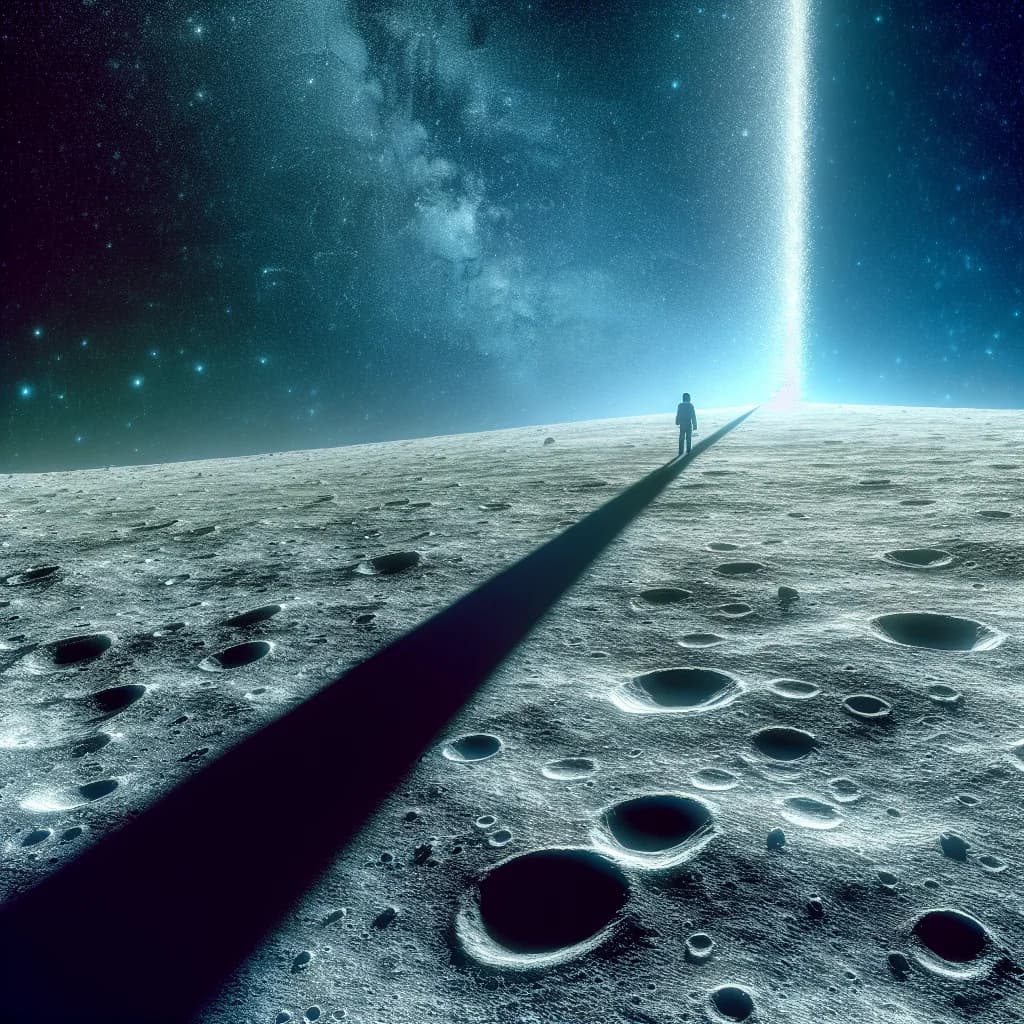
Imagine standing on a vast, dusty horizon where the sun appears as a brilliant but tiny dot in the charcoal sky. You bend your knees, brace yourself, and push off with the same effort you would use to hop over a puddle on a sidewalk. Instead of landing a few feet away, you soar upward, drifting higher and higher until the ground fades beneath you, easily clearing the roof of a five-story apartment complex. This isn't science fiction; it is a direct consequence of the physical laws governing our solar system. In this exploration, we will analyze the gravitational environment of the dwarf planet Ceres—the largest object in the asteroid belt—and use the principles of Newtonian mechanics to explain why you would possess "superhuman" leaping abilities on its surface.
The Monarch of the Asteroid Belt: Understanding Ceres
To understand why you could jump so high, we must first look at the scale of our stage. Ceres is a dwarf planet located between Mars and Jupiter. While it accounts for roughly one-third of the total mass of the entire asteroid belt, it is still a tiny world compared to Earth.
- Diameter: Approximately 940 kilometers (about the width of Texas).
- Mass: Roughly $9.39 \times 10^{21}$ kilograms.
- Surface Composition: A mix of water ice and various hydrated minerals.
Because gravity is a force dictated by mass, the relatively small size of Ceres means its "pull" on your body is significantly weaker than what you experience on Earth. On our home planet, we are accustomed to an acceleration due to gravity ($g$) of approximately $9.8 \text{ m/s}^2$. On Ceres, that value drops to a mere $0.27 \text{ m/s}^2$. This means the gravity on Ceres is about 2.7% of Earth's—or roughly 1/36th the strength.
The Math of the Mega-Jump
When you jump on Earth, your leg muscles exert a force to counteract gravity. For an average healthy adult, a vertical leap of about 0.5 meters (20 inches) is a standard baseline. To calculate how this translates to Ceres, we look at the inverse relationship between gravitational acceleration and height.
Calculating the Height
If we assume you exert the same initial takeoff velocity on both worlds, the formula for the maximum height ($h$) of a jump is $h = v^2 / 2g$. Since the gravity ($g$) on Ceres is 36 times weaker than on Earth, your jump height would be 36 times greater.
- Earth Jump: 0.5 meters.
- Ceres Jump Calculation: $0.5 \text{ m} \times 36 = 18 \text{ meters}$.
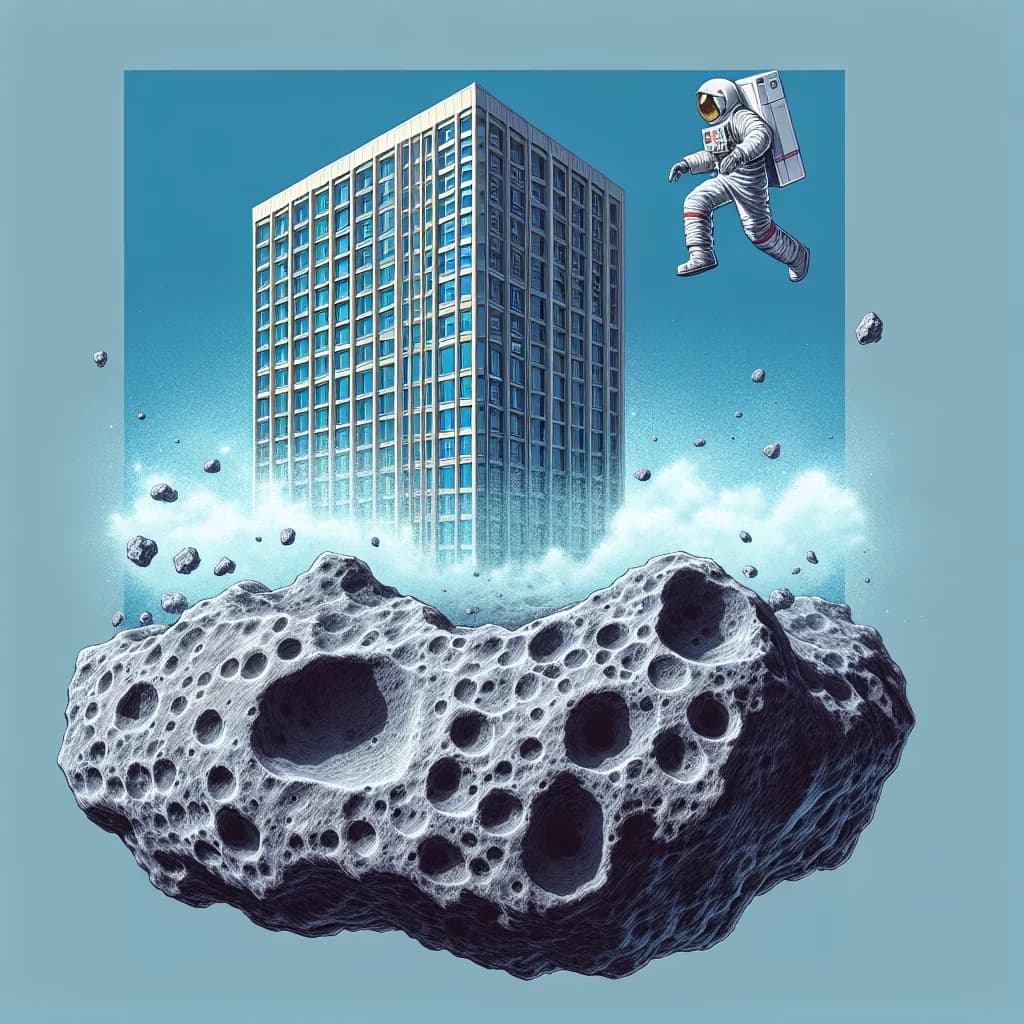
For context, a standard five-story building is typically between 15 and 17 meters tall. By simply exerting the same effort you use for a modest hop on Earth, you would comfortably clear the roof of that building on Ceres.
The Physics of "Hang Time"
On Earth, a jump lasts about half a second. On Ceres, because the downward acceleration is so sluggish, you wouldn’t just jump higher; you would stay in the "air" (or rather, the vacuum) much longer. You would experience a graceful, slow-motion arc, spending several minutes ascending and descending before your boots finally touched the regolith again.
Atmospheric and Physical Constraints
While the math is clear, the environment of Ceres adds fascinating variables to our thought experiment.
The Absence of Air Resistance
On Earth, air resistance slightly limits how high and fast we move. Ceres has no meaningful atmosphere. Without air molecules to bump into, your trajectory would be a "pure" parabola. Every ounce of energy from your legs goes directly into upward motion, making your leap even more efficient than it would be in a pressurized gym on Earth.
The Impact of Equipment
In reality, you would be wearing a pressurized space suit. While these suits are heavy (often exceeding 100 kilograms), their weight is also subject to the 1/36th gravity rule. A 120-kilogram suit on Ceres would feel like it weighs only 3.3 kilograms (about 7 pounds). Your increased strength-to-weight ratio would make you feel incredibly light, even while wearing bulky life-support gear.
Conclusion: A New Perspective on Gravity
Standing on Ceres, the laws of physics transform the mundane act of walking into a series of majestic, soaring glides. Because Ceres possesses only a fraction of Earth’s mass, its gravitational pull is too weak to tether human-scale energy to the ground. By applying the simple ratio of 1:36, we find that a human being becomes a natural high-jumper, capable of clearing five-story structures with ease.
This thought experiment highlights a fundamental truth: our physical capabilities are not absolute but are defined by the world beneath our feet. As we look toward a future of space exploration, understanding these gravitational mechanics is essential for imagining how humans will one day work, move, and even play among the stars. Ceres reminds us that in the right environment, the impossible becomes elementary.