If you stood on Venus, would the thick atmosphere bend light enough to see your own back
Imagine a world where the air is so dense it warps reality, potentially bending light in a complete circle around the planet. Step onto the scorching surface of Venus to discover if this extreme refraction could actually allow you to stare directly at the back of your own head.

Too Long; Didn't Read
Venus’s dense atmosphere causes extreme light refraction that makes the horizon appear to curve upward like a bowl, but it is not powerful enough to bend light all the way around the planet. Atmospheric scattering and absorption would also blur any light long before it could travel far enough for you to see your own back.
The Venusian Optical Loop: Could You See Your Own Back in the Morning Star’s Atmosphere?
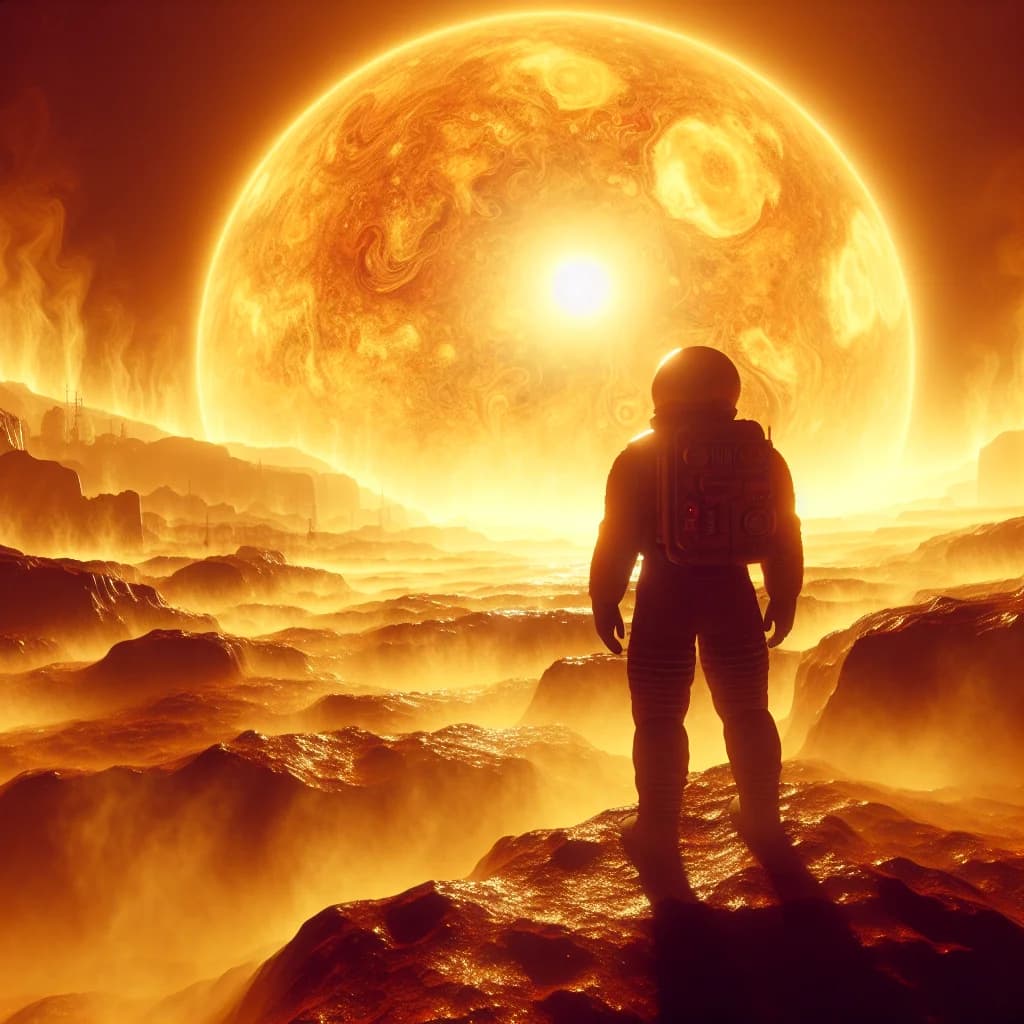
Imagine standing on the surface of Venus. You are shielded from the 900-degree Fahrenheit heat and the crushing pressure of ninety Earth atmospheres by a futuristic suit. As you look out toward the horizon, something strange happens: the ground doesn't seem to drop away. Instead, the landscape appears to curve upward, like the inside of a giant bowl. This leads to a fascinating scientific riddle: is the Venusian atmosphere so thick and dense that it could actually bend light all the way around the planet, allowing you to stare directly at the back of your own head?
To answer this, we must dive into the realms of atmospheric optics and planetary physics. By examining how gas density influences the refractive index of light, we can determine if Venus acts as a global lens or if the laws of physics impose a blurry limit on our interplanetary sight-seeing.
The Science of the "Great Bend"
The phenomenon at the heart of this experiment is refraction. On Earth, we see refraction when a straw looks broken in a glass of water. Light travels slower through denser mediums, causing it to bend. Because Venus’s atmosphere is approximately 92 times denser than Earth's at the surface—comparable to the density of water at a depth of 3,000 feet—it acts like a massive, spherical prism.
Calculating the Curvature
For you to see your own back, a ray of light would have to travel in a complete circle around the planet’s circumference (about 38,000 kilometers). For this "optical orbit" to occur, the atmosphere's refractive index would need to decrease with altitude at a very specific rate.
- The Critical Gradient: On Earth, the atmosphere bends light slightly downward, which is why we can see the sun for a few minutes after it has technically set below the geometric horizon.
- Venusian Refraction: On Venus, the density gradient is much more extreme. Calculations based on the Gladstone-Dale relation (which links gas density to refractive index) suggest that while light bends significantly, it does not quite reach the "critical refraction" point required to circle the entire globe.
- The Resulting Visual: Instead of seeing yourself, you would experience extreme "looming." The horizon would appear to lift up, making you feel as though you were standing at the bottom of a vast, orange-tinted crater.
The Barrier of Rayleigh Scattering
Even if the math allowed for a perfect optical circle, a second physical law would intervene: Rayleigh scattering. This is the same principle that makes Earth’s sky blue, as gas molecules scatter shorter wavelengths of light.
On Venus, the atmosphere is so thick that light doesn't just bend; it gets exhausted.
- Photon Fatigue: By the time a photon traveled even a fraction of the way around Venus, it would have collided with billions of carbon dioxide molecules.
- Diffusion: This scattering turns directed light into a diffused, directionless glow. If you tried to look for your back, you wouldn't see a clear image; you would see a thick, murky orange fog.
- Visibility Limits: Estimates suggest that visibility on the Venusian surface is limited to a few kilometers at best. The light required to show you your own reflection would be absorbed and scattered into heat long before it completed its 38,000-kilometer marathon.
A World of "Looming" Horizons
While you cannot see your own back, the actual optical reality of Venus is still breathtakingly strange. Because of the high refractive index, light rays from distant objects are bent downward toward the surface. This creates a perpetual mirage. If there were a mountain a hundred miles away, the atmosphere might bend the light just enough to pull that mountain up over the horizon and into your line of sight. On Venus, the "horizon" is not a physical edge, but a fading gradient where the atmosphere finally becomes too thick to see through.
Conclusion
Ultimately, the dream of seeing your own back on Venus remains a theoretical impossibility. While the planet’s crushing atmosphere performs impressive optical gymnastics, it lacks the perfect density gradient to loop light in a full circle. Furthermore, the sheer thickness of the air acts as an impenetrable curtain, scattering light until all shapes dissolve into a dim, amber haze.
This thought experiment highlights the incredible diversity of our solar system. It reminds us that "vision" is not just about our eyes, but about the medium through which light travels. Venus may not be a perfect mirror, but its ability to warp the very horizon reminds us that on other worlds, even the simplest act of looking forward can be a journey into the extraordinary.