If you threw a baseball at ninety percent the speed of light, why would it create a nuclear explosion
At 90% the speed of light, a simple game of catch transforms the air itself into a fusion reactor, leveling everything in its path before the batter can even blink. Discover the terrifying physics that turn a standard baseball into a city-shattering nuclear event.

Too Long; Didn't Read
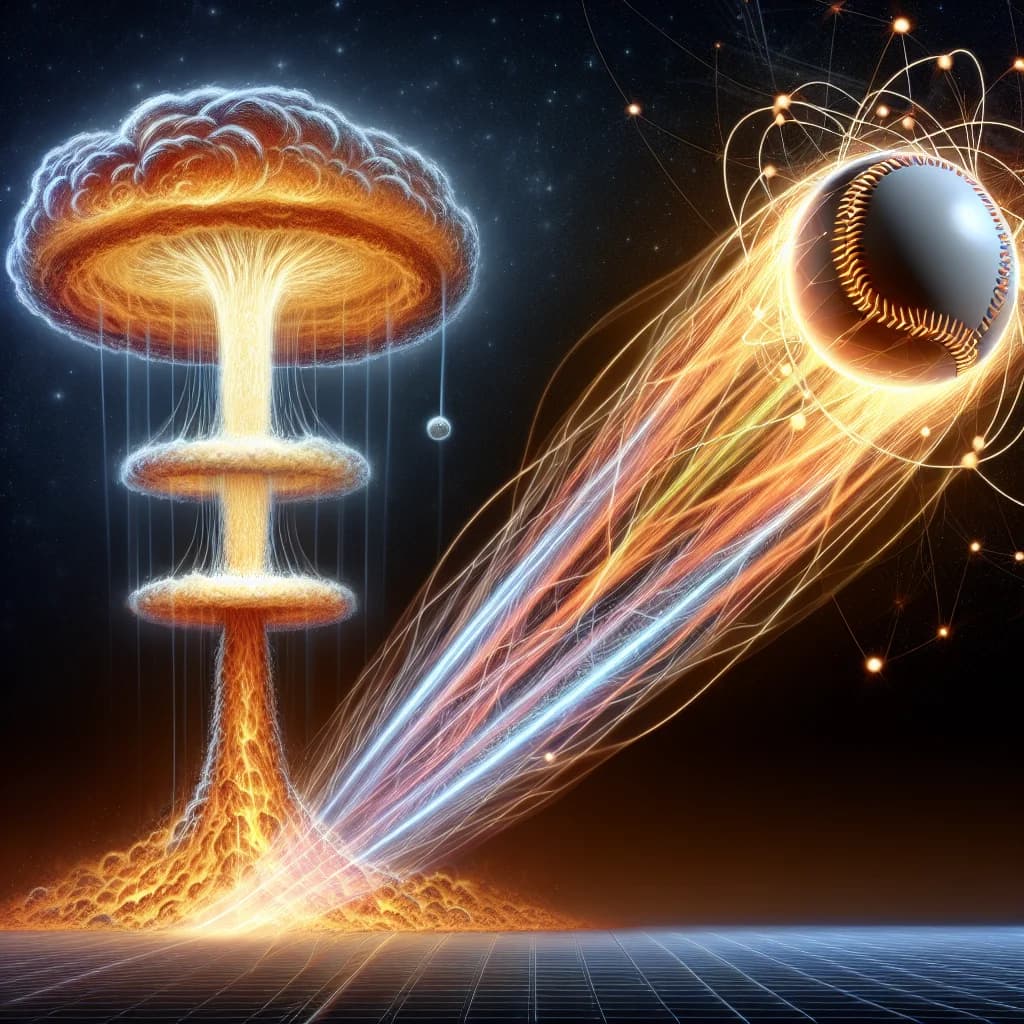
At 90% the speed of light, air molecules collide with the ball so violently that they trigger nuclear fusion. This creates a massive surge of gamma radiation and X-rays, transforming the ball into an expanding cloud of plasma and resulting in a devastating nuclear-scale explosion before it even reaches the batter.
The Ultimate Fastball: Why a Near-Light-Speed Pitch Would Trigger a Nuclear Event
Imagine a pitcher stepping onto the mound, winding up, and releasing a standard major-league baseball. However, instead of the usual 95 miles per hour, this ball leaves the hand at ninety percent of the speed of light (approximately 604 million miles per hour). At these relativistic speeds, the mundane rules of a Sunday afternoon ballgame vanish, replaced by the high-energy physics usually reserved for particle accelerators and distant stars.
This thought experiment explores what happens when a 142-gram object interacts with a nitrogen-rich atmosphere at 0.9c. By applying the principles of special relativity, fluid dynamics, and nuclear physics, we can determine why this "fastball" wouldn't just break the sound barrier—it would fundamentally alter the local environment through a massive release of energy.
The Physics of Relativistic Motion
In everyday life, we calculate kinetic energy using the formula $1/2mv^2$. However, as an object approaches the speed of light, we must use Einstein’s equations for relativistic kinetic energy. At ninety percent the speed of light, the baseball’s "Lorentz factor" (a measure of how much time, mass, and energy shift) is roughly 2.29.
This means the baseball isn't just moving fast; it possesses far more energy than its rest mass would suggest. To put this in perspective:
- Energy Output: The kinetic energy of the ball would be approximately $1.6 \times 10^{16}$ Joules.
- Real-World Metric: This is equivalent to roughly 4 megatons of TNT.
For context, that is hundreds of times more powerful than the energy released by conventional large-scale explosive devices, all packed into the volume of a leather-stitched sphere.
When Air Becomes a Solid Wall
Normally, a baseball moves through the air by pushing gas molecules out of its path. Aerodynamics handles the rest. But at 0.9c, the air molecules simply do not have time to move. The ball is traveling so fast that it essentially "outruns" the pressure waves it creates.
To the baseball, the atoms in the atmosphere (mostly nitrogen and oxygen) aren't a gas—they are a stationary wall of individual nuclei. As the ball moves forward, it undergoes a series of constant, violent collisions with these atoms. Because of the immense velocity, these are not mere mechanical bumps; they are high-energy particle collisions.
The Onset of Fusion
The most fascinating aspect of this scenario is the transition from chemistry to nuclear physics. When the atoms of the baseball hit the atoms of the air at 0.9c, the force of the collision overcomes the electrostatic repulsion between the atomic nuclei.
- Nuclear Fusion: The nuclei of the baseball's carbon and the air's nitrogen are forced together so violently that they undergo nuclear fusion.
- Gamma Radiation: Each collision releases a burst of gamma rays and high-energy particles.
- Plasma Formation: Within microseconds, the baseball is no longer a solid object. It becomes an expanding cloud of incandescent plasma, growing in volume as it consumes the air in front of it.
The Atmospheric Chain Reaction
As the ball—now a sphere of expanding plasma—continues its journey, it creates a localized "fusion bubble." The intense X-ray and gamma-ray emission strips electrons from surrounding air molecules, turning the immediate atmosphere into a blindingly bright, superheated ionized gas.
While the ball technically "travels" toward the plate, it is actually being consumed by the very energy it generates. A spherical shockwave of energy begins to expand outward from the path of the ball. In a clinical sense, the "explosion" is the result of the atmosphere reacting to a sudden, massive injection of kinetic energy that has nowhere else to go but into the thermal and radiant spectrum.
Conclusion
The transformation of a simple game of catch into a nuclear-scale event is a direct consequence of the laws of special relativity. When an object with mass is accelerated to ninety percent of light speed, its kinetic energy becomes so vast that the boundary between "matter" and "energy" begins to blur. The "explosion" is simply the result of that energy being transferred to the atmosphere through nuclear fusion and high-energy particle interactions.
While we are unlikely to see a 0.9c pitch in the Major Leagues anytime soon, this scenario serves as a brilliant reminder of the incredible energy contained within the fabric of our universe. It demonstrates that the laws of physics are not just guidelines—they are the fundamental rules that turn a simple throw into a cosmic display of power.