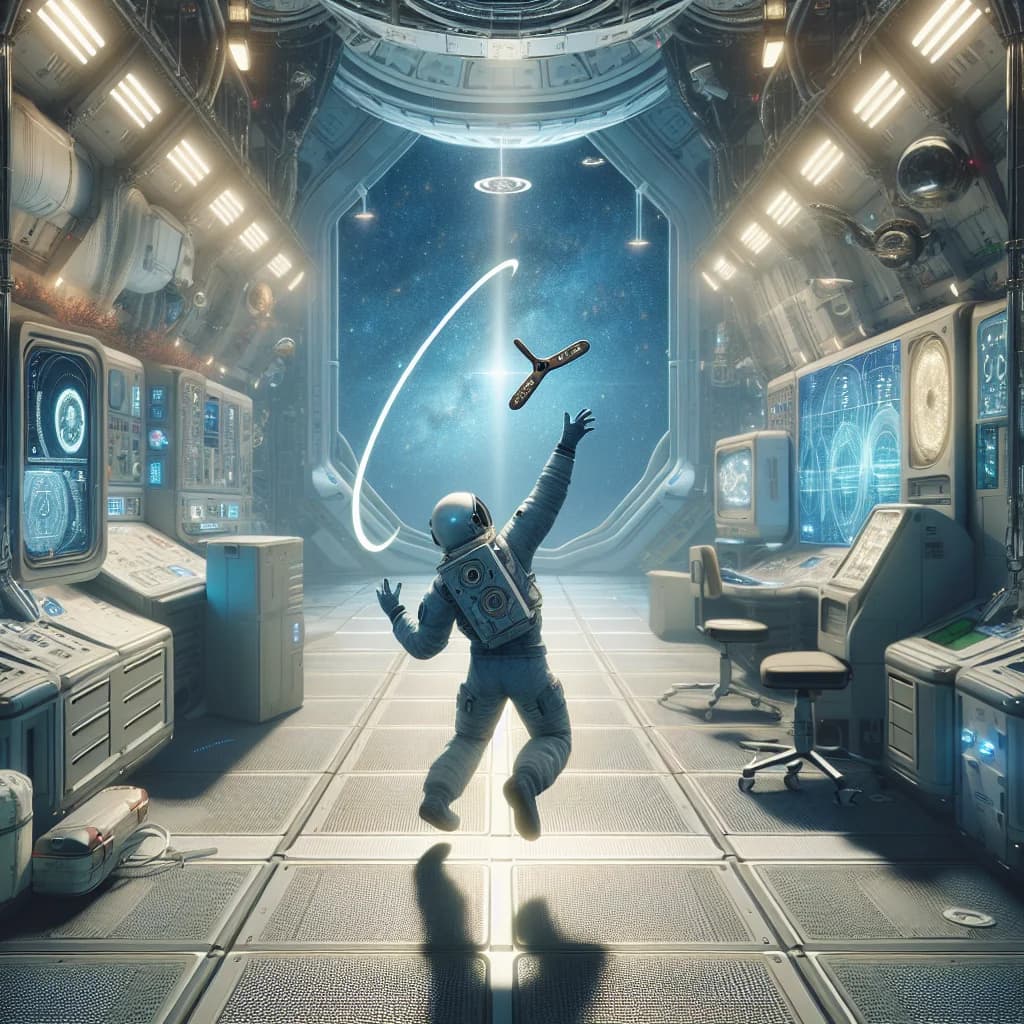
If you threw a boomerang inside a space station, why would it still return to your hand
Think zero gravity would send a boomerang sailing into infinity? Discover the surprising physics of air pressure that force this iconic toy to pull a perfect U-turn, even while orbiting 250 miles above Earth.

Too Long; Didn't Read
A boomerang returns inside a space station because it relies on air, not gravity, to function. The station’s pressurized atmosphere provides the necessary gas for the spinning blades to generate aerodynamic lift and gyroscopic precession. Without gravity pulling it downward, the boomerang follows its curved flight path back to the thrower even more easily than it does on Earth.
Zero-G Curves: Why a Boomerang Thrown in Space Still Comes Back to You
Imagine you are floating aboard the International Space Station (ISS), 250 miles above the Earth’s surface. In your hand, you hold a traditional returning boomerang. In an environment where "up" and "down" have lost their meaning and water beads into floating spheres, common sense might suggest that a boomerang would simply sail away in a straight line or tumble chaotically into a storage rack. However, physics tells a different story.
The question of whether a boomerang returns in microgravity isn't just a whimsical thought experiment; it is a fascinating dive into fluid dynamics and classical mechanics. To understand why a boomerang still functions in orbit, we must look beyond the absence of gravity and focus on the two primary pillars of its flight: aerodynamic lift and gyroscopic precession. This post will analyze how these forces interact within the pressurized atmosphere of a space station to bring the projectile back to its starting point.
It’s All About the Air, Not the Weight
The most common misconception about boomerangs is that they require gravity to function. In reality, a boomerang is a flying machine, much like an airplane. For a boomerang to work, it requires an atmosphere—a medium through which its wings can move to generate force.
Inside the ISS, the environment is pressurized to approximately 101.3 kilopascals (14.7 psi), which is nearly identical to the atmospheric pressure at sea level on Earth. Because the station is filled with a standard nitrogen-oxygen mix, the physical "tools" a boomerang needs to operate are fully present.
The Two Pillars of Boomerang Flight
To understand the return flight, we have to look at the interaction of two specific scientific principles:
1. Aerodynamic Lift (The Bernoulli Principle)
A boomerang’s arms are shaped like airfoils—curved on the top and flat on the bottom. As the boomerang spins and moves forward, air flows faster over the curved surface, creating a difference in pressure. This generates lift. On Earth, we use this lift to counteract gravity. In a space station, that lift is simply a force pushing the boomerang "sideways" relative to its spin axis.
2. Gyroscopic Precession
This is the "secret sauce" of the boomerang. When you throw a boomerang, the wing at the top of the spin is moving forward through the air faster than the wing at the bottom (because the top wing’s rotational speed is added to the throw speed).
- Earth Metric: If you throw a boomerang at 30 mph and it spins at 30 mph, the top wing effectively moves at 60 mph while the bottom wing is at 0 mph relative to the air.
- The Resulting Torque: This creates more lift on the top than the bottom. In physics, when you apply force to a spinning object, the result is "precession"—the object turns at a right angle to the force. This constant "nudging" causes the flight path to curve into a circle.
The Microgravity Advantage
In a terrestrial environment, a thrower must tilt the boomerang slightly to create upward lift to fight Earth’s constant 9.8 m/s² gravitational pull. If the lift isn't strong enough, the boomerang hits the ground before completing its arc.
Inside a space station, the "cascading consequence" of microgravity is actually a simplified flight path:
- No "Drop": Because there is no significant gravitational force pulling the object toward the floor, the boomerang does not need to generate upward lift to stay aloft.
- Pure Geometry: The boomerang will follow a much more "perfect" circular path. Without gravity dragging it down, it will orbit around a central point in the air until the friction of the air (drag) eventually slows its spin and forward momentum.
Conclusion
The scientific outcome of our orbital experiment is clear: a boomerang thrown inside a space station will indeed return to the thrower. This happens because the return mechanism is powered by aerodynamic lift and gyroscopic precession, both of which rely on the presence of air, not the presence of gravity.
By applying the laws of fluid dynamics, we see that the ISS is essentially a laboratory where the "noise" of gravity is removed, allowing the elegant geometry of angular momentum to take center stage. This thought experiment reminds us that many of the physical behaviors we observe on Earth are not dictated by the ground beneath our feet, but by the invisible sea of air that surrounds us—even when that air is trapped in a metal cylinder hurtling through the vacuum of space.