If you threw a boomerang inside the International Space Station, would it still return to your hand
In a world without "up" or "down," does the most iconic returning toy still find its way back to your hand? Discover the mind-bending physics of what happens when you throw a boomerang in the weightless halls of the International Space Station.

Too Long; Didn't Read
Yes, a boomerang thrown inside the ISS will return to the thrower. Because the station is filled with air, the aerodynamic lift and gyroscopic precession required for its curved flight path still function. Gravity is not what makes a boomerang return; rather, it is the interaction between the spinning blades and the surrounding atmosphere.
Gravity-Defying Returns: What Happens if You Throw a Boomerang Inside the International Space Station?
Imagine you are floating 250 miles above the Earth’s surface, encased in a multi-billion dollar pressurized laboratory hurtling through the vacuum at 17,500 miles per hour. In your hand, you hold one of humanity's oldest aerodynamic inventions: the boomerang. If you were to give it a sharp, spinning flick across the laboratory module, would it behave like its terrestrial counterparts and arc back to your hand, or would it simply fly straight until it collided with a multi-million dollar computer screen? This thought experiment isn't just a whimsical "what if"; it is a fascinating dive into the physics of flight. By analyzing the intersection of fluid dynamics, gyroscopic precession, and microgravity, we can determine exactly how this ancient hunting tool navigates a high-tech, weightless environment.
The Essential Ingredient: An Atmosphere to Move In
The first thing to understand is that a boomerang does not require gravity to function; it requires air. The International Space Station (ISS) is not a vacuum. To keep astronauts alive, the modules are pressurized to approximately 14.7 pounds per square inch (psi), which is the same atmospheric pressure we experience at sea level on Earth.
Because the ISS is filled with a standard nitrogen-oxygen mix, the boomerang’s wings (or "blades") have a medium to interact with. As the boomerang spins, the shape of these blades—which are essentially airfoils—generates lift. On Earth, this lift opposes the force of gravity to keep the boomerang airborne. In the ISS, where gravity is not pulling the object toward a floor, that lift becomes the primary force dictating the object's trajectory.
The Physics of the Curve: Lift and Precession
The "return" of a boomerang is governed by two main scientific principles: Bernoulli's principle and gyroscopic precession.
Bernoulli’s Principle and Differential Lift
As a boomerang spins and moves forward, the wing moving "forward" into the wind experiences a higher relative airspeed than the wing moving "backward." According to Bernoulli’s principle, this higher velocity results in more lift on the upper half of the spin than the lower half.
Gyroscopic Precession
On Earth, you might expect this unequal lift to simply flip the boomerang over. However, because the boomerang is spinning, it acts like a gyroscope. When a force is applied to a spinning object, the result is felt 90 degrees later in the direction of the rotation. This is called gyroscopic precession. Instead of flipping, the unequal lift creates a constant torque that turns the boomerang's flight path into a circle.
In the microgravity environment of the ISS, this circular path remains intact. Without the downward pull of gravity to complicate the flight path or drag the boomerang to the ground, the aerodynamic forces are actually "purer."
Real-World Application: The Doi Experiment
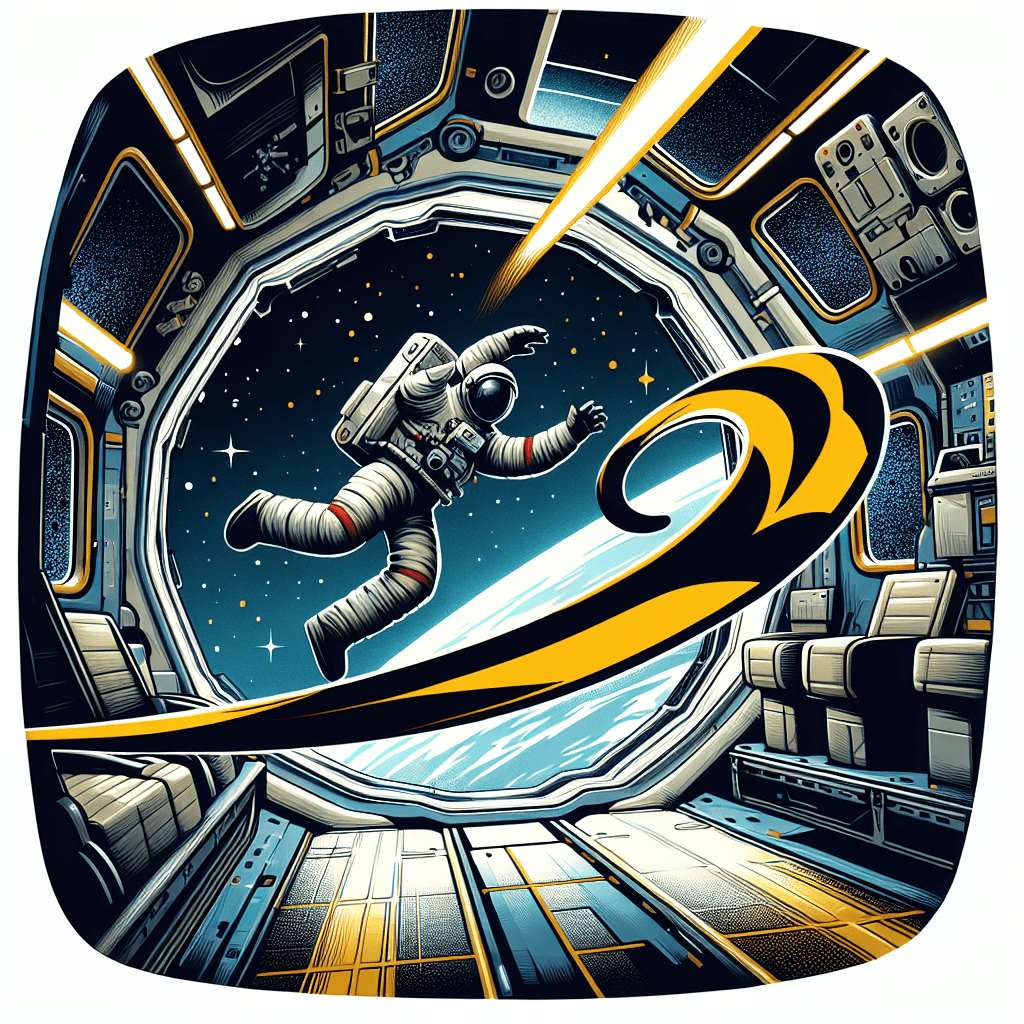
This scenario isn't entirely hypothetical. In 2008, Japanese astronaut Takao Doi performed this exact experiment in the Japanese Experiment Module (Kibo) on the ISS. Using a small paper boomerang, Doi demonstrated that the tool behaves exactly as physics predicts.
- The Launch: Doi flicked the boomerang with a high rate of spin.
- The Arc: The boomerang followed a tight, curved trajectory.
- The Return: Despite the absence of a "down" direction, the boomerang completed its circle and returned toward the astronaut.
The scale of the flight is the only major constraint. A standard Australian hunting boomerang might require a flight path with a diameter of 20 to 30 meters. Since the Kibo module is only about 11 meters long and 4 meters wide, a full-sized boomerang would likely hit a bulkhead before completing its circuit. However, a smaller model—scaled to the interior volume of the station—works perfectly.
Conclusions: A Universal Law of Flight
The ultimate scientific outcome is a resounding "yes": a boomerang thrown inside the International Space Station will return to the thrower. This occurs because the return mechanism is dependent on the interaction between the boomerang's shape and the air molecules around it, rather than the gravitational pull of the planet beneath it.
The core principles of gyroscopic precession and differential lift are universal. Whether you are standing in a park in Sydney or floating in a laboratory in low Earth orbit, the laws of physics remain consistent. This experiment serves as a beautiful reminder that even in the most "alien" environments we have ever inhabited, the fundamental mechanics that govern our world travel with us. It bridges the gap between ancient human ingenuity and the cutting edge of space exploration, proving that science is, quite literally, everywhere.