If you threw a bucket of water onto a neutron star, would it explode more powerfully than a nuclear bomb
Think a simple splash of water is harmless? When dropped onto a neutron star, that single bucket transforms into an explosion so violent it makes our most powerful nuclear weapons look like mere firecrackers.

Too Long; Didn't Read
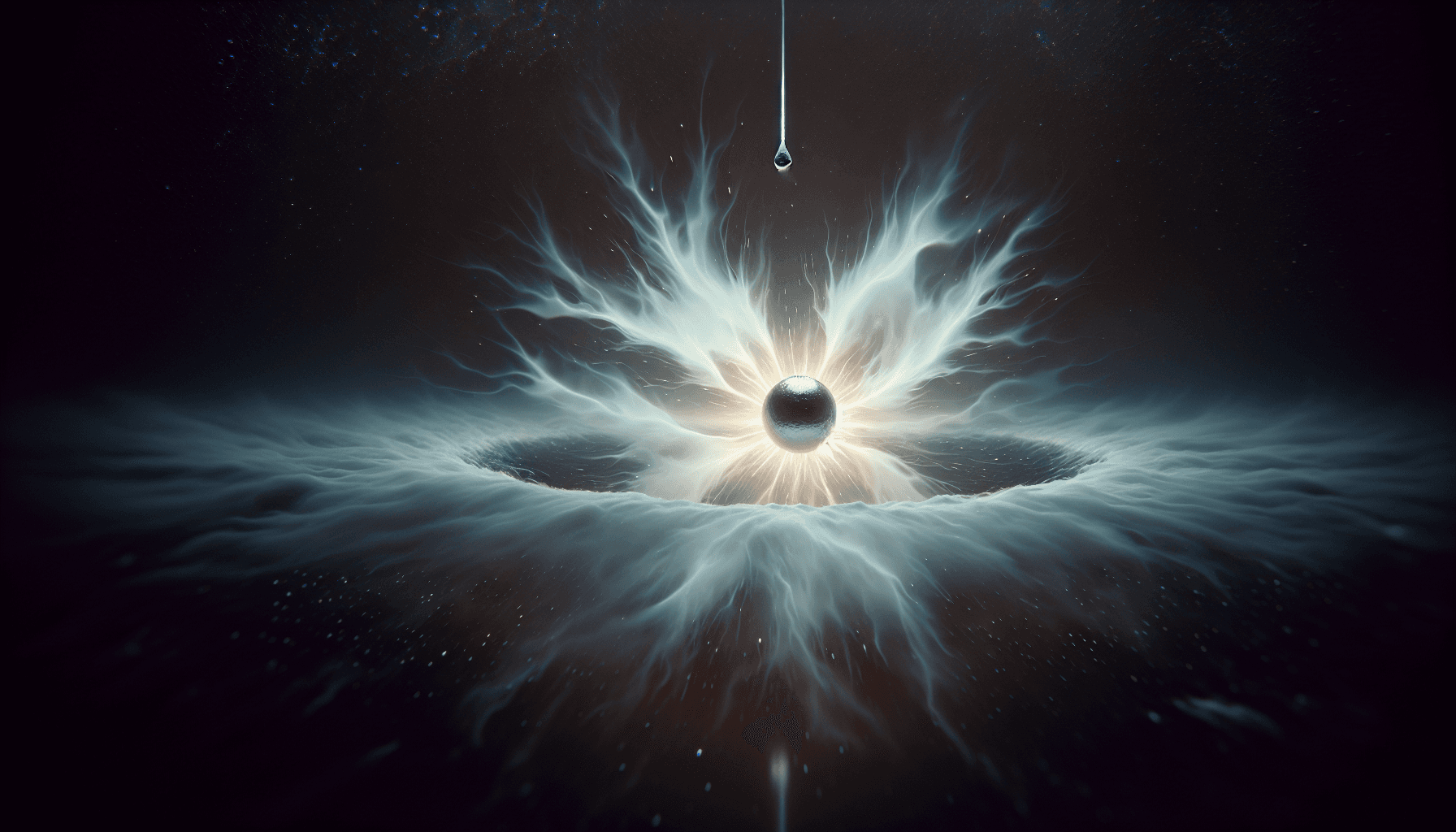
Yes, throwing a bucket of water onto a neutron star would create an explosion far more powerful than any nuclear bomb. The star’s extreme gravity accelerates the water to roughly half the speed of light, causing it to release a massive burst of energy upon impact equivalent to a multi-megaton blast.
The Ultimate Splash: Would a Bucket of Water on a Neutron Star Outshine a Nuclear Bomb?
Imagine, for a moment, that you are hovering in a specialized spacecraft a safe distance from a neutron star. In your hand—or perhaps held by a robotic arm—is a standard, 10-liter bucket of household tap water. You tip the bucket, letting the water tumble toward the star's surface. In our everyday experience, this would result in a simple splash. However, in the realm of extreme astrophysics, this mundane act triggers an event of staggering proportions.
To analyze this scenario, we must look at the foundational parameters of neutron stars: objects so dense that a single teaspoon of their material would weigh about a billion tons. By applying the laws of gravitational potential energy and relativistic mechanics, we can determine exactly how much energy that "splash" would release. The short answer? You are about to witness one of the most efficient energy conversions in the known universe.
Gravity on Steroids: The Neutron Star Environment
To understand the fate of our bucket of water, we first have to look at the "floor" it’s falling toward. A neutron star is the collapsed core of a massive sun, packing roughly 1.4 times the mass of our Sun into a sphere only about 20 kilometers in diameter.
Because so much mass is packed into such a tiny space, the gravitational pull at the surface is unimaginably strong—roughly 200 billion times stronger than Earth's gravity. When you drop something onto a neutron star, it doesn't just fall; it is accelerated to "relativistic speeds," meaning speeds that are a significant fraction of the speed of light.
The Physics of the Fall: Kinetic Energy Unleashed
When our 10-kilogram bucket of water begins its descent, the star's gravity begins to work on it immediately. As it nears the surface, the water is accelerated to approximately 100,000 kilometers per second—roughly one-third the speed of light.
In physics, the energy of an object in motion is called kinetic energy. Because the velocity is so high, the kinetic energy of our water bucket becomes astronomical. We can estimate the energy release using the principles of gravitational potential energy:
- Mass (m): 10 kilograms (the water).
- Velocity (v): ~100,000,000 meters per second.
- Energy Output: Impacting a neutron star converts about 10% to 20% of an object's rest mass directly into energy.
By the time the water hits the "crust" of the neutron star, it is no longer liquid. The tidal forces would have shredded the water molecules into a stream of atoms, and eventually, a plasma of subatomic particles, long before impact.
The Big Bang in a Small Bucket
So, how does this compare to a nuclear bomb? On Earth, a nuclear weapon like the one used in Hiroshima released about 63 Terajoules of energy.
When our 10kg bucket of water hits the neutron star, the conversion of its kinetic energy into thermal energy and radiation is incredibly efficient. Using the estimation that 10% of the mass is converted to energy via the formula $E=mc^2$:
- Mass: 10 kg
- Efficiency: 10% (1 kg of mass-energy equivalent)
- Result: Roughly $9 \times 10^{16}$ Joules.
To put that in perspective, our bucket of water would produce an explosion roughly 1,400 times more powerful than the Hiroshima blast. This single bucket of water would release more energy than several of the largest hydrogen bombs ever detonated on Earth combined.
The Aftermath: A Flash in the Dark
The "explosion" wouldn't look like a fireball in the way we see them in movies. Because the gravity is so intense, the energy can’t expand outward in a giant mushroom cloud. Instead, the impact creates:
- A Massive X-ray Burst: The kinetic energy is converted almost instantly into high-energy X-rays and gamma rays.
- Instant Assimilation: The water doesn't "puddle." The hydrogen and oxygen nuclei are instantly crushed and incorporated into the star's exotic crust, becoming part of the ultra-dense neutron degenerate matter.
- A Localized Hotspot: For a brief moment, the impact site would glow with an intensity that could be seen across the galaxy if our telescopes were pointed in the right direction.
Conclusion
Throwing a bucket of water onto a neutron star would indeed result in an explosion vastly more powerful than a nuclear bomb. This happens not because of a chemical or nuclear reaction within the water itself, but because of the sheer gravitational power of the neutron star transforming motion into raw energy.
This thought experiment highlights the incredible "efficiency" of gravity. While humans have learned to split the atom to release energy, nature simply needs to drop a bit of matter onto a dense star to achieve results that are orders of magnitude more spectacular. It serves as a humbling reminder that in the vast laboratory of the cosmos, even the most ordinary substances can become sources of extraordinary power.