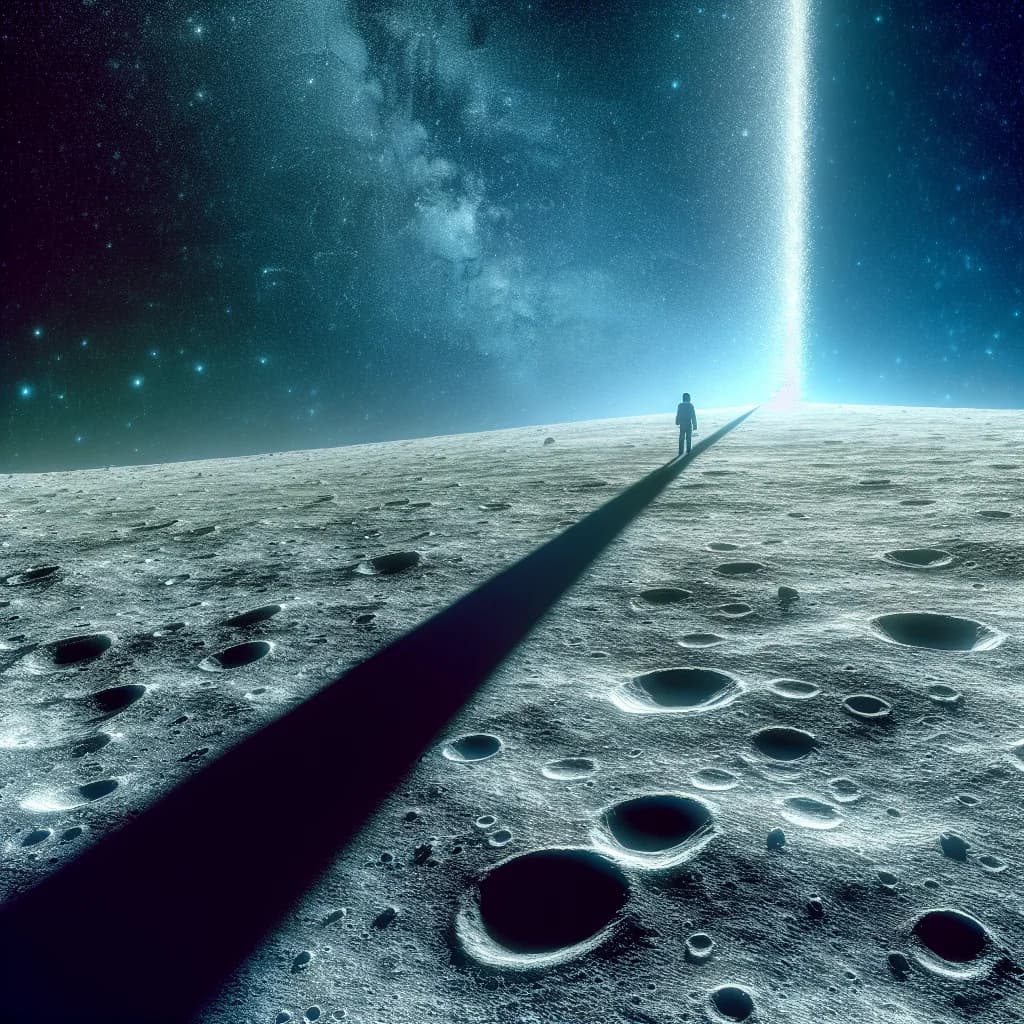
If you traveled back in time, why would Earth’s movement through space leave you stranded in a vacuum
Think time travel is just about the date? If you don’t account for the Earth’s breakneck speed through the cosmos, your trip to the past won't lead to history—it will leave you floating in the deadly silence of deep space.


Too Long; Didn't Read
Time travel often ignores that Earth is constantly moving. Because the planet orbits the Sun and the Sun orbits the galaxy, jumping through time without accounting for these spatial shifts would leave you at your original coordinates in the empty vacuum of space while Earth is millions of miles away.
Where Did the World Go? Why Time Travel Without a Spacecraft Might Leave You Stranded
In popular films, time travelers step into a machine, a flash of light occurs, and they reappear in the exact same spot—just fifty years in the past. It is a convenient narrative device, but it ignores a fundamental reality of our universe: Earth is never in the same place twice. If you built a device that only moved you through the fourth dimension (time) without accounting for the other three (space), you wouldn't find yourself in a vintage town square. Instead, you would likely find yourself floating in the silent, dark vacuum of space, watching a distant blue dot recede into the darkness.
To understand why, we must look at the principles of celestial kinematics and the complex, high-velocity "dance" Earth performs through the cosmos. By applying basic physics and orbital mechanics, we can calculate just how far the ground moves beneath our feet every single second.
The Triple Threat of Celestial Motion
Earth is not a stationary platform; it is a high-speed vehicle participating in several different races simultaneously. When we talk about "staying in the same place," we have to ask: relative to what?
1. The Daily Spin
Even if we ignore Earth’s journey around the Sun, the planet is constantly rotating on its axis. At the equator, the Earth’s surface moves at approximately 1,600 kilometers per hour (1,000 mph). If you traveled just one hour back in time and remained stationary in space, the Earth would have rotated 1,600 kilometers away from your position. You wouldn't be in your backyard; you would be hovering over a completely different longitude, or more likely, thousands of meters above or below the surface.
2. The Orbital Sprint
The most significant hurdle for any aspiring time traveler is Earth’s orbital velocity. Our planet zips around the Sun at a staggering average speed of 30 kilometers per second (67,000 mph).
To put that into perspective:
- In one minute, Earth moves 1,800 kilometers.
- In one hour, Earth travels 108,000 kilometers—roughly one-fourth of the distance to the Moon.
- In one day, the planet moves over 2.5 million kilometers.
If your time machine does not have a "GPS" that tracks the Earth's orbit, a one-day trip into the past would leave you millions of kilometers away from any solid ground.
3. The Galactic Drift
Even if you timed your jump to be exactly one year in the past—hoping to catch the Earth when it returns to the same spot in its orbit—you would still be out of luck. The entire solar system is orbiting the center of the Milky Way galaxy at about 230 kilometers per second (514,000 mph). Furthermore, our galaxy is moving toward the Great Attractor at roughly 600 kilometers per second.
Because of this "galactic drift," the Earth never occupies the same coordinates in space twice. The "spot" where Earth was a year ago is now hundreds of millions of kilometers behind us in the cosmic rearview mirror.
Calculating the Displacement
To visualize the scale of this problem, let’s look at a "short" jump of one year into the past.
- Orbital Displacement: ~940 million kilometers (total path length).
- Galactic Displacement: ~7.2 billion kilometers.
When you combine these vectors, the "stationary" point in space where you stood a year ago is now a vast, empty void. To successfully travel through time and land on Earth, your machine would actually need to be a Teleporting Space-Time Calculator. It would have to calculate the precise gravitational influences, the eccentricity of Earth’s orbit, and the constant expansion of the universe to "aim" you at a moving target that is thousands of times faster than a speeding bullet.
Conclusion
The ultimate scientific outcome of a "simple" time jump is a spatial mismatch of astronomical proportions. The laws of inertia and celestial mechanics dictate that because everything in the universe is in constant, multi-layered motion, time and space are inextricably linked. You cannot navigate one without accounting for the other.
This thought experiment serves as a brilliant reminder of the fascinating reality of our existence. While we feel like we are standing still, we are actually passengers on a magnificent, high-speed organic spaceship, hurtling through the cosmos at millions of kilometers per day. Any successful time traveler wouldn't just need a clock—they would need the most sophisticated map ever conceived.