If you unraveled every strand of DNA in your body, would the total length reach past the planet Pluto
Your DNA may be microscopic, but unraveled, its total length is so vast it doesn't just reach Pluto—it could make the round trip to the edge of our solar system several times over. Discover the mind-bending scale of the astronomical bridge hidden inside your very own cells.

Too Long; Didn't Read
Yes, if you unraveled all the DNA in your body, it would stretch approximately 74 billion kilometers. This is long enough to reach past Pluto and back to Earth six times over.
The Cosmic Blueprint: If You Unraveled Your DNA, Would It Reach Past Pluto?
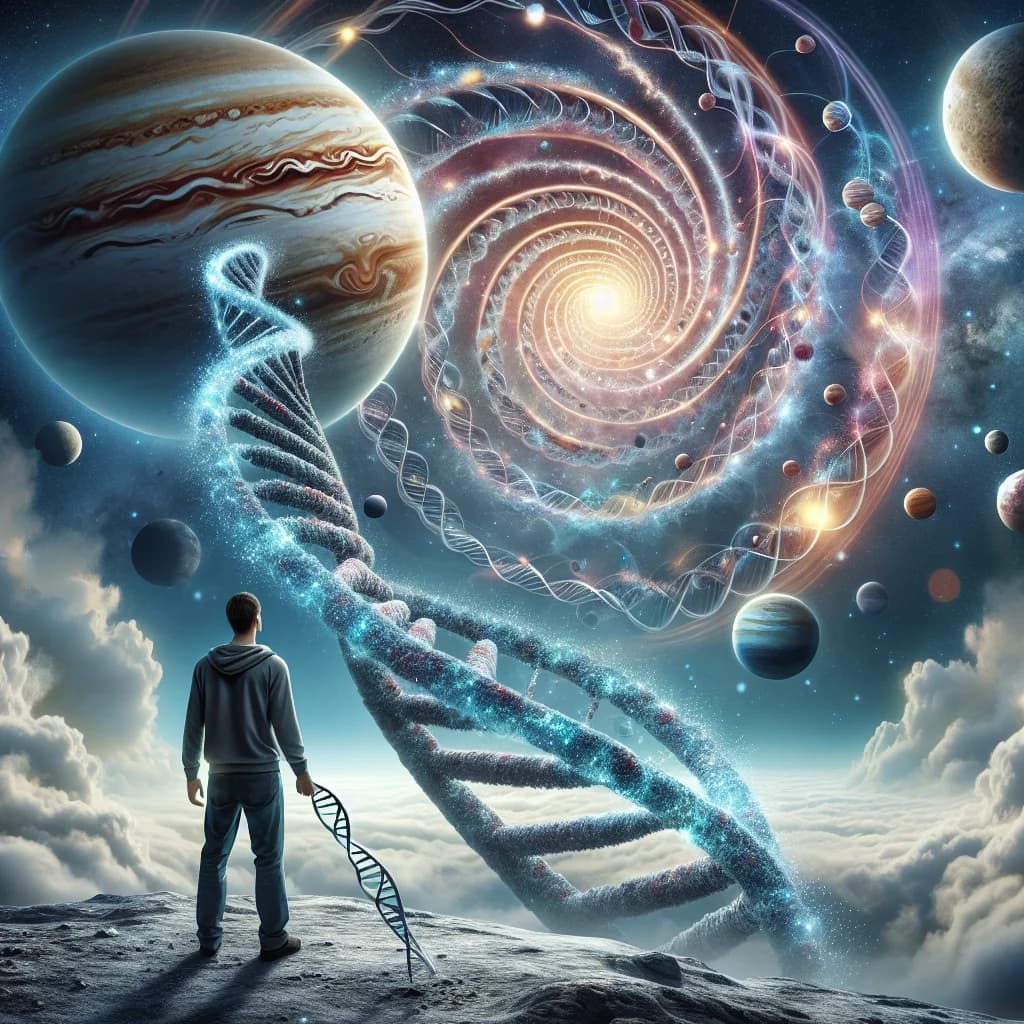
Imagine for a moment that you are a biological magician. With a snap of your fingers, you can reach into every single cell of your body, extract the tightly coiled strands of DNA, and tie them end-to-end to create one continuous, microscopic thread. As you begin to spool this thread out into the dark vacuum of space, you pass the Moon, leave the scorched surface of Mercury behind, and sail past the rings of Saturn. The question is: where does the thread end? Does it fall short of the outer reaches of our solar system, or does it stretch past the icy plains of Pluto?
To answer this, we must dive into the fascinating intersection of cellular biology and astrophysics. By calculating the total length of the human genome and comparing it to the vast distances of our celestial neighborhood, we can reveal the staggering scale of the blueprints that make you, "you."
The Microscopic Yardstick: Measuring One Cell
Every human body is a masterpiece of biological engineering, but the sheer scale of our internal components is often difficult to grasp. Within the nucleus of nearly every cell in your body lies a complete set of genetic instructions. If you were to take the DNA from a single diploid cell and stretch it out into a straight line, it would measure approximately two meters (about 6.5 feet) in length.
While two meters might not seem like a galactic distance, it is an incredible feat of natural packaging. This thread is only about two nanometers wide—so thin that if it were the thickness of a piece of sewing thread, the two-meter strand would be equivalent to several miles long in proportion.
Doing the Galactic Math
To find our total length, we must determine how many "two-meter threads" are currently working inside you. While estimates vary slightly based on body size and health, scientific consensus (such as the 2013 study published in Annals of Human Biology) suggests that the average adult human body contains approximately 37.2 trillion cells.
Let’s look at the calculation:
- Length per cell: 2 meters
- Total cells: 37,200,000,000,000
- Total length: 74,400,000,000,000 meters
When we convert this into kilometers, the number remains gargantuan: 74.4 billion kilometers. To put that in perspective, a billion is a thousand millions. We are talking about a biological bridge spanning 74,400 million kilometers.
Destination: The Edge of the Solar System
Now, we must compare our 74.4 billion-kilometer thread to the geography of our solar system.
- The Distance to Pluto: Pluto travels in an elliptical orbit, but its average distance from the Sun is approximately 5.9 billion kilometers.
- The Round Trip: If you started your DNA thread at the Sun and stretched it toward Pluto, you wouldn't just reach the dwarf planet; you would pass it, turn around, and come back.
- Multiple Journeys: In fact, 74.4 billion divided by 5.9 billion equals roughly 12.6.
This means your DNA is long enough to stretch from the Sun to Pluto and back again six times. If you prefer a closer target, consider the Sun itself. The average distance to the Sun is 150 million kilometers. Your DNA could make the round trip to our star about 248 times.
The Magic of Biological Compaction
How does a 74-billion-kilometer thread fit inside a human body without creating a tangled mess? The answer lies in a sophisticated biological "spooling" system.
- Histones: DNA doesn't just float freely; it wraps around proteins called histones.
- Chromatin: These wrapped "beads on a string" fold further into a structure called chromatin.
- Supercoiling: The chromatin loops and folds again and again in a process called supercoiling, eventually forming the dense chromosomes we see under a microscope.
This level of organization is so efficient that the DNA remains accessible for reading and copying, yet stays compact enough to fit into a space smaller than the point of a needle.
Conclusion
The scientific verdict is clear: your DNA does not just reach past Pluto; it could complete the journey multiple times over. This thought experiment highlights the incredible density of information and structure within the human body. By applying simple mathematics to cellular biology, we discover that every human being carries a "cosmic" amount of data within them.
The next time you look up at the night sky and feel small in the face of the vast universe, remember the 74 billion kilometers of life-coding thread tucked away inside your cells. You aren't just a spectator in the universe; in terms of complexity and scale, you are a pocket of the cosmos yourself.