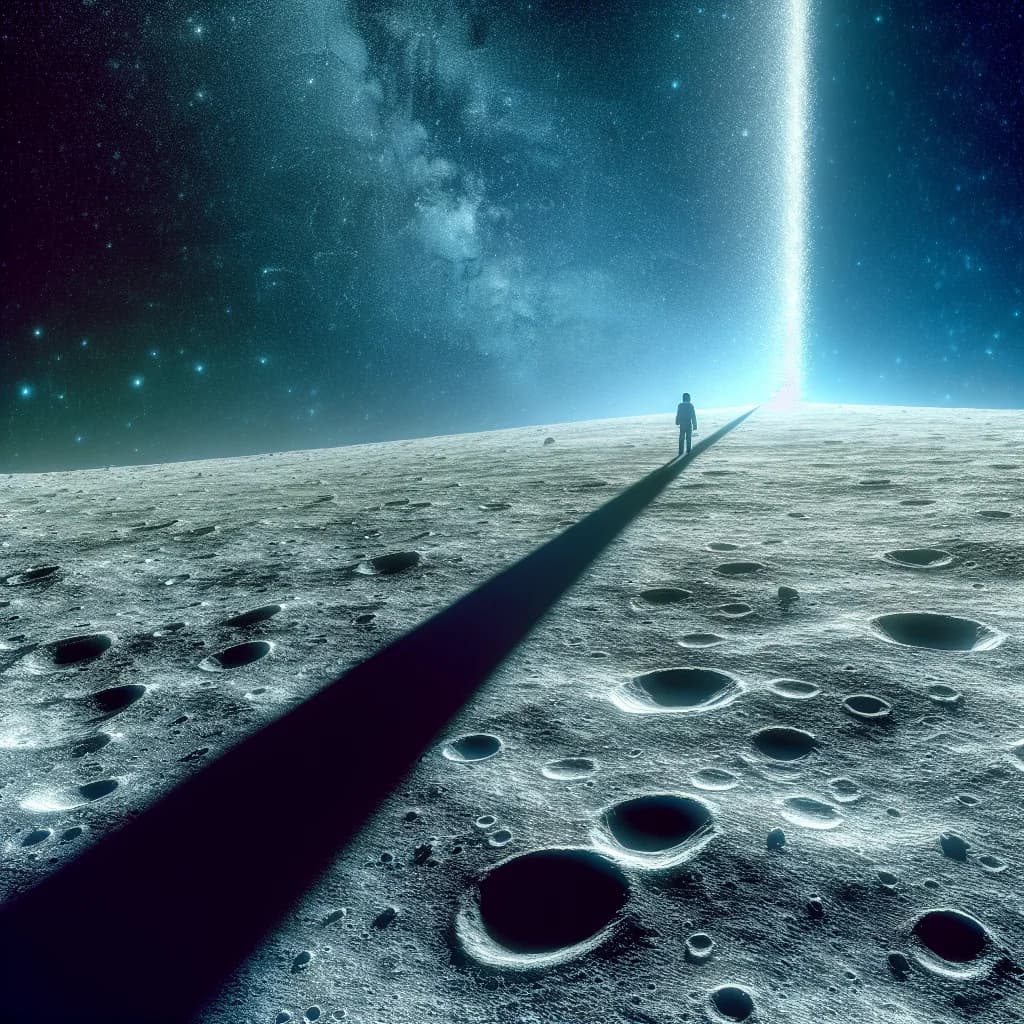
If you were an astronaut in deep space, would closing your eyes reveal a show of tiny cosmic fireworks
Imagine floating in the silent void, eyes shut tight, yet witnessing a dazzling display of phantom light dancing across your vision. Discover the surreal science behind why space is never truly dark for an astronaut—even with their eyes closed.


Too Long; Didn't Read
Astronauts in deep space experience flashes of light called cosmic ray visual phenomena, which are caused by high-energy particles passing through the eyes and interacting with the retina. These tiny cosmic fireworks occur even with closed eyelids, serving as a visible reminder of the constant radiation present in the space environment.
Closing Your Eyes in Deep Space: Do You Really See a Show of Cosmic Fireworks?
Imagine you are an astronaut drifting in the profound silence of deep space. Exhausted from a day of orbital repairs, you settle into your sleeping tether and close your eyes. Instead of the expected velvet blackness of sleep, your vision is suddenly pierced by a brilliant flash of light—a streak of silver, a pinpoint of white, or a starburst of neon. You aren't dreaming, and there are no windows nearby. You are witnessing a private, subatomic firework show occurring right inside your own eyes.
This phenomenon is not science fiction; it is a documented reality for travelers beyond Earth's protective atmosphere. To understand why this happens, we must look at the intersection of high-energy particle physics, human physiology, and the unique environment of the cosmos. By analyzing "Cosmic Ray Visual Phenomena" (CRVP), we can uncover the invisible forces that govern our universe.
The Subatomic Guests: What Are Cosmic Rays?
The "fireworks" seen by astronauts are caused by cosmic rays. Despite the name, these aren't actually rays of light, but high-speed atomic nuclei—mostly protons—traveling through the vacuum of space at nearly the speed of light.
On Earth, our thick atmosphere and magnetic field act as a shield, absorbing or deflecting the vast majority of these particles. However, in deep space or even in Low Earth Orbit (LEO), this shield is significantly thinner.
- Velocity: These particles travel at relativistic speeds, often exceeding 90% of the speed of light.
- Energy: A single cosmic ray particle can carry kinetic energy equivalent to a well-hit baseball, packed into a space smaller than an atom.
- Frequency: During the Apollo missions, astronauts reported seeing these flashes approximately once every three minutes during their transit to the Moon.
The Mechanism: How the Eye "Sees" the Invisible
When a high-energy cosmic ray passes through the hull of a spacecraft and into an astronaut's head, it can interact with the visual system in two primary ways:
1. Direct Retinal Interaction
As the particle zips through the vitreous humor (the gel inside the eye) and strikes the retina, it can physically displace electrons in the rod and cone cells. The brain interprets this sudden localized energy as a flash of light. It is a "false" signal, meaning no actual photon entered the eye from the outside world, but the neural pathway responds as if it did.
2. Cherenkov Radiation: The "Sonic Boom" of Light
In some instances, the particle is traveling faster than the speed of light within the medium of the eye’s fluid. While nothing can exceed the speed of light in a vacuum, light slows down when it passes through water or glass. If a cosmic ray enters the eye’s fluid at its original vacuum speed, it creates a visual "shockwave." This is called Cherenkov radiation. This effect produces a characteristic faint blue glow or a sharp streak, much like a miniature, silent sonic boom made of light.
Classifying the Fireworks
Astronauts have categorized these visual anomalies into distinct "show" types based on how the particles intersect with their optical nerves:
- "Stars" or Pinpoints: Occur when a particle strikes the retina perpendicularly.
- "Streaks": Occur when a particle passes through the retina at an angle, triggering a line of sensors.
- "Clouds": Result from a cascade of secondary particles if the cosmic ray hits the eye's structure and shatters into a spray of smaller fragments.
The Consequences of the Cosmic Light Show
While these "fireworks" are a fascinating display of physics, they serve as a clinical reminder of the radiation environment in space. From a scientific perspective, each flash represents a single event of ionization. In the short term, these flashes are harmless and provide a unique way for humans to "feel" the radiation environment around them. However, for long-duration missions to Mars, engineers must develop advanced shielding—such as water-lined walls or polyethylene layers—to reduce the frequency of these interactions and protect the delicate biological systems of the crew.
Conclusion
The show of tiny cosmic fireworks behind an astronaut’s eyelids is a vivid confirmation that space is never truly "empty." It is a bustling highway of high-energy particles that have traveled across the galaxy only to end their journey against a human retina. This phenomenon is governed by the principles of relativistic physics and the sensitivity of our own biological detectors.
Ultimately, these flashes serve as a bridge between the abstract world of subatomic particles and our tangible human experience. They remind us that even in the darkest reaches of the void, the universe is pulsing with energy, constantly interacting with us in ways that are both invisible and, occasionally, brilliantly bright.