If you were caught in a storm of diamond rain on Neptune, would the impact feel like bullets
Imagine a sky raining literal diamonds, but instead of finding a fortune, you’re caught in a deadly crossfire. Dive into the crushing atmosphere of Neptune to see if these falling gems would strike with the lethal force of a high-velocity bullet.

Too Long; Didn't Read
No, the diamonds would not feel like bullets because Neptunes atmosphere is so dense that it slows falling objects significantly. While these gems form deep within the planet, the extreme heat and crushing pressure would destroy a human long before they ever experienced the rain.
Diamonds from the Sky: Would a Rainstorm on Neptune Feel Like a Hail of Bullets?
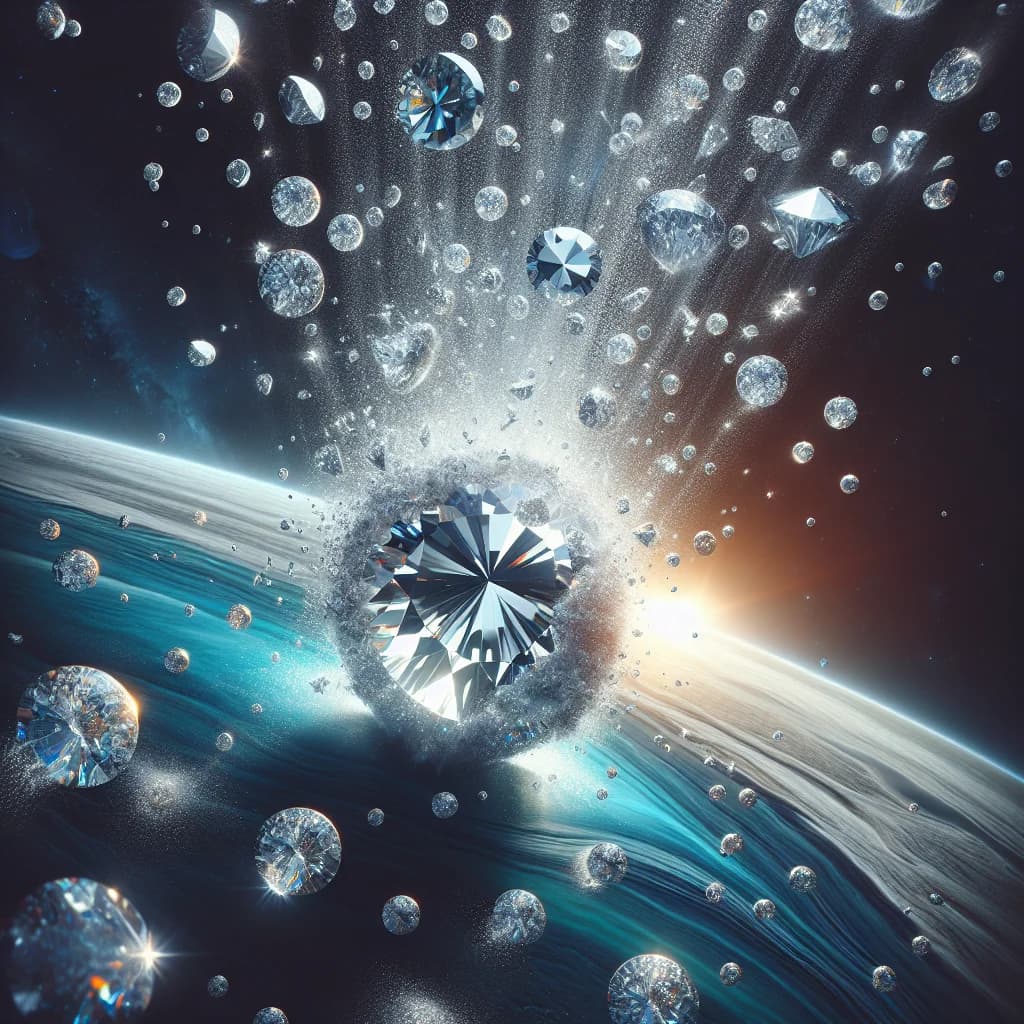
Imagine standing on a world where the very air is thick with the scent of methane and the clouds don’t drop water, but precious gemstones. Neptune, the brilliant blue "ice giant" of our outer solar system, is theorized to host one of the most exotic weather patterns in the universe: diamond rain. This isn't a fairy tale; it is a hypothesis driven by high-pressure physics and planetary chemistry. But if you were to stand amidst such a storm, would those falling gems strike you with the lethal velocity of a marksman’s bullet, or would they be more akin to a sparkly afternoon shower?
To answer this, we must look at the intersection of fluid dynamics, atmospheric density, and gravitational acceleration. By applying the laws of physics to the extreme environment of Neptune, we can determine the "impact force" of a falling diamond and see if it truly lives up to its ballistic reputation.
The Chemistry of a Sparkling Storm
The journey of a Neptunian diamond begins high in the atmosphere, where methane (CH₄) is abundant. Neptune’s intense internal heat and crushing pressures—thousands of times greater than Earth's—work to strip the hydrogen away from the carbon. Under these extreme conditions, the isolated carbon atoms are pressed together into a crystalline lattice.
In laboratory experiments simulating these conditions, researchers at the SLAC National Accelerator Laboratory found that carbon can transform into nanodiamonds almost instantly. These diamonds then "rain" down toward the planet's core. While we often imagine these as polished jewelry-store gems, they likely resemble jagged, gritty hailstones or "slushy" crystalline structures as they begin their descent.
The Physics of the Fall: Gravity vs. Drag
To understand the impact, we first look at Neptune’s gravity. Despite being 17 times the mass of Earth, Neptune is so large that its surface gravity is only about 1.14 times that of Earth's. If you dropped a diamond on Earth and Neptune from the same height in a vacuum, the one on Neptune would accelerate only slightly faster.
However, Neptune’s atmosphere is anything but a vacuum. It is a dense "soup" of hydrogen and helium. This brings us to the concept of terminal velocity—the constant speed an object reaches when the upward force of air resistance (drag) equals the downward force of gravity.
Calculating the Impact
On Earth, a typical raindrop falls at roughly 20 mph (9 meters per second). A hailstorm might see stones hitting at 60 to 100 mph. In contrast, a standard handgun bullet travels at approximately 700 to 900 mph.
For a diamond rainstone to feel like a bullet, it would need to overcome the massive resistance of Neptune's thick atmosphere. Because Neptune’s air is significantly denser than Earth’s as you descend deeper, the "drag" on a falling object increases dramatically.
- Atmospheric Density: As the diamonds fall into the deeper layers of the mantle, the medium becomes more like a liquid than a gas.
- The Result: Instead of accelerating to supersonic speeds, the diamonds would likely be slowed down by the "viscous drag." They would move more like a pebble falling through a jar of honey than a bullet flying through the air.
Ballistic Velocity vs. Terminal Descent
Let’s compare the kinetic energy. Kinetic energy is calculated as $KE = ½mv²$. While a diamond is much denser than a drop of water (about 3.5 times denser), the terminal velocity is the limiting factor.
- Mass: A pea-sized diamond has more mass than a raindrop, increasing the potential impact force.
- Velocity: On Earth, a hailstone of similar size might reach 50 mph. On Neptune, given the gravity and the crushing atmospheric density, the diamond might reach similar or slightly higher speeds in the upper layers, but it would decelerate as the atmosphere thickens.
Scientific estimates suggest that while these diamonds would strike with significantly more force than water rain—likely feeling like being hit by a handful of gravel thrown with moderate force—they would not reach the 800+ mph speeds required to mimic a bullet. The impact would be physically significant, but the "ballistic" comparison falls short because the atmosphere acts as a natural brake.
The Environmental Reality
In this thought experiment, the impact of the diamond is actually the least of your worries. Long before a diamond could tap you on the shoulder, the atmospheric conditions would take center stage:
- Pressure: The pressure required to form diamonds is roughly 1.5 million atmospheres.
- Temperature: The regions where this rain occurs are estimated to be thousands of degrees Fahrenheit.
In a clinical sense, any terrestrial observer would be fundamentally changed by the environment (transitioning from a solid to a pressurized plasma) before they could even register the sensation of a falling gemstone.
Conclusion
While the idea of a diamond rainstorm sounds like a high-velocity gauntlet, the physics of Neptune suggests a different story. Due to the intense drag created by the planet's dense, pressurized atmosphere, these falling gems would likely behave more like heavy, crystalline hail than supersonic projectiles. The "bullet" theory is a fascinating exaggeration, but the reality is dictated by the sobering laws of fluid dynamics.
This thought experiment reminds us that the universe often exceeds our imagination. Neptune might not be a cosmic shooting gallery, but the fact that it may contain oceans of liquid carbon with solid diamond "icebergs" floating in them is a testament to the incredible, extreme varieties of chemistry that exist just a few billion miles away.