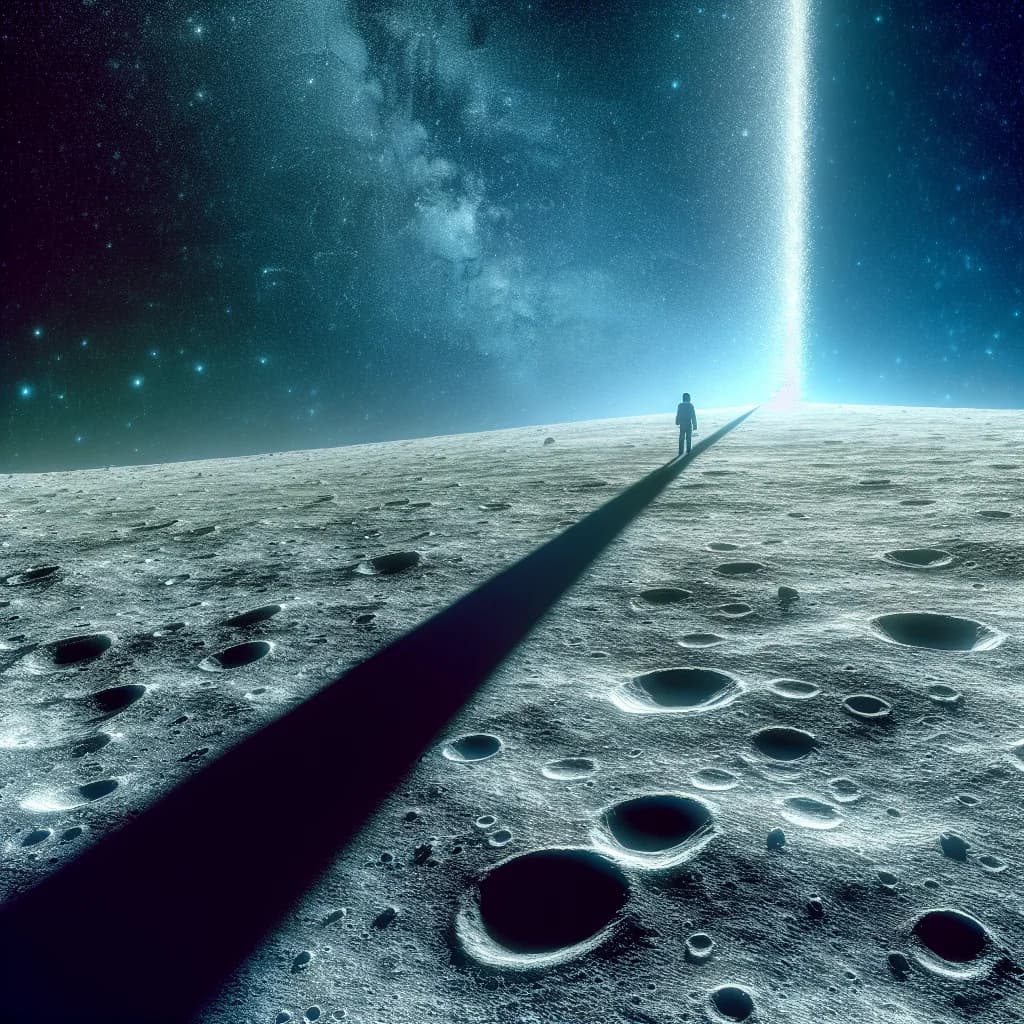
If you were hit by a single grain of sand traveling at 99 percent light speed, what would happen
It’s just a tiny speck of silica—until it hits 99% the speed of light and carries the kinetic energy of a massive explosion. Discover why this microscopic projectile wouldn’t just pierce your skin, but trigger a catastrophic event that defies everything you know about physics.

Too Long; Didn't Read
A grain of sand hitting you at 99 percent light speed would release energy equivalent to a large bomb explosion. It would instantly vaporize your body and the surrounding area with the force of roughly 1.3 tons of TNT.
The Relativistic Grain: What Happens if Sand Hits You at 99% Light Speed?
Imagine a lazy afternoon at the beach. You feel the grit of a single grain of sand between your toes—a tiny, harmless speck of silicon dioxide weighing barely a milligram. Now, imagine that same speck accelerated to 99 percent the speed of light, hurtling directly toward you. While it sounds like a premise from a science fiction blockbuster, this scenario provides a fascinating window into the world of special relativity and high-energy physics. In this exploration, we will use the principles of Einsteinian physics and kinetic energy equations to determine how such a microscopic object could yield a truly macroscopic impact.
The Physics of the "Slow" and the "Fast"
In our everyday lives, kinetic energy is straightforward: the heavier and faster an object is, the more energy it carries. However, as an object approaches the speed of light ($c$), the classical rules of Isaac Newton take a backseat to Albert Einstein’s Special Relativity.
At 99 percent of light speed ($0.99c$), we must account for the Lorentz factor ($\gamma$). This mathematical term describes how much "extra" energy and momentum an object gains as it nears the cosmic speed limit. For an object traveling at $0.99c$, the Lorentz factor is approximately 7.09. This means the grain of sand isn't just carrying a lot of speed; its energy profile is over seven times greater than what classical physics would predict.
Calculating the Energy Output
To understand the scale of this event, we first need to look at the numbers. A typical grain of sand has a mass of about 1 milligram ($0.000001 \text{ kg}$). Using the relativistic kinetic energy formula—$K = (\gamma - 1)mc^2$—we can calculate the energy released upon impact:
- Mass ($m$): $1 \times 10^{-6} \text{ kg}$
- Velocity ($v$): $0.99c$
- Energy ($K$): Approximately 548 billion Joules ($5.48 \times 10^{11} \text{ J}$).
To put that abstract number into perspective, let’s compare it to a familiar metric: TNT. One ton of TNT releases about $4.184$ billion Joules. Therefore, our single grain of sand carries the energy equivalent of roughly 131 tons of TNT.
The Moment of Impact: Atmospheric Interaction
Before the sand even reaches a human target, it has to contend with Earth’s atmosphere. At $0.99c$, the air molecules aren't just "gas" anymore; they are stationary obstacles that the sand grain will collide with violently.
- Fusion on the Fly: The grain would be moving so fast that it would trigger nuclear fusion with the nitrogen and oxygen atoms in the air.
- The Plasma Trail: Instead of a whistling sound, the grain would create a blinding flash of light and a trail of superheated plasma as it compresses the air in front of it faster than the air can move out of the way.
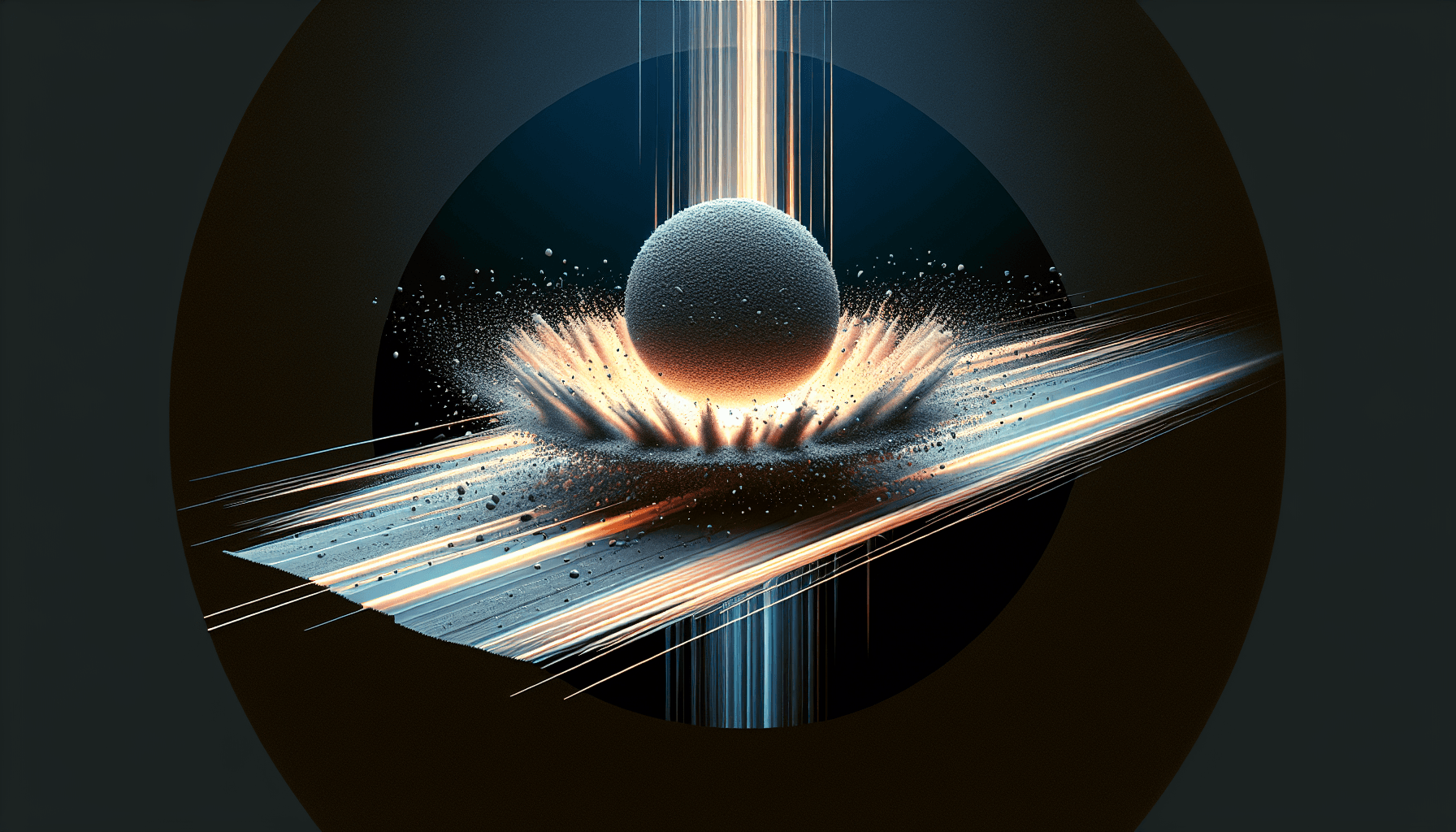
- The Kinetic Burst: Because the grain is so small but the energy is so high, it wouldn't act like a "bullet." Instead, the moment it makes contact with any solid or liquid surface (like a human target), that energy is released all at once in a massive thermal expansion.
What Would the Outcome Look Like?
In a strictly scientific sense, the result is not a "hit" in the way we think of a ball hitting a glove. Because the energy is so concentrated, the impact would result in an immediate and significant release of light and heat.
- Thermal Expansion: The energy equivalent of 131 tons of TNT would cause the air and the immediate vicinity to expand outward in a brilliant, clinical flash.
- A Perfect Circle: The "impact site" would experience a localized, spherical pressure wave. From a distance, it would look less like a collision and more like a very bright, very brief photographic flashbulb going off.
- Scientific Abstraction: If you were standing in the path of this grain, you wouldn't feel a "poke." The sheer volume of energy would result in a sudden change in state for the local environment, turning the immediate area into a brief, high-pressure zone of ionized gas.
Conclusion
The ultimate scientific outcome of being hit by a grain of sand at 99 percent light speed is a dramatic demonstration of $E=mc^2$. While the sand grain is tiny, its velocity grants it the energy of a massive industrial explosion. This thought experiment highlights the core principles of special relativity: that mass and energy are inextricably linked, and that speed can transform the most mundane objects into powerhouses of physical force.
It is a humbling reminder of the incredible energy stored within the universe's smallest building blocks. While we are safe from relativistic sand here on Earth, these calculations help scientists understand the high-energy particles—cosmic rays—that constantly rain down on our atmosphere from deep space, reminding us that the reality of physics is often more extraordinary than fiction.