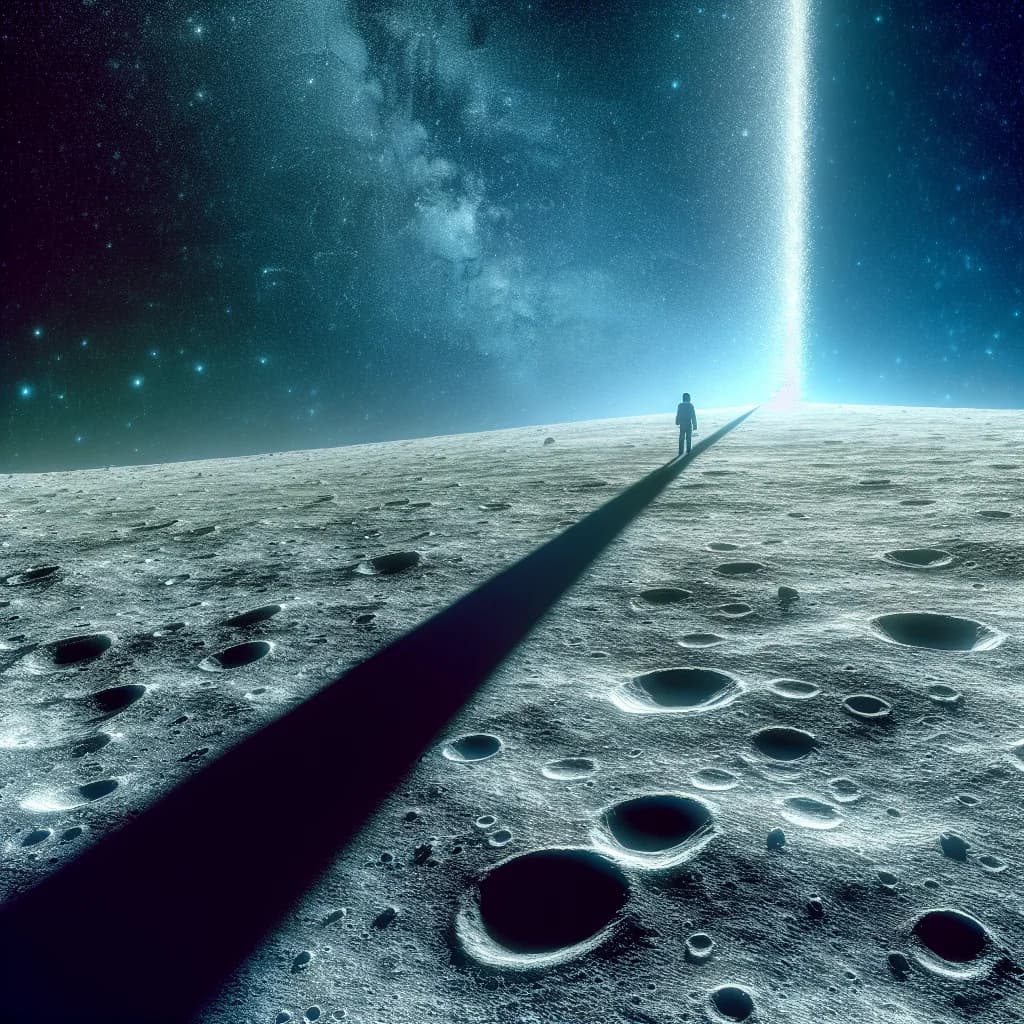
If you were on a planet with supersonic winds, could you even hear a person shouting from behind you
Imagine a world where the wind literally outruns your voice, leaving your loudest shouts trapped in a silent wake. Dive into the mind-bending physics of alien atmospheres to see if communication is even possible when the breeze breaks the sound barrier.

Too Long; Didn't Read
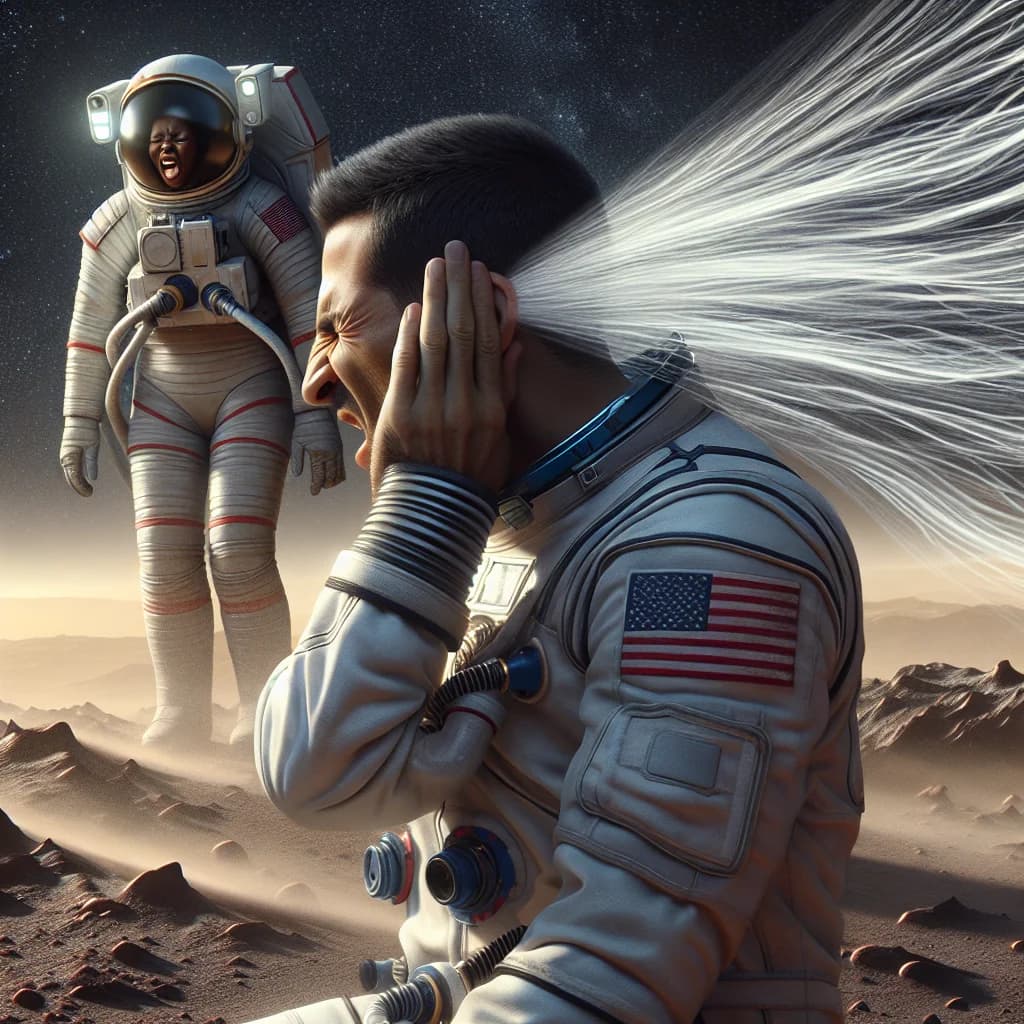
No, you would not hear them. Because the wind is moving faster than the speed of sound, it carries the sound waves away before they can travel toward you. The sound effectively cannot move upstream against the supersonic flow to reach your ears.
Breaking the Sound Barrier: Could You Hear a Shout in Supersonic Winds?
Imagine standing on the surface of a distant exoplanet like HD 189733b, where the weather forecast doesn’t involve light showers, but rather winds screaming at seven times the speed of sound. In this alien environment, the very laws of acoustics are pushed to their limits. If a friend stood just a few meters behind you and shouted your name, would the sound ever reach your ears, or would it be lost in the atmospheric chaos?
To solve this cosmic riddle, we must look toward fluid dynamics and classical acoustics. By analyzing how sound waves—which are essentially mechanical pressure waves—interact with a medium moving faster than the waves can propagate, we can determine if communication is even physically possible. This thought experiment requires us to apply the Doppler effect and vector addition to a world where the air itself outruns the voice.
The Speed Limit of Sound
To understand hearing in supersonic winds, we first need to define the "speed limit" of the medium. On Earth, at sea level and 20°C, sound travels at approximately 343 meters per second (about 767 mph). This is the speed at which a pressure wave can nudge neighboring molecules to pass along a signal.
When we talk about "supersonic" winds, we are describing a scenario where the bulk movement of the air molecules is faster than the speed at which those same molecules can transmit a vibration. If the wind is moving at Mach 1.5, it is traveling at 150% the speed of sound. This creates a fascinating physical conflict: the medium is moving faster than the message.
Vector Addition: Racing Against the Gale
Whether you hear a shout depends entirely on the direction of the wind relative to the speaker and the listener. Sound velocity is additive. If $V_s$ is the speed of sound and $V_w$ is the velocity of the wind, the effective speed of the shout ($V_{eff}$) is:
$$V_{eff} = V_s + V_w$$
Scenario A: The Tailboarding Shout
If your friend is behind you and the supersonic wind is blowing from them toward you, you are in luck—mathematically speaking. The sound waves are being "pushed" by the wind. If the wind is Mach 1 and the shout is Mach 1, the sound reaches you at Mach 2 relative to the ground. In this case, the sound waves are compressed, resulting in a massive upward Doppler shift, making your friend's voice sound incredibly high-pitched.
Scenario B: The Upwind Battle
However, if you are facing into a supersonic wind and your friend shouts from behind you, the physics change. Here, the wind is moving away from you toward your friend at speeds exceeding the speed of sound. The sound waves try to travel toward you at Mach 1, but the "conveyor belt" of air is carrying them away at Mach 1.5.
- The Result: The sound wave’s net velocity toward you is negative.
- The Physical Consequence: The sound waves can never close the distance. They are effectively swept backward, creating a "Zone of Silence" in front of the speaker.
The Geometry of the Mach Cone
In a supersonic flow, sound cannot travel "upstream" at all. This creates a physical boundary known as a Mach Cone. When a person shouts in a supersonic wind, the sound waves cannot spread out in a circle as they do on a calm day. Instead, they are confined within a cone-shaped region extending downstream from the speaker’s mouth.
If you are standing outside of this cone—which you would be if the wind is blowing from you toward the person behind you—the sound waves physically cannot reach your coordinates. The air is simply moving too fast for the pressure front to make any forward progress.
Turbulence and Atmospheric Noise
Even in the "favorable" scenario where the wind carries the sound to you, "hearing" is a strong word. Supersonic environments are characterized by:
- Extreme Turbulence: High-speed flows create chaotic eddies that would scatter sound waves, turning a clear shout into unrecognizable acoustic "smog."
- Acoustic Overload: The sheer friction of supersonic air moving past your ears would generate local noise levels far exceeding the decibel level of a human shout.
- Density Fluctuations: On planets with supersonic winds, the atmospheric pressure is often significantly different from Earth's, which changes the efficiency of sound transmission.
Conclusion
The scientific verdict is clear: if you were on a planet with supersonic winds, your ability to hear someone behind you depends entirely on the wind's direction. If the wind is blowing from them to you, the sound arrives "supercharged" and high-pitched. If the wind is blowing from you to them, the sound is physically incapable of reaching you, trapped forever in a cone of receding air.
This experiment highlights the incredible balance of our own atmosphere. On Earth, winds rarely exceed a small fraction of the speed of sound, allowing our voices to travel in all directions. It serves as a reminder that the simple act of hearing a friend call your name is a privilege granted by the gentle, subsonic physics of our home planet.