If you were trapped in a room of perfectly reflective mirrors, would your body heat eventually cook you alive
In a room of 100% reflective mirrors, your own body heat has absolutely nowhere to escape. Discover the fascinating—and slightly terrifying—physics of how your own warmth could eventually turn a hall of mirrors into a lethal, self-contained oven.

Too Long; Didn't Read
Yes. Because perfectly reflective mirrors prevent thermal radiation from escaping, your body’s constant metabolic heat would be trapped inside the room. Over time, the ambient temperature would rise until you suffered from fatal hyperthermia.
Reflecting on Thermodynamics: Would a Room of Perfect Mirrors Actually Cook You?
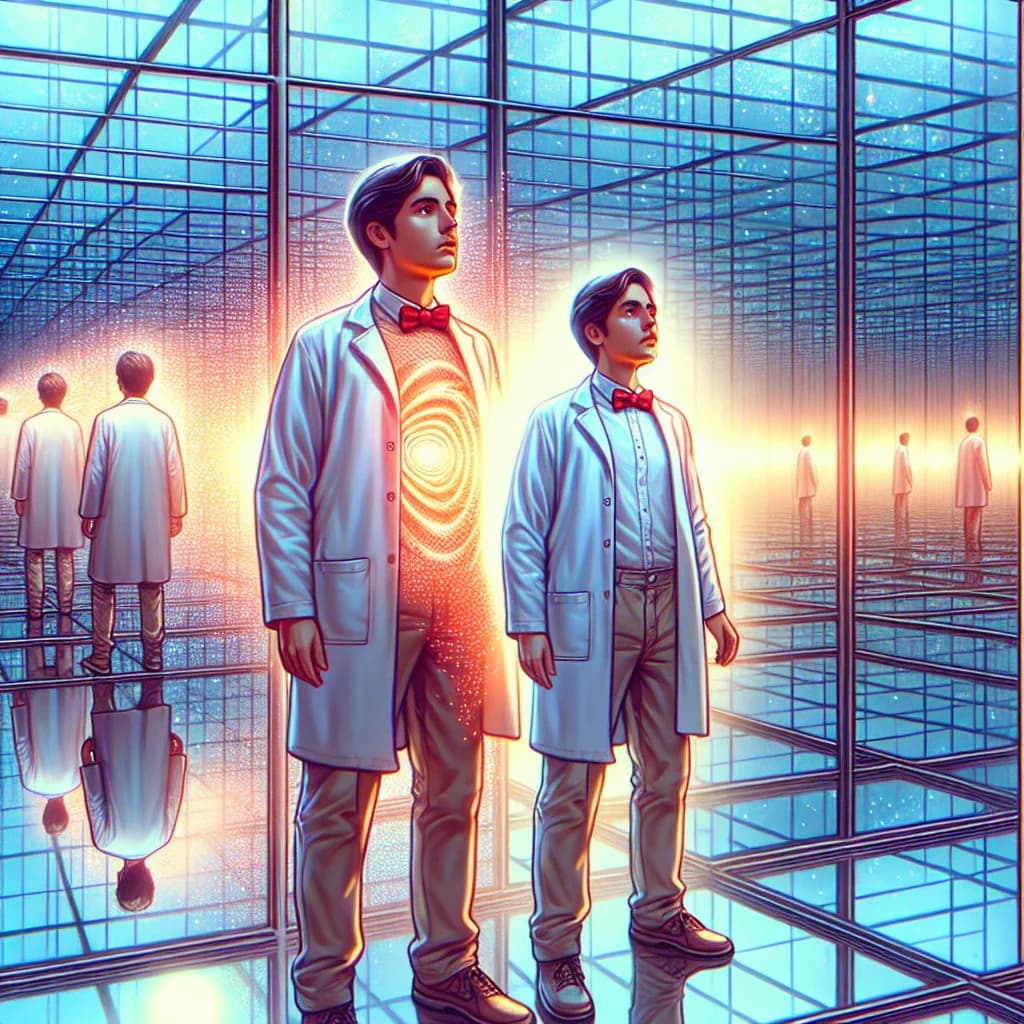
Imagine waking up in a room where every surface—the floor, the ceiling, and all four walls—is a "perfect" mirror. It is a world of infinite reflections, a visual kaleidoscope that stretches into eternity. While this sounds like a scene from a high-concept sci-fi film, it poses a fascinating scientific question: if no energy can escape this perfectly reflective enclosure, would your own body heat eventually lead to your demise? To answer this, we must step away from the visual aesthetics and dive into the rigorous world of thermodynamics and human biology. By applying the laws of energy conservation and the specific heat capacity of air, we can determine exactly how long it would take for a human "lightbulb" to turn their pristine mirror room into a high-tech oven.
The Physics of Perfection: The 100% Reflective Surface
In the real world, mirrors are imperfect. Even a high-quality household mirror absorbs about 10% of the light that hits it, converting that energy into heat within the glass and silvering. However, for this thought experiment, we are utilizing a "perfect" mirror.
A perfect mirror reflects 100% of all electromagnetic radiation, including visible light and, crucially, infrared radiation (heat). In this scenario, the room is a closed system. According to the First Law of Thermodynamics, energy cannot be created or destroyed, only transformed. The heat your body radiates has nowhere to go; it cannot pass through the walls, nor can it be absorbed by them. It simply bounces back toward the center of the room.
The Human Radiator: Measuring Your Power Output
To understand the consequences of this trap, we have to look at the human body as a biological machine. Even while resting, your metabolism is hard at work, burning calories to keep your heart beating and your brain functioning. This process generates heat as a byproduct.
- Metabolic Rate: An average adult at rest produces approximately 80 to 100 Watts of power.
- The Lightbulb Comparison: You are essentially equivalent to an old-fashioned 100-watt incandescent lightbulb.
- The Accumulation: In a standard room, this heat dissipates into the environment. In our perfect mirror room, you are adding 100 Joules of energy to the air every single second.
Calculating the Temperature Spike
Let’s assume the room is a modest cube, roughly 2 meters on each side, giving us a volume of 8 cubic meters. After accounting for the volume your body occupies, we have about 9.6 kilograms of air inside. Using the specific heat capacity of air (the amount of energy required to raise the temperature of air), we can calculate the rate of warming.
- Energy Input: 100 Watts (Joules per second).
- Hourly Total: In one hour, you release 360,000 Joules of energy.
- The Result: In a perfectly insulated 8-cubic-meter space, your body heat would raise the air temperature by approximately 37.5 degrees Celsius (67.5 degrees Fahrenheit) every hour.
If you started at a comfortable room temperature of 21°C (70°F), by the end of the first hour, the air would be a blistering 58.5°C (137.5°F). This is significantly hotter than the highest recorded natural temperature on Earth.
Biological Consequences: Reaching Thermal Equilibrium
As the environment warms, your body’s primary cooling mechanism—sweating—begins to fail. Sweating works through evaporative cooling; however, in a small, sealed room, the humidity would rapidly reach 100% as your breath and sweat saturate the air.
Once the room temperature exceeds your internal body temperature (37°C or 98.6°F), you can no longer shed heat. Instead, the laws of physics dictate that heat will begin to flow from the hot air into your body. This leads to hyperthermia. From a biochemical perspective, the proteins in your cells are sensitive to heat. Just as an egg white turns from clear to white when heated, extreme internal temperatures cause cellular structures to lose their shape and function.
Conclusion: The Ultimate Scientific Outcome
The verdict is clear: if trapped in a room of perfectly reflective mirrors, your own metabolic processes would indeed lead to a terminal rise in temperature. The core scientific principles of energy conservation and thermal equilibrium ensure that in a system where energy cannot escape, the temperature must rise until the source of that energy ceases to function.
While the idea of being "cooked" by your own reflection sounds like a nightmare, it serves as a powerful reminder of how efficiently our bodies produce energy. In the real world, we are constantly exchanging heat with a vast environment that keeps us in a delicate balance. This thought experiment highlights the incredible invisible dance of photons and thermal energy that allows life to thrive in a world that is—thankfully—not made of perfect mirrors.