Why can a laser beam act as a tractor beam to move individual living cells
From the realm of science fiction to the cutting edge of biology, discover how scientists are using "invisible hands" made of light to grab and manipulate living cells. Explore the mind-bending physics behind the laser technology that allows us to move the building blocks of life without ever touching them.

Too Long; Didn't Read
Laser beams act as tractor beams using optical tweezers, which exploit the momentum of light. When laser light refracts through a cell, it exerts a tiny force that pushes the cell toward the beam's center, allowing researchers to trap and move individual living cells without physical contact.
From Sci-Fi to Lab Reality: How Can a Laser Beam Act as a Tractor Beam to Move Living Cells?
Imagine a massive starship caught in an inescapable beam of light, slowly being pulled toward a docking bay. While the "tractor beams" of science fiction are usually used to move gargantuan metal vessels, modern science has actually turned this fantasy into a reality—albeit on a much smaller scale. Instead of pulling spaceships, scientists use specialized lasers to grab, move, and manipulate individual living cells without ever touching them.
This phenomenon is not magic; it is the result of highly precise physics. By leveraging the principles of photon momentum and refractive gradients, researchers have developed "optical tweezers." This post will explore how we can use the microscopic pressure of light to navigate the complex world of microbiology, applying classical mechanics to the delicate machinery of life.
The Momentum of a Photon: Light’s Tiny Punch
To understand how a laser moves a cell, we must first accept a surprising fact: light has mass-like properties. Although photons (particles of light) are massless, they carry momentum. When a photon hits an object or passes through it, it exerts a tiny amount of physical pressure known as radiation pressure.
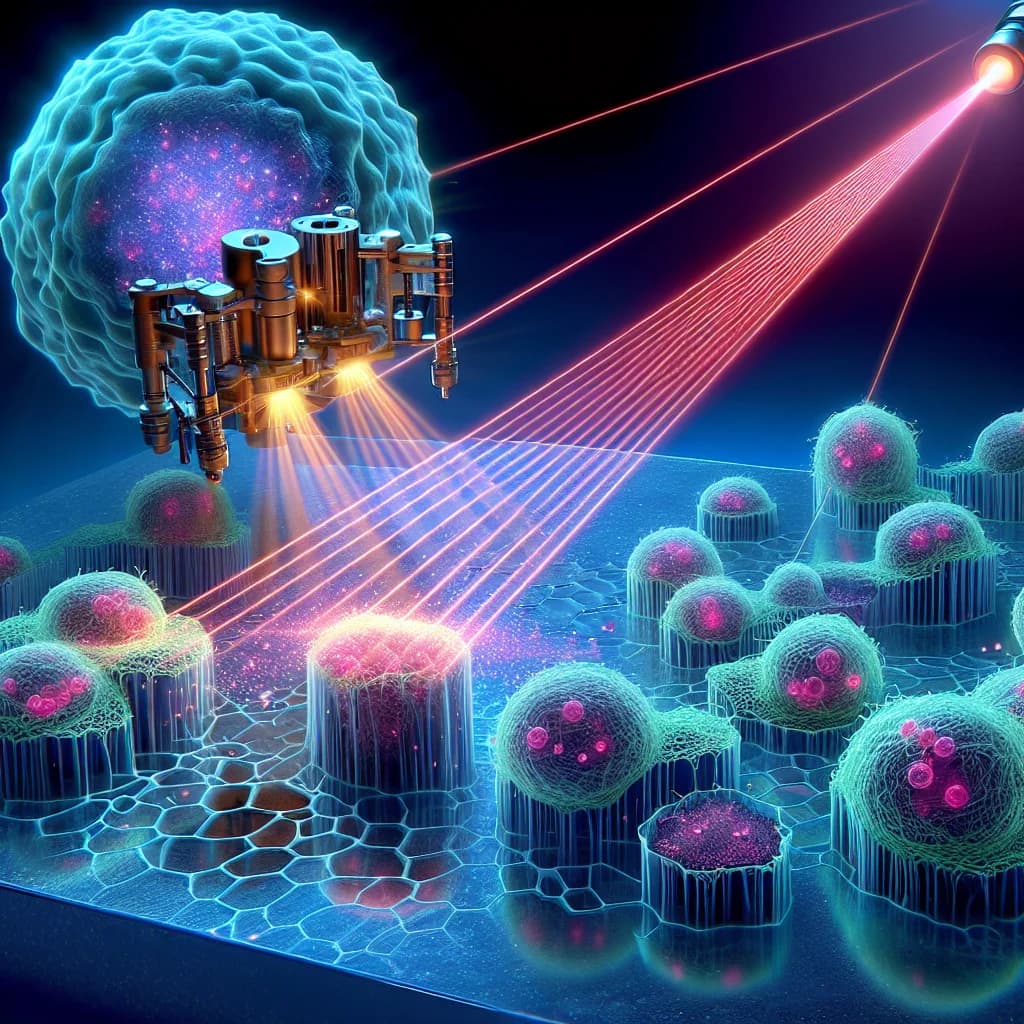
When a laser beam encounters a living cell, the cell acts like a tiny, translucent lens. As the light passes through the cell, it refracts—or bends. According to Newton’s Third Law of Motion, for every action, there is an equal and opposite reaction. As the cell changes the direction of the light, the light imparts a reciprocal force back onto the cell.
The "Trap": Understanding Gradient Forces
The secret to a "tractor beam" lies in the structure of the laser beam itself. Most optical tweezers use a Gaussian beam, where the light is most intense at the very center and tapers off toward the edges.
The Microscopic Tug-of-War
When a cell is slightly off-center in the laser beam, it refracts more light toward the center. This refraction creates a "gradient force" that pushes the cell back toward the highest intensity of the beam.
- The Centering Effect: The cell is essentially "sucked" into the brightest part of the laser.
- The Z-Axis Trap: By focusing the laser through a high-quality microscope objective lens, scientists create a point of "optical gradient" that traps the cell in three dimensions, holding it steady in the "focal spot."
Measuring the Force
The forces involved are incredibly small, measured in piconewtons ($10^{-12}$ Newtons). To put this in perspective:
- A single piconewton is roughly the weight of a single red blood cell.
- It would take trillions of these "tractor beams" to lift a single paperclip. However, for a lone bacterium or a yeast cell, a few piconewtons are more than enough to overcome the fluid resistance of their environment.
Why Don’t the Cells Explode?
A common question is why a high-powered laser doesn't simply vaporize the living subject. The answer lies in the "Optical Window." Scientists typically use near-infrared (NIR) lasers for biological tractor beams.
Living tissues and the water they reside in are largely transparent to these specific wavelengths. This allows the light to pass through the cell to provide momentum without being absorbed as heat. This "bloodless" interaction ensures the cell remains viable, maintaining its biological integrity while being ferried around the petri dish like a microscopic passenger.
Cascading Consequences in Research
The ability to move cells with light has revolutionized biology. By using these optical traps, scientists can:
- Sort Cells: Physically move healthy cells away from diseased ones with 100% purity.
- Measure Elasticity: Pull on a cell membrane to see how "stretchy" it is, which helps in identifying cancerous changes.
- Micro-Surgery: Position a single bacterium precisely next to a white blood cell to watch the immune response in real-time.
Conclusion
The reality of the tractor beam is perhaps more impressive than its fictional counterpart because it works within the strict, beautiful laws of our universe. By balancing the momentum of photons against the refractive properties of biological matter, we have gained a set of "photon-powered hands" capable of rearranging life at its most fundamental level.
Ultimately, the study of optical tweezers reminds us that light is not just something we use to see the world; it is a physical force that can shape it. While we may not be towing starships anytime soon, the ability to move a single cell with a beam of light has opened the door to a new era of medical and biological discovery, proving that even the smallest forces can lead to the biggest breakthroughs.