Why can an immortal jellyfish technically live forever by reverting its entire life cycle back to its beginning
While humanity searches for the secret to eternal life, one tiny ocean dweller has already mastered the ultimate biological "undo" button. Discover how this extraordinary jellyfish cheats death by literally aging in reverse, transforming from a mature adult back into a baby whenever life gets tough.

Too Long; Didn't Read
The immortal jellyfish avoids death by using a process called transdifferentiation to transform its adult cells back into their earliest state. This allows the creature to revert from a mature medusa to a youthful polyp, effectively hitting a biological reset button to restart its life cycle indefinitely.
Can a Jellyfish Cheat Death? The Science of Biological Immortality and the Turritopsis dohrnii
Imagine reaching the twilight of your life, feeling the weight of years and the wear of the world, and simply deciding to become a child again. While this sounds like the plot of a high-concept science fiction novel, it is a Tuesday afternoon for the Turritopsis dohrnii, better known as the "immortal jellyfish." This tiny marine organism, no larger than a fingernail, has captivated the scientific community by performing a feat that appears to violate the fundamental laws of biology: it can reverse its entire life cycle. By shifting from a mature adult back to its earliest developmental stage, the Turritopsis dohrnii effectively resets its biological clock. To understand how this is possible, we must dive into the fascinating world of cellular biology, specifically the rare process known as transdifferentiation.
The Life Cycle Loop: From Medusa to Polyp
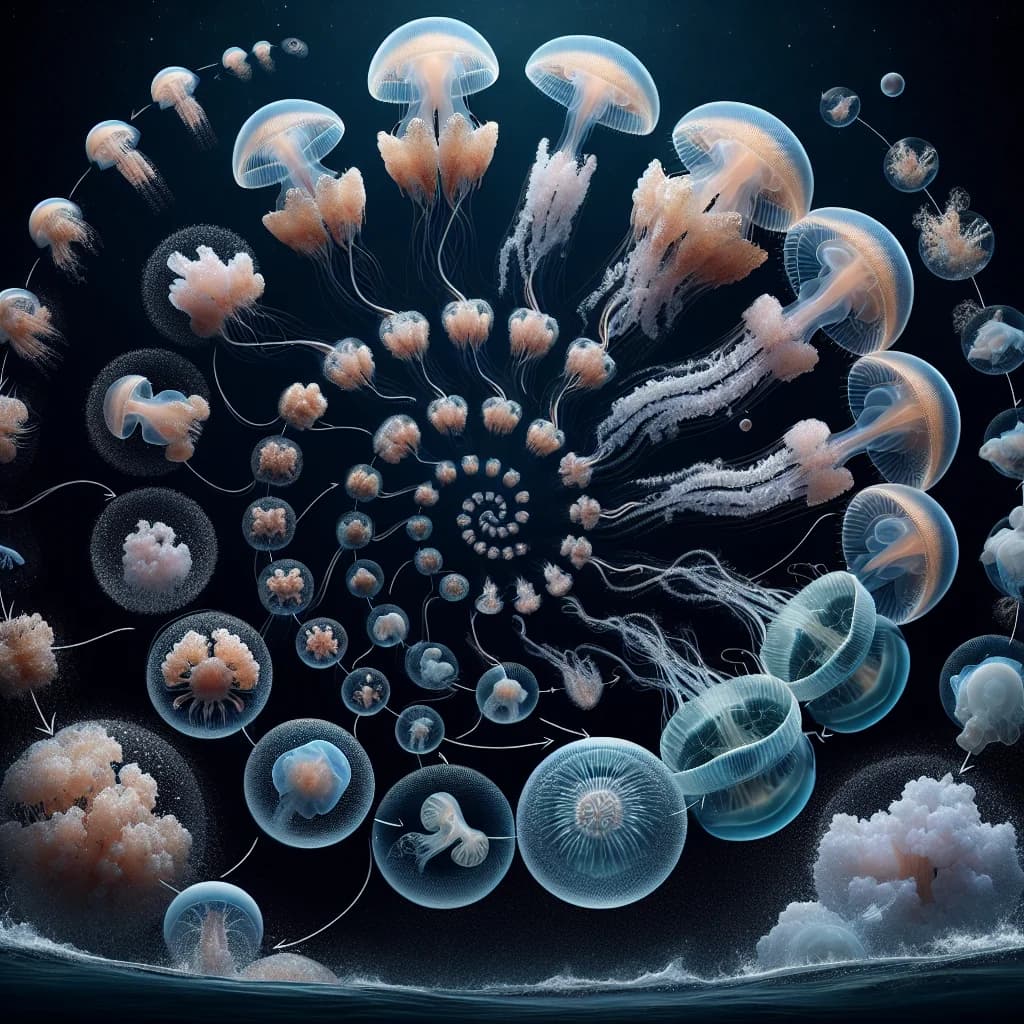
To appreciate the "magic" of the immortal jellyfish, one must first understand the standard life cycle of a hydrozoan. Most jellyfish begin as tiny larvae called planulae, which settle on the sea floor and grow into a colony of polyps—stationary, tube-like structures. Eventually, these polyps bud off free-swimming medusae, which are the bell-shaped creatures we recognize as jellyfish.
In a typical scenario, the medusa grows, reproduces, and eventually expires. However, when the Turritopsis dohrnii faces physical stress, starvation, or environmental shifts, it refuses to follow this linear path. Instead, it undergoes a "lifecycle reversal." The bell and tentacles of the medusa deteriorate, and the organism sinks to the ocean floor, transforming back into a cyst that eventually becomes a new polyp colony. This is not mere regeneration; it is a total structural and biological reset.
Transdifferentiation: The Biological Reset Button
The engine behind this incredible feat is a process called transdifferentiation. Most animal cells are "specialized"—a muscle cell stays a muscle cell, and a nerve cell remains a nerve cell. However, the immortal jellyfish can transform its specialized adult cells into entirely different types of specialized cells.
- Cellular Reprogramming: During the reversal, the jellyfish's cells essentially lose their specific identities and re-emerge as the foundational building blocks for a new polyp.
- The Lego Analogy: Imagine building a complex Lego castle (the adult medusa). When the castle is damaged, instead of just repairing the walls, the jellyfish breaks the entire structure down into individual bricks and uses those exact same bricks to build a completely different garden shed (the polyp).
- Genetic Silencing: Recent genomic sequencing suggests that T. dohrnii has extra copies of genes associated with DNA repair and protection, allowing it to maintain the integrity of its genetic code throughout these repetitive transitions.
The Scale of Immortality: Metrics and Constraints
While the term "immortal" suggests a creature of mythic proportions, the Turritopsis dohrnii is remarkably modest in scale.
- Physical Size: A mature medusa is only about 4.5 millimeters in diameter—roughly the size of a pencil eraser.
- Energy Efficiency: The transition from medusa back to polyp is highly efficient. Because the organism reuses its existing cellular mass rather than growing entirely from scratch, it bypasses the massive energy expenditure usually required for a new generation of life.
- Temporal Comparisons: If a human could perform a similar feat, a 70-year-old individual would be able to revert to a state of embryonic development in a matter of weeks, retaining their original DNA but starting their physical growth process from zero.
However, "biological immortality" does not mean "invincibility." In the real world, these jellyfish face significant physical constraints. They are frequently consumed by predators like sea slugs and fish, or they succumb to diseases. Their immortality is a theoretical potential within a closed loop, rather than a guarantee of eternal existence in the wild.
The Environmental Consequences of the Eternal Loop
If these jellyfish can technically live forever, why isn't the ocean overflowing with them? The answer lies in the balance of the marine ecosystem. The Turritopsis dohrnii is a "silent passenger" in the world’s oceans, often hitching rides in the ballast water of cargo ships.
Because they can survive the stress of long journeys by reverting to their polyp stage, they are highly successful invasive species. While their presence hasn't caused an ecological collapse, their ability to "reboot" allows them to colonize new environments where other species would perish. Their survival strategy is one of extreme resilience rather than aggressive domination, ensuring the species persists even when environmental conditions turn unfavorable.
Conclusion
The Turritopsis dohrnii stands as a remarkable exception to the biological rule that life is a one-way street. Through the sophisticated mechanism of transdifferentiation, this organism proves that cellular aging is not necessarily an irreversible process. By reverting from a mature medusa to a juvenile polyp, it utilizes its own cellular architecture to cheat the traditional end of its life cycle.
While the "immortal jellyfish" may not be a giant or a conqueror of the seas, its tiny, transparent form holds the secrets to cellular plasticity and genetic repair. This fascinating creature reminds us that nature often hides its most complex and revolutionary mechanisms in the smallest packages, challenging our understanding of time, aging, and the very definition of a "lifespan."