Why can spiders use the Earth’s natural electric field to fly miles high without any wind for lift
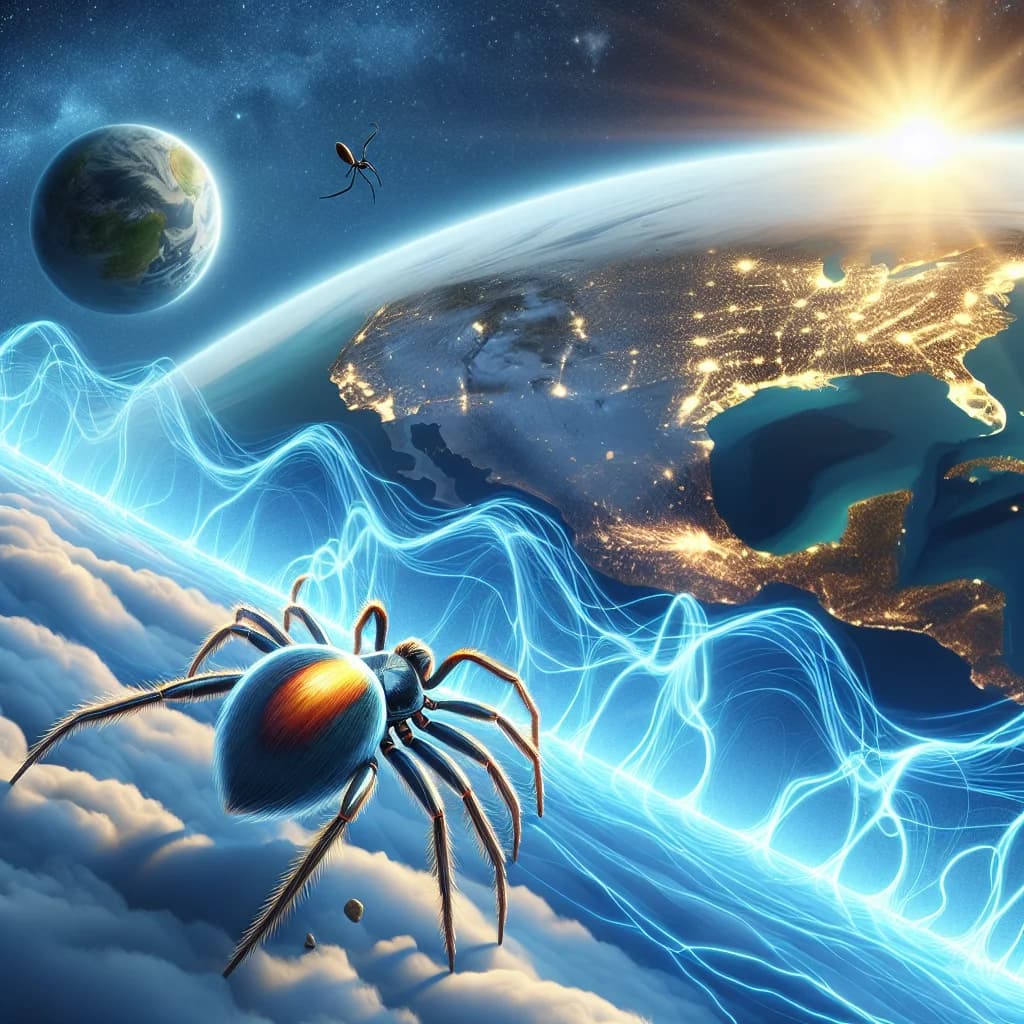
Forget everything you know about flight—spiders don’t need wings or wind to soar miles into the sky. Discover the hidden science of how these eight-legged aviators harness the Earth’s invisible electric fields to defy gravity and launch into the atmosphere.

Too Long; Didn't Read
Spiders use a technique called ballooning to fly by tapping into the Earth’s natural electric field. They release ultra-fine silk threads that become negatively charged, creating electrostatic lift that propels them upward. This mechanism allows them to travel thousands of miles and reach high altitudes even in the complete absence of wind.
High-Voltage Hikers: Can Spiders Really Use the Earth’s Electric Field to Fly Without Wind?
Imagine standing on a mountaintop and seeing a tiny, wingless creature float past you, ascending toward the clouds. You look around for a breeze, but the air is perfectly still. For decades, scientists were baffled by how spiders—some found as high as 2.5 miles in the atmosphere—could achieve takeoff on days with zero wind. This isn't magic; it is a masterclass in biological engineering.
The secret lies in the Earth’s Atmospheric Potential Gradient (APG), a natural electric circuit that exists between the ground and the upper atmosphere. By applying the principles of electrostatics and fluid dynamics, we can see how spiders have evolved to "sail" on electric fields. This post will analyze the physics of electrostatic flight and how these tiny arachnids harness the very energy of our planet to travel across oceans.
The Earth as a Giant Battery
To understand spider flight, we first have to look at the Earth itself. Our planet acts like a massive electric circuit. The ground has a negative charge, while the upper atmosphere is positively charged. On a clear day, this creates an electric field of about 100 to 120 volts for every meter you move upward.
While humans don’t feel this charge, for a creature weighing only a few milligrams, it is a significant source of power. This electric field fluctuates based on weather patterns; during thunderstorms, the voltage can skyrocket to tens of thousands of volts per meter. Spiders have learned to detect these invisible forces using specialized sensory hairs called trichobothria. These hairs are so sensitive they can detect the shift in an electric field, signaling to the spider that "flight conditions" are optimal.
The "Tiptoe" Launch and Silk Sails
When a spider decides to travel, it performs a behavior known as "tiptoeing." It straightens its legs and raises its abdomen toward the sky. It then releases multiple strands of gossamer silk.
The Physics of Electrostatic Repulsion
Unlike a kite that needs wind to create high and low pressure, spider silk utilizes Coulomb’s Law. As the silk leaves the spider's spinnerets, it picks up a negative charge. Because the Earth's surface is also negatively charged, the silk is physically repelled by the ground.
- Surface Area to Mass Ratio: A typical "ballooning" spider weighs between 0.2 and 5 milligrams.
- The Silk "Fan": Instead of one thick rope, the spider releases dozens of microscopic, fan-like fibers. This increases the surface area, allowing the electric field to exert more upward force (lift) on the negatively charged silk.
Calculating the Lift: More Power Than You Think
Is the Earth's electric field strong enough to lift a solid object? In a laboratory setting, researchers at the University of Bristol demonstrated that even in the absence of air movement, spiders would take off when an electric field was turned on.
- Force vs. Gravity: For a 1-milligram spider, the force of gravity is roughly 10 micronewtons.
- Electric Thrust: In a standard 100 V/m field, a few meters of charged silk can generate enough electrostatic force to counteract gravity entirely.
- Atmospheric Elevators: Once the spider is airborne, the upward-reaching lines of the APG act like an invisible elevator. As the spider rises, it enters different layers of the atmosphere, allowing it to "surf" on electric currents that can carry it thousands of miles across the sea.
Environmental and Biological Consequences
This ability to use electricity for transport has profound ecological impacts. It explains how spiders are often the first species to colonize new volcanic islands. Because they don't rely on unpredictable winds, they can "launch" whenever the electric conditions are right.
This creates a high-altitude "aerial plankton" layer. The atmosphere is teeming with these tiny travelers, moving silently and efficiently without burning a single calorie of internal energy for propulsion. It is a completely green, zero-emission transportation system designed by evolution.
Conclusion
The phenomenon of spiders utilizing the Earth’s natural electric field transforms our understanding of animal migration. By combining the biology of silk production with the physics of the Atmospheric Potential Gradient, spiders have unlocked a method of travel that bypasses the need for wings or wind. They are essentially biological capacitors, sensing and reacting to the invisible voltages that surround us all.
This discovery reminds us that the natural world is filled with hidden forces. While we see a calm, still day, a spider sees a high-voltage highway waiting to be explored. It is a stunning example of how life adapts to the fundamental laws of physics in ways we are only just beginning to map.