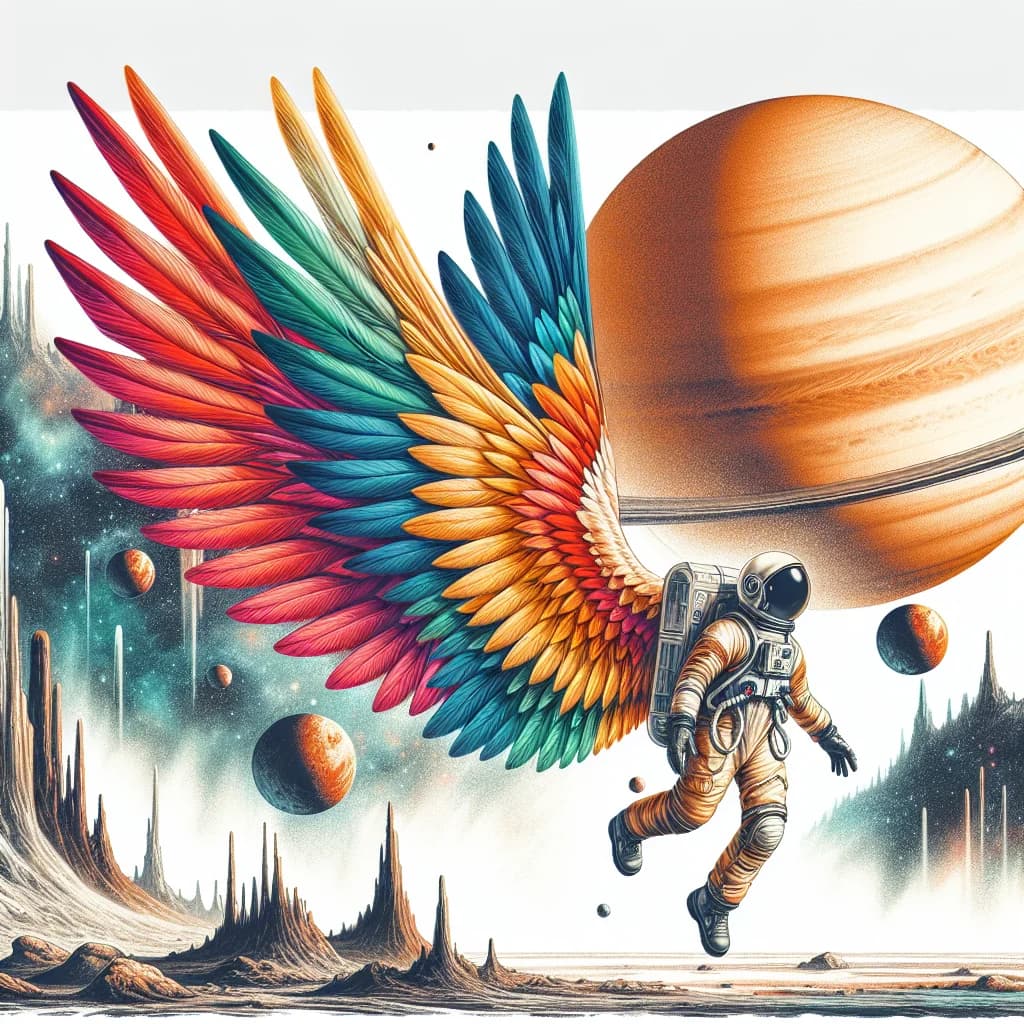
Why could a human fly by strapping wings to their arms on Saturn's moon Titan
Imagine soaring through an alien sky using nothing but your own muscle power and a pair of artificial wings. On Saturn’s moon Titan, a unique mix of low gravity and thick air turns the impossible dream of human flight into a startling scientific reality.

Too Long; Didn't Read
Titan combines weak gravity with an incredibly thick atmosphere. Because the dense air provides high lift while the low gravity exerts minimal downward pull, a person would have enough physical strength to achieve flight simply by flapping arm-mounted wings.
Could Humans Really Fly Like Birds on Saturn's Moon Titan?
Imagine standing on a cold, orange-hued shoreline where the "sand" is actually frozen grains of water ice and the "oceans" are liquid methane. You look up into a thick, hazy sky and realize you aren't weighted down by the heavy pull of Earth. Instead, you feel light, bouncy, and remarkably agile. In this alien landscape, a long-held dream of humanity becomes a physical reality: flight through muscle power alone. While Earth’s gravity and thin air keep us firmly grounded, Saturn’s largest moon, Titan, offers a unique laboratory for the laws of physics. By analyzing the intersection of low gravitational pull and high atmospheric density, we can determine exactly how a human could soar through Titan’s skies using nothing more than a pair of strapped-on wings and a bit of arm strength.
The Perfect Storm for Flight: Gravity vs. Density
To understand why flight is possible on Titan, we have to look at the "flight ratio"—the relationship between how hard gravity pulls you down and how much "stuff" there is in the air to push you up.
1. The Lightness of Being
Titan is a small world with a diameter roughly 40% of Earth's. Consequently, its gravitational pull is much weaker—specifically, about 0.138g. To put that into perspective, if you weigh 180 pounds (81 kg) on Earth, you would weigh a mere 25 pounds (11 kg) on Titan. This drastically reduces the amount of upward force, or "lift," required to get your body off the ground.
2. Swimming Through Air
While the gravity is low, the atmosphere is surprisingly thick. Titan’s surface pressure is about 1.45 times that of Earth’s, but because the air is so cold (-290°F or -179°C), the molecules are packed tightly together. This results in an atmospheric density roughly four times higher than Earth’s. On Titan, walking through the air feels a bit more like moving through a swimming pool, providing a massive amount of resistance for a wing to push against.
Doing the Math: How Big Would Your Wings Need to Be?
On Earth, human-powered flight is an extreme engineering challenge. To stay aloft, a human must pedal a bicycle-like mechanism connected to wings with a span of over 100 feet. On Titan, the math changes in our favor.
- The Lift Equation: Lift is generated based on the density of the fluid ($\rho$), the velocity of the movement ($v$), and the surface area of the wing ($A$).
- The Comparison: Because Titan’s air is 4 times denser and the gravity is 7 times weaker than Earth’s, the total "effort" required to fly is roughly 28 times lower.
- Wing Size: Scientific estimations suggest that a human could maintain level flight on Titan using wings with a surface area of about 6 to 10 square feet per arm. This is roughly the size of two large swim fins or a pair of oversized capes.
Instead of needing a massive aircraft, a person could essentially strap "arm-flippers" to their suit and achieve takeoff by simply running and flapping.
The Physical Experience of Titan Flight
What would it actually feel like to be a "human bird" on this moon?
- Low Stall Speed: On Earth, a plane must travel at high speeds to stay in the air. On Titan, you could likely stay aloft while moving at a brisk jogging pace.
- Muscle Power: Since your effective weight is so low, your pectoral and back muscles would finally be strong enough to generate the necessary thrust. You wouldn't need a motor; your morning gym routine would be your engine.
- Environmental Constraints: While the physics of flight are easy, the environment is harsh. You would need a pressurized, heated suit and oxygen. However, even with the added mass of a heavy life-support suit, the 0.138g gravity ensures you remain light enough to fly.
Conclusion
The scientific outcome of our thought experiment is clear: Titan is the premier destination for human-powered aviation. The moon’s unique combination of weak lunar-like gravity and a thick, dense atmosphere overcomes the biological limitations that keep us tethered to Earth. By applying the fundamental laws of fluid dynamics and gravitation, we see that a human could indeed fly with simple arm-mounted wings. This fascinating scenario reminds us that "impossible" feats like human flight aren't universal constants; they are merely products of the environment we inhabit. While we may never flap our arms to fly on Earth, the physics of our solar system suggests that, somewhere else in the dark reaches of space, we could truly touch the clouds.