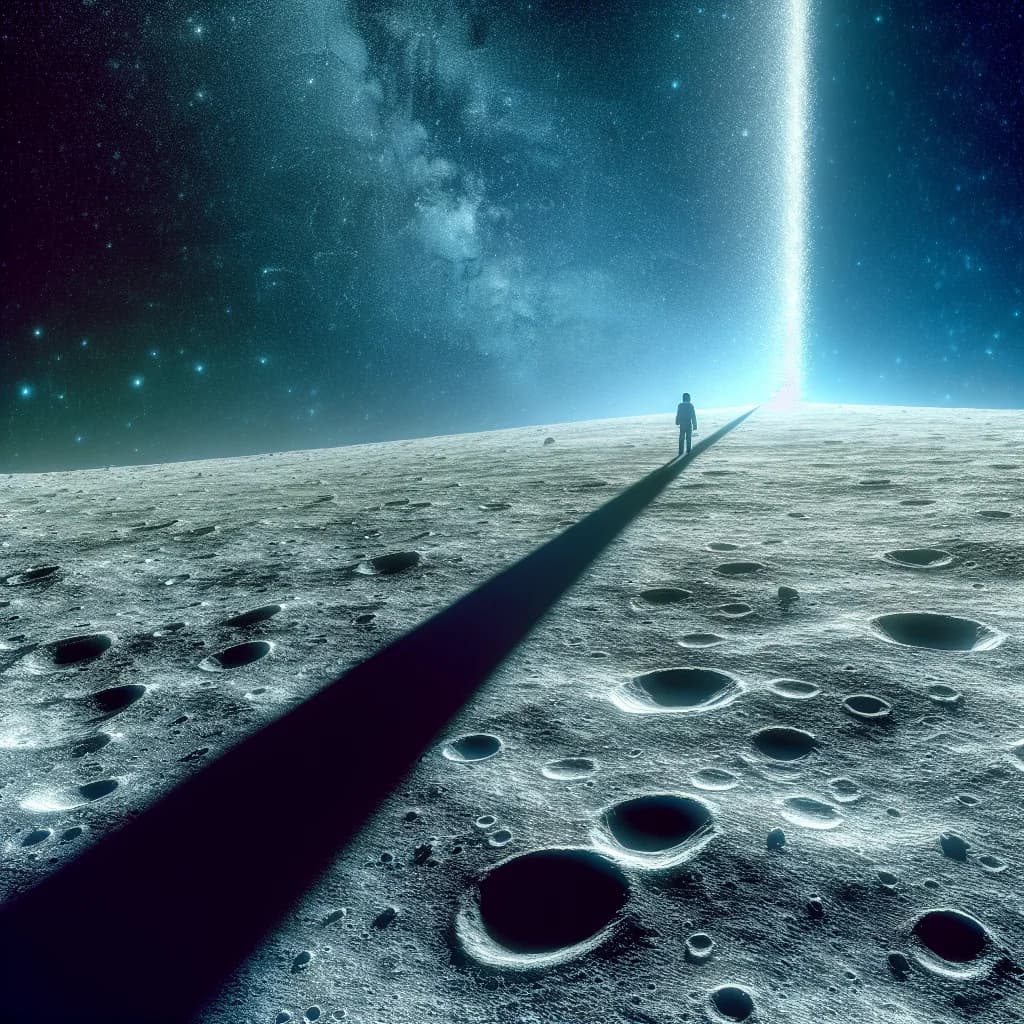
Why do astronauts see mysterious light flashes with their eyes closed while passing through the South Atlantic Anomaly
Even with their eyes tightly shut, astronauts passing through the “Bermuda Triangle of Space” witness ghostly explosions of light that shouldn’t exist. Discover the unsettling science behind these cosmic flashes and why this magnetic anomaly is one of the most mysterious regions in orbit.

Too Long; Didn't Read
Astronauts experience light flashes in the South Atlantic Anomaly because high-energy cosmic rays and protons pass through the spacecraft and interact directly with their eyes. These particles trigger the retina or create Cherenkov radiation in the eye fluid, causing the brain to perceive bursts of light known as phosphenes even when eyes are closed.
Shadows and Sparkles: Why Do Astronauts See Mysterious Light Flashes in the South Atlantic Anomaly?
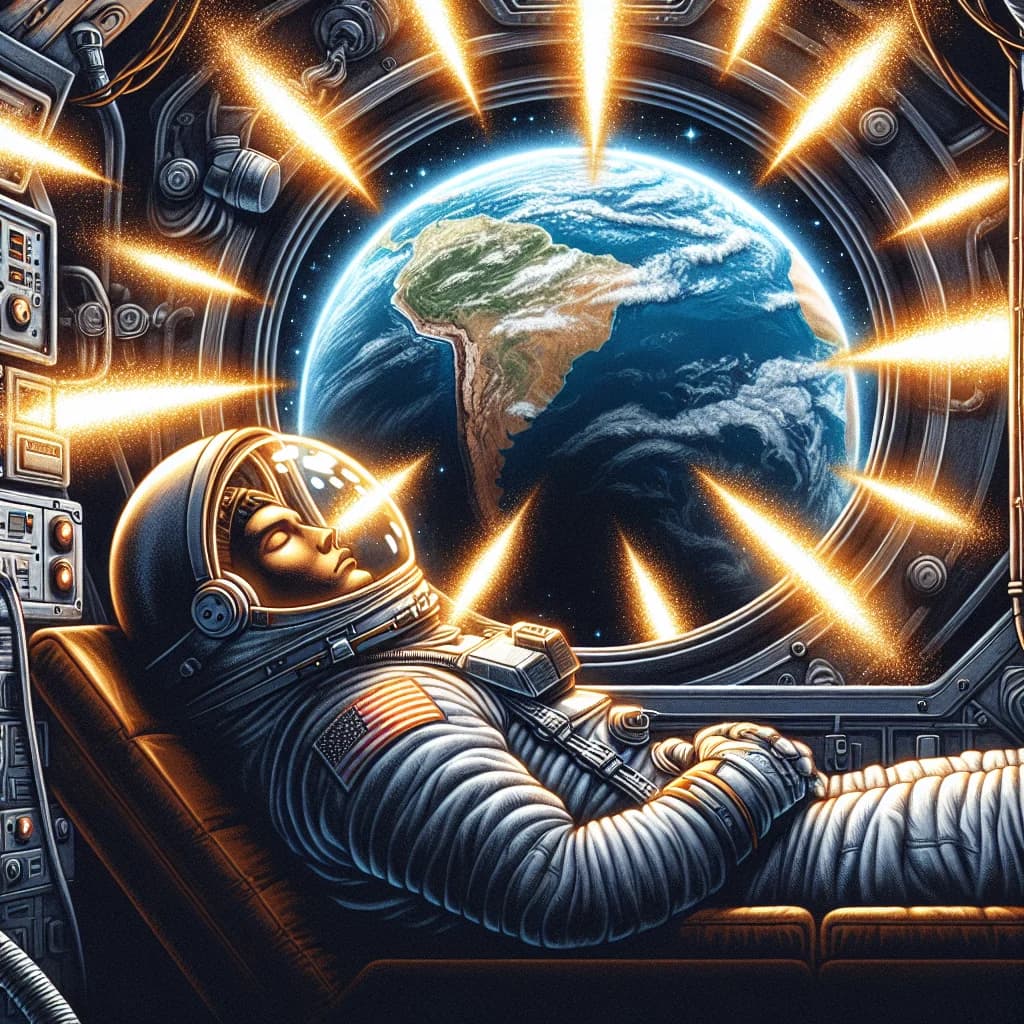
Imagine you are an astronaut aboard the International Space Station (ISS). It is "night" during your orbital cycle, and you have settled into your sleeping quarters. You close your eyes, drifting into the quiet of microgravity, when suddenly—zap! A brilliant streak of light flashes across your vision. A few moments later, a tiny starburst appears, then a faint glow. You aren’t dreaming, and your eyes are definitely closed. This eerie "cosmic firework show" is a well-documented phenomenon, particularly when spacecraft pass through a specific region known as the South Atlantic Anomaly (SAA). By blending the disciplines of magnetospheric physics and sensory biology, we can decode why the "Bermuda Triangle of Space" causes these phantom lights.
The Galactic Pothole: What is the South Atlantic Anomaly?
To understand the flashes, we must first look at the Earth’s protective "bubble." Our planet is shielded by the Van Allen radiation belts—two giant, donut-shaped rings of energetic charged particles trapped by Earth’s magnetic field. Normally, these belts hover thousands of kilometers above us. However, because the Earth’s magnetic axis is slightly tilted and offset from its rotational axis, there is a specific "dent" in the magnetic field over South America and the southern Atlantic Ocean.
In this region, known as the South Atlantic Anomaly (SAA), the inner radiation belt dips down to an altitude of just 200 kilometers. Since the ISS orbits at roughly 400 kilometers, it passes directly through this high-intensity radiation zone several times a day. While the ISS shielding protects the crew from most harm, it cannot stop everything.
Cosmic Bowling: High-Energy Particles vs. The Human Eye
The mysterious flashes are officially known as "cosmic ray visual phenomena." They occur because the SAA is densely packed with high-energy protons and heavy ions moving at relativistic speeds—nearly the speed of light. When an astronaut enters the SAA, the frequency of these particle strikes increases by a factor of 30 or more compared to other parts of the orbit.
But how does a particle transform into a visual flash? There are two primary scientific theories:
1. Cherenkov Radiation: The Optical Sonic Boom
When a charged particle travels through a medium (like the vitreous humor, the clear gel inside your eye) faster than light can travel through that same medium, it creates a "shockwave" of light. This is called Cherenkov radiation. It is the optical equivalent of a supersonic jet breaking the sound barrier. To the astronaut, this appears as a faint, bluish flash or a "streak" as the particle zips through the eyeball.
2. Direct Ionization
Alternatively, these high-energy particles can physically strike the retina at the back of the eye. As the particle passes through the light-sensing cells (rods and cones), it can trigger a chemical reaction or an electrical impulse just as a photon of actual light would. The brain receives a signal saying "Look, light!" even though the eyelids are shut tight.
Measuring the Invisible
To put the scale of this into perspective, consider the following metrics:
- Particle Density: In the heart of the SAA, the radiation flux can be hundreds of times higher than in the surrounding space.
- The Speed of Impact: These protons are traveling at approximately 90% the speed of light. At this velocity, a particle could travel from New York to Los Angeles in roughly 0.015 seconds.
- Observation Frequency: During the Apollo missions, astronauts reported seeing these flashes roughly once every 2.9 minutes. In the SAA, this frequency increases significantly, creating a "dazzling" effect for the observer.
While these "phosphenes" (the technical term for seeing light without light entering the eye) are harmless in the short term, they serve as a constant reminder of the intense environment of Low Earth Orbit.
Conclusion
The mysterious light flashes seen by astronauts are not ghosts or equipment malfunctions, but a direct encounter with the raw power of the cosmos. Driven by the unique geometry of the South Atlantic Anomaly and the physics of Cherenkov radiation, these visual anomalies prove that our bodies can sense the invisible forces of the universe. By studying how high-energy protons interact with the human eye, scientists gain vital data on radiation protection for future missions to the Moon and Mars. This phenomenon reminds us that even in the darkest reaches of space, the universe is teeming with hidden energy, waiting to be "seen" in the most unexpected ways.