Why do two pieces of bare metal instantly fuse together if they touch in the vacuum of space
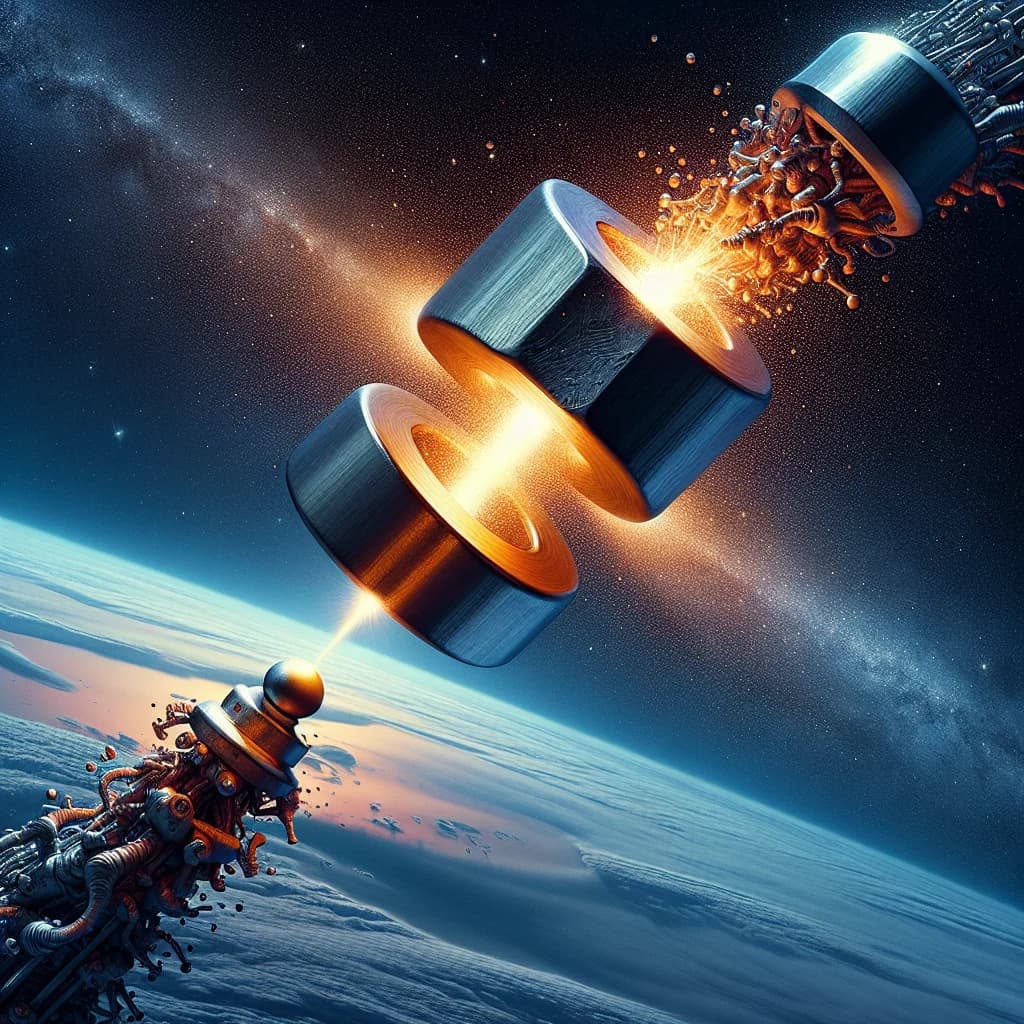
Imagine two separate pieces of metal instantly becoming one solid object the moment they touch, without any heat or sparks. In the silent vacuum of space, atoms "forget" they belong to different parts, triggering a bizarre physical phenomenon that defies everything we know about the solid world on Earth.

Too Long; Didn't Read
Cold welding occurs in space because the absence of oxygen prevents a protective oxide layer from forming on metal surfaces. Without this barrier, the atoms in separate pieces of metal cannot distinguish themselves from one another and bond instantly upon contact.
The Infinite Bond: Why Do Metals Instantly Fuse in the Vacuum of Space?
Space is a realm where our Earthly intuition often fails us. In the familiar environment of our atmosphere, if you tap two aluminum blocks together, they simply clink and part ways. However, in the silent, airless void of the cosmos, those same two blocks could undergo a transformation that seems like magic: they can instantly fuse into a single, solid piece of metal. This phenomenon, known as cold welding, is not the result of heat or intense pressure, but rather a fascinating quirk of surface chemistry and solid-state physics. To understand this "instant glue" of the stars, we must examine the behavior of atoms when the protective shield of Earth’s atmosphere is stripped away.
The Atomic Identity Crisis: Why Metals Forget Their Boundaries
On a fundamental level, metals are composed of an organized lattice of atoms surrounded by a "sea" of shared electrons. This unique structure allows metals to conduct electricity and be shaped into tools. In a vacuum, when two clean, bare metallic surfaces come into contact, the atoms on the surface of one piece "look" across the gap and see the atoms of the other piece.
Because there is no air or moisture between them, the atoms have no way of knowing they belong to different objects. From the perspective of a copper atom, the copper atom in the adjacent block looks identical to its neighbor within its own block. When they touch, the metallic bonds extend across the interface. The two pieces effectively become one because their atomic lattices align and merge.
The Invisible Barrier: Why This Doesn't Happen on Earth
You might wonder why your car doesn't fuse to the garage floor or why your silverware doesn't become a single metallic clump in the kitchen drawer. The reason is oxygen.
- The Oxide Layer: On Earth, our atmosphere is roughly 21% oxygen. When metal is exposed to air, it reacts almost instantaneously (within nanoseconds) to form a thin layer of oxidation.
- Nanoscale Shields: This oxide layer is incredibly thin—often only 2 to 5 nanometers thick (about 20,000 times thinner than a human hair)—but it acts as a powerful chemical insulator.
- The Barrier Function: This layer prevents the metal atoms of two different objects from ever truly touching. Even when you press them together, you are actually pressing two layers of "rust" or oxide against each other, which do not share electrons in the same way bare metals do.
In the vacuum of space, however, there is no oxygen to replenish this layer. If two pieces of metal are cleaned or if their surfaces are rubbed together hard enough to scrape off the existing oxide, there is nothing to stop the pure metal underneath from bonding.
Measuring the Strength of the Void
The efficiency of cold welding depends on the materials involved and the "cleanliness" of the contact. Scientists use the following metrics and principles to analyze these interactions:
- Surface Energy: Every square centimeter of bare metal has a specific surface energy. In a vacuum, the system wants to reach the lowest energy state possible. Joining two surfaces into one reduces the total surface area, which is energetically favorable.
- Lattice Matching: Cold welding is most effective between identical metals. If you touch a piece of pure gold to another piece of pure gold, the lattice structures match perfectly.
- Pressure and Friction: While "instant" fusion can occur, it is often accelerated by "fretting"—small sliding movements that scrub away any residual contaminants, allowing for 100% metallic contact.
To put the scale into perspective, if you were to cold-weld two 1-kilogram cubes of steel in a perfect vacuum, the resulting bond could theoretically support the entire weight of the cubes as if they had been forged in a furnace. The joint is not a "sticking" point; it is a continuous crystalline structure.
Real-World Consequences: When Satellites Get Stuck
While cold welding sounds like a convenient way to build space stations without a blowtorch, it is more often a significant engineering headache. If a mechanical joint, a hinge, or a landing gear component is not properly designed, it can "seize" permanently.
- The Galileo Mission: One of the most famous examples occurred with the Galileo spacecraft in the 1990s. Its high-gain antenna failed to deploy fully because several of its ribs cold-welded together during the journey to Jupiter.
- Mitigation Strategies: To prevent accidental fusion, NASA and other space agencies use specialized coatings. They often plate moving parts with gold (which does not oxidize but is soft) or use dry lubricants like molybdenum disulfide. In some cases, engineers simply ensure that two different types of metal touch, as dissimilar atomic structures are less likely to "recognize" each other and fuse.
Conclusion
The phenomenon of cold welding is a vivid reminder that the "laws" of physics we experience on Earth are often moderated by our atmosphere. In the vacuum of space, the absence of a simple layer of oxygen allows the fundamental nature of metallic bonding to assert itself, turning two objects into one through the mere act of contact. By understanding the dance of atoms and the necessity of surface barriers, we can better prepare our machines for the harsh, unforgiving, and sometimes "clingy" reality of the final frontier. It teaches us that even in the vast emptiness of the void, matter is always looking for a way to connect.