Why do two touching grapes produce a ball of glowing plasma inside a kitchen microwave
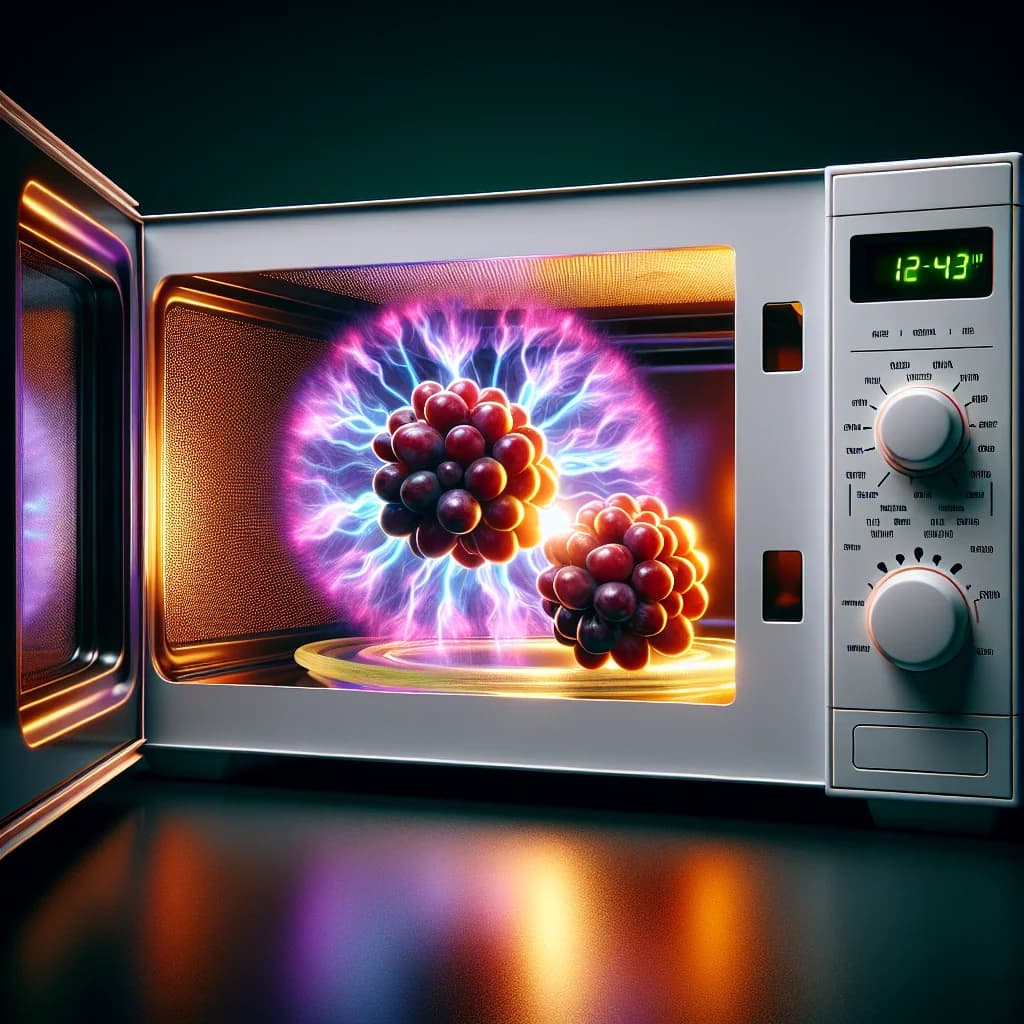
It sounds like a dangerous kitchen myth, but placing two touching grapes in a microwave creates a literal fireball of glowing plasma. Uncover the mind-bending physics behind this miniature lightning show and why it baffled scientists for decades.

Too Long; Didn't Read
Grapes act as resonant cavities that trap and concentrate microwave energy due to their specific size and water content. When two grapes touch, the energy is focused at the junction point, creating an intense electromagnetic field that ionizes surface salts and air into a ball of glowing plasma.
From Fruit to Fireball: Why Do Touching Grapes Create Plasma in Your Microwave?
If you place two grapes side-by-side in a microwave and hit "start," you aren't just heating a snack—you are witnessing a high-energy physics experiment. Within seconds, a brilliant, crackling orb of glowing plasma will erupt between the two fruits, hovering like a miniature sun. While this might look like a kitchen glitch or a supernatural event, it is actually a complex demonstration of nanophotonics and electromagnetic resonance.
The foundational parameters of this phenomenon involve the interaction between standard 2.45 GHz microwave radiation and the specific dielectric properties of water-rich spheres. By applying the principles of classical electromagnetism, optics, and thermal ionization, we can deconstruct how a humble piece of fruit becomes a particle accelerator in your kitchen. This post explores the fascinating journey from liquid-filled fruit to ionized gas.
The Dielectric Resonator: Grapes as Light Traps
For years, many believed the "grape plasma" effect required a thin bridge of skin to act as a wire. However, recent high-speed thermal imaging has proven that two whole grapes just touching each other will suffice. The secret lies in the grape’s composition—mostly water.
Water has a high refractive index and a high dielectric constant at microwave frequencies. In a vacuum, microwaves have a wavelength of about 12 centimeters. However, when these waves enter the water-filled interior of a grape, the wavelength shrinks by a factor of about nine, reducing it to roughly 1.3 centimeters.
- Size Correspondence: Because a standard grape is roughly 1.5 to 2 centimeters in diameter, it perfectly matches the shortened wavelength of the microwaves.
- The Resonator Effect: The grape acts as a "dielectric resonator," trapping the microwave energy inside its volume. Instead of passing through, the waves bounce around and become concentrated within the fruit.
The Formation of the "Hot Spot"
When a single grape is microwaved, the energy tends to concentrate at its center. However, when two grapes are placed in contact, the physics changes dramatically. The geometry of two touching spheres creates a focal point at the exact site of contact.
The Physics of Constructive Interference
The microwave energy from both grapes leaks slightly into the narrow gap where they touch. This results in constructive interference, a phenomenon where waves overlap to reinforce one another.
- Energy Concentration: The electromagnetic field at the contact point becomes incredibly intense.
- Electric Field Amplification: Calculations suggest the electric field at this junction can be over 100 times stronger than the field in the rest of the microwave oven.
- Rapid Heating: This concentrated field vibrates the water molecules and dissolved ions at the surface so violently that the temperature skyrockets in a fraction of a second.
From Steam to Star: The Ionization Phase
Once the energy density at the contact point reaches a critical threshold, the transition to plasma begins. This is not a chemical fire, but a physical state change.
As the contact point superheats, it vaporizes the water and the minerals dissolved within the grape juice—specifically potassium and sodium. The intense electric field then strips electrons away from these atoms, a process known as ionization.
- The Plasma Result: Once the gas is ionized, it becomes a plasma—a soup of free-moving ions and electrons that can conduct electricity and emit light.
- The Glowing Orb: The resulting fireball is buoyant and rises, often forming a glowing sphere that dances against the ceiling of the microwave.
- Color Signature: The distinct bright yellow or orange glow of the plasma is caused by the "emission spectra" of the potassium and sodium ions, similar to the orange hue of high-pressure sodium streetlights.
Scaling the Intensity: Kitchen vs. Laboratory
To put the intensity of this event into perspective, consider the energy density required to ionize air. The electromagnetic field at the grape junction is comparable to the intensity found in focused high-power laser experiments.
While a microwave usually spreads its 700 to 1,200 watts of power throughout its entire cavity (approx. 30,000 cubic centimeters), the "grape effect" compresses a significant portion of that energy into a space smaller than a cubic millimeter. This represents an energy density increase of several orders of magnitude, turning a household appliance into a functional plasma generator.
Conclusion
The phenomenon of the "microwaved grape" is a spectacular display of how geometry and material composition can manipulate electromagnetic waves. By acting as dielectric resonators, the grapes trap and focus microwave radiation into a tiny hot spot, eventually ionizing the air and mineral vapors to create a brilliant plasma discharge.
This experiment serves as a vivid reminder that the laws of physics are active in even the most mundane settings. The same principles of resonance and wave interference that allow us to create miniature fireballs in a kitchen are the foundation for advanced technologies like fiber optics and specialized medical imaging. It turns out that a grape isn't just a snack—it’s a window into the complex and beautiful world of photonics.