Why does a candle flame become a perfect blue sphere when burning in microgravity
On Earth, fire reaches for the sky, but in the weightless void of microgravity, it transforms into a hauntingly beautiful, glowing blue orb. Discover the strange physics that strip away the flicker to reveal the true, spherical nature of a flame.

Too Long; Didn't Read
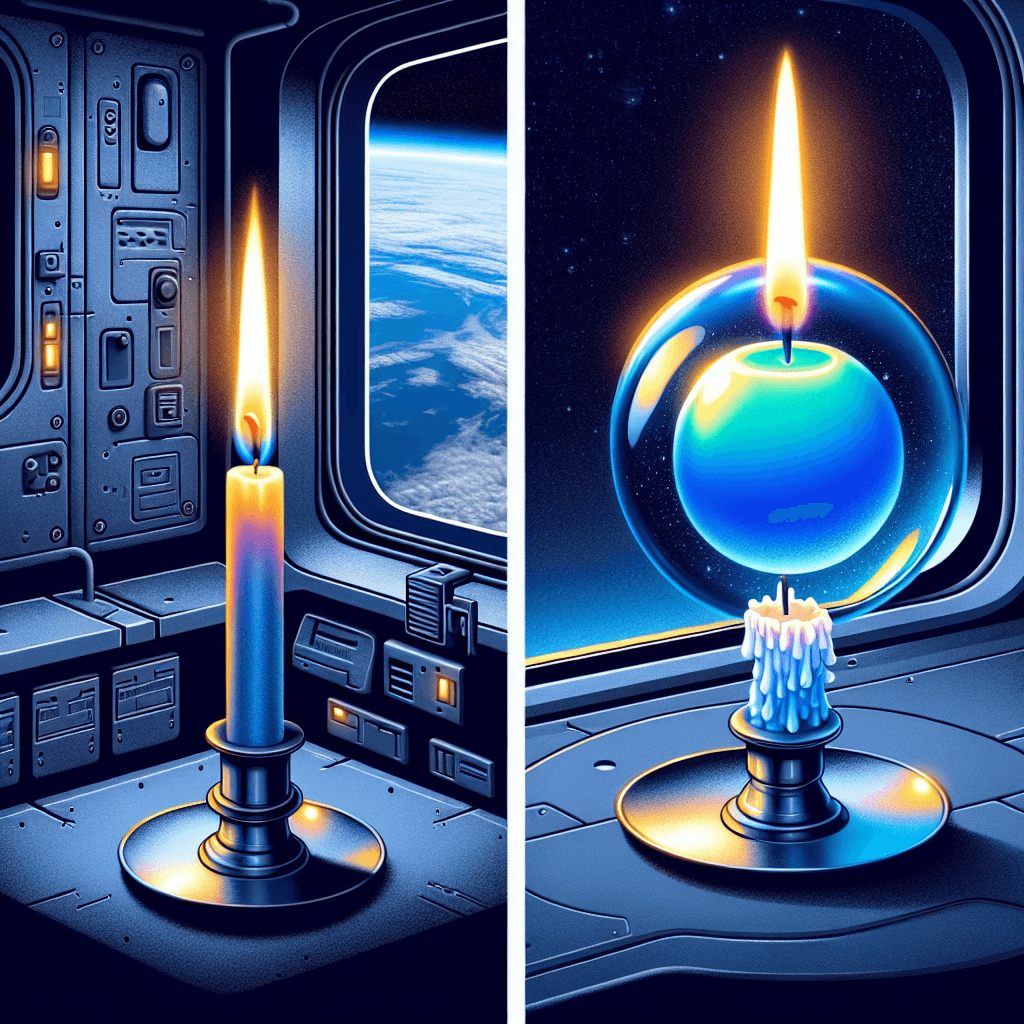
In microgravity, the absence of buoyancy-driven convection prevents hot air from rising into the traditional teardrop shape. Oxygen instead reaches the flame through uniform molecular diffusion from all directions, creating a symmetrical sphere. The blue color indicates lean, efficient combustion that lacks the soot particles responsible for a yellow glow on Earth.
Beyond the Flicker: Why Does a Candle Flame Become a Perfect Blue Sphere in Microgravity?
Imagine lighting a birthday candle aboard the International Space Station. Instead of the familiar, dancing yellow teardrop we see on Earth, the flame transforms into a ghostly, stationary blue orb. This isn't science fiction; it is a fascinating display of fluid dynamics and combustion chemistry. To understand this phenomenon, we must step outside our "1g" comfort zone and look at how gravity—or the lack thereof—dictates the very shape of fire. By applying the principles of thermodynamics, buoyancy, and molecular diffusion, we can uncover why the absence of "up" changes everything we know about a simple wick and wax.
The Shape of Fire: Gravity’s Hidden Hand
On Earth, the shape of a candle flame is governed by a process called buoyancy-driven convection. When you light a candle, the chemical reaction heats the surrounding air. Because hot air is less dense than cool air, gravity pulls the heavier, cooler air downward, pushing the hot gases upward.
This creates a constant "conveyor belt" of gas:
- The Updraft: Hot combustion products rise rapidly, stretching the flame into its iconic elongated teardrop shape.
- The Fresh Intake: As the hot air rises, it draws fresh oxygen into the base of the wick, fueling the fire.
In microgravity, this convection current vanishes. Without gravity to pull the denser air down, there is no "up" for the hot air to go. The movement of gases is no longer a turbulent race; it becomes a slow, orderly expansion.
The Sphere of Stillness: Diffusion Takes Over
Without convection, the flame must rely on a much slower process called molecular diffusion. In this scenario, oxygen molecules don't "rush" into the flame; they drift toward it randomly. Simultaneously, combustion products like water vapor and carbon dioxide drift away from the wick.
Because this happens at an equal rate in every direction, the flame naturally organizes itself into a mathematically perfect sphere.
The Math of the Micro-Flame
To visualize the scale of this change, consider these physical shifts:
- Flow Velocity: On Earth, convective flow can move at roughly 0.5 to 1.0 meters per second. In microgravity, the diffusion speed is often less than 10 centimeters per second.
- Energy Output: Because oxygen arrives so much slower, the candle burns significantly slower. A candle that lasts an hour on Earth might last several hours in space, though it produces much less light.
- Temperature: Earth flames typically peak around 1,400°C (2,552°F). Microgravity flames are often cooler, sometimes burning at temperatures 200°C to 500°C lower than their terrestrial counterparts because the heat isn't concentrated by a rising plume.
Why the Blue Hue? The End of Soot
The most striking difference isn't just the shape—it’s the color. Earth flames are predominantly yellow due to incandescence. In a standard flame, the rising heat is so intense that carbon particles (soot) glow like the filament in a lightbulb before they can fully burn.
In microgravity, two things happen to eliminate the yellow:
- Soot Suppression: Because the flame is cooler and oxygen is limited, the chemical reaction is more uniform.
- Complete Chemiluminescence: Without glowing soot to mask it, we see the natural color of the chemical reaction. This is called chemiluminescence, where excited molecules like $C_2$ (diatomic carbon) and $CH$ radicals emit light in the blue and ultraviolet spectrum.
The result is a dim, sapphire-like glow that represents a "cleaner" but much weaker combustion process.
Atmospheric Consequences: A Gentle Bubble
In the enclosed environment of a spacecraft, these spherical flames create a unique atmospheric interaction. Because there is no wind to whisk away the exhaust, a "blanket" of carbon dioxide and water vapor builds up around the sphere. If the sphere grows too large, it can actually "smother" itself, as the concentration of exhaust prevents fresh oxygen from reaching the reaction zone. This leads to a peaceful, self-extinguishing puff, rather than the flickering burnout we see on Earth.
Conclusion
The transformation of a candle flame into a blue sphere is a masterclass in how gravity masks the underlying laws of physics. On Earth, buoyancy dominates the scene, creating the bright, flickering flames we use for heat and light. In the stillness of microgravity, buoyancy retreats, allowing the elegant, symmetrical power of molecular diffusion to take center stage.
Ultimately, these tiny blue orbs teach us that even the most "common" earthly phenomena—like fire—are actually complex interactions between chemistry and the gravitational pull of our planet. By removing one constant, we reveal a hidden world of spherical perfection and sapphire light.