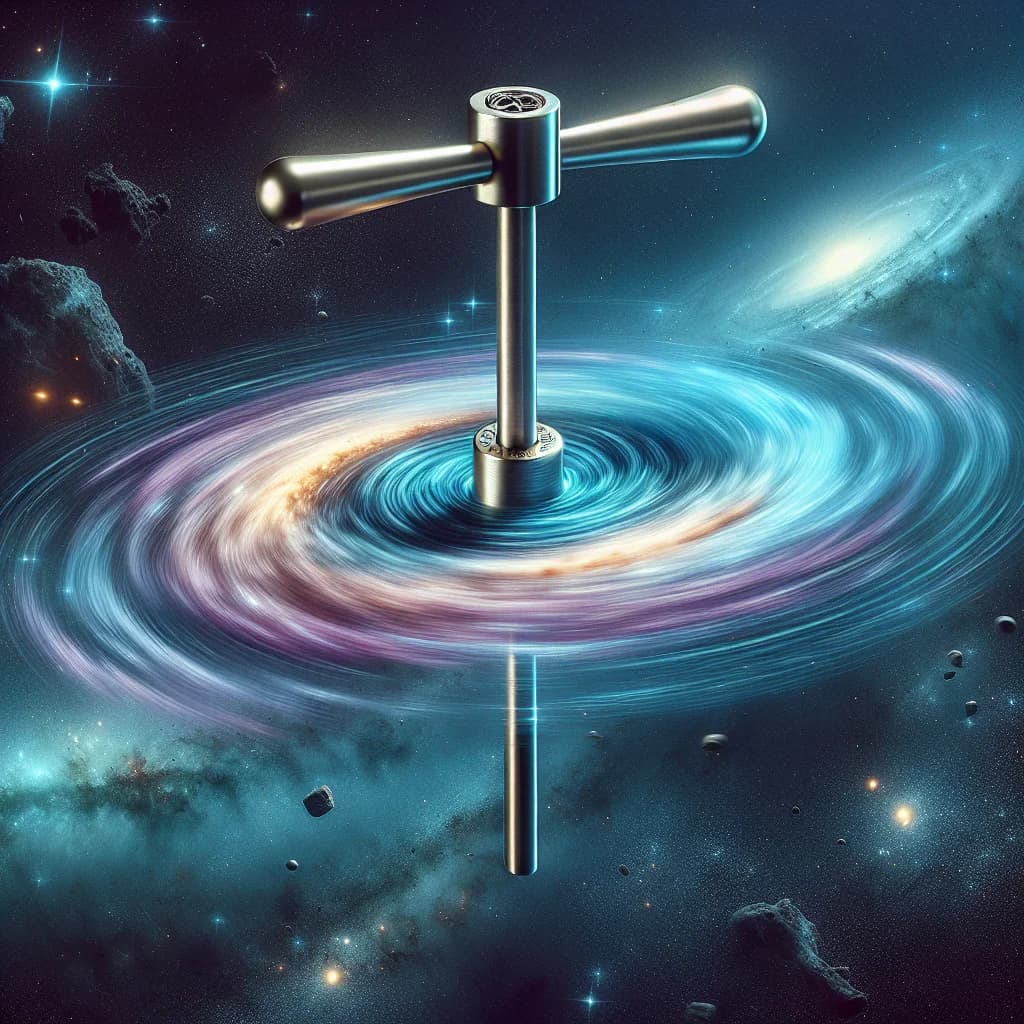
Why does a T-handle spinning in space periodically do a backflip without any outside force acting upon it
In the silent vacuum of space, a spinning T-handle will suddenly perform a spontaneous backflip as if pushed by an invisible hand. Uncover the mind-bending physics behind this "glitch in the universe" and why it reveals a startling truth about the hidden instability of rotating objects.

Too Long; Didn't Read
This phenomenon, known as the Dzhanibekov Effect or the Intermediate Axis Theorem, occurs because rotation around an object’s middle axis is inherently unstable. Due to the way mass is distributed in a T-handle, any tiny wobble while spinning around this axis causes it to periodically flip 180 degrees to conserve its angular momentum and kinetic energy.
The Great Galactic Flip: Why Does a T-Handle Defy Logic in Space?
Imagine you are floating inside the International Space Station. To pass the time, you give a simple T-handle tool a quick spin. At first, it rotates perfectly around its center. But then, without a single puff of air or a nudge from your finger, the handle suddenly performs a somersault, flipping 180 degrees while continuing its spin. A few seconds later, it flips back. It looks like a glitch in the matrix or a ghost at work, but there is no magic involved. This mesmerizing phenomenon, often called the Dzhanibekov Effect, occurs in the vacuum of space without any outside force acting upon the object. By applying the laws of classical mechanics and the Intermediate Axis Theorem, we can peel back the curtain on this strange celestial acrobatics and understand why geometry dictates the behavior of spinning objects.
The Three Pillars of Rotation
To understand why a T-handle flips, we must first look at how objects spin in three-dimensional space. Every solid object has three "principal axes" of rotation, which are essentially the imaginary lines around which it can spin. These axes are defined by their "moment of inertia," a fancy term for how difficult it is to get an object spinning around a specific path based on its mass distribution.
- The Major Axis: This is the axis with the highest moment of inertia (usually spinning the object the "long" way).
- The Minor Axis: This is the axis with the lowest moment of inertia (usually spinning the object around its thinnest point).
- The Intermediate Axis: This is the "middle child" axis, with a moment of inertia that falls somewhere between the highest and lowest values.
In a T-handle, the spin we usually give it is around this intermediate axis. Physics tells us that rotations around the major and minor axes are perfectly stable. However, the intermediate axis is a different story entirely.
The Geometry of Instability
The reason the T-handle flips is rooted in the Intermediate Axis Theorem (also known as the Tennis Racket Theorem). When an object spins in space, it must conserve two things: its angular momentum and its kinetic energy.
If the rotation were mathematically perfect, the handle might spin forever without flipping. However, in the real world, no spin is perfectly aligned. Even a microscopic deviation—perhaps a tiny vibration or an uneven flick of the wrist—causes the object to deviate from its path.
The Energy-Momentum Dance
Imagine the object's rotation as a path on a map. For the major and minor axes, these paths are small, tight circles. If the object wobbles slightly, it just stays in that small circle. But for the intermediate axis, the path across the object’s "momentum surface" is shaped like a giant figure-eight or a wide loop.
- The Accumulation of Error: As the T-handle spins, the tiny initial deviation grows.
- The Reversal: Because the laws of physics require the handle to maintain its total energy, it follows the only path available—a long, sweeping trajectory that carries it all the way to the opposite side.
- The Backflip: This trajectory manifests to our eyes as a 180-degree flip. The handle isn't "deciding" to flip; it is simply following the geometric constraints of its own mass.
Calculations and Real-World Scale
While it looks chaotic, the timing of the flip is actually quite predictable. If you know the mass of the handle (let's say 200 grams) and the specific dimensions of the "T" shape, you can calculate the interval between flips.
- Mass Distribution: The more "extreme" the difference between the three axes, the more pronounced the effect.
- Rotation Speed: A faster spin doesn't stop the flip; it simply increases the frequency of the flips.
- Angular Displacement: In a vacuum, the handle will consistently flip 180 degrees, then flip back 180 degrees, creating a periodic cycle that resembles a rhythmic dance.
This isn't just a quirk of T-handles. You can replicate this on Earth by tossing a tennis racket or a rectangular smartphone (carefully!) into the air while spinning it around its middle axis. You will notice it cannot complete a clean spin without flipping over its short side.
Conclusion
The mysterious backflip of a T-handle in space is a beautiful demonstration of classical mechanics in its purest form. It proves that even in the absence of friction, gravity, or external interference, the internal geometry of an object dictates its destiny. The flip is the result of the Intermediate Axis Theorem, where the "middle" path of rotation is inherently unstable, forcing the object to undergo periodic 180-degree reversals to satisfy the conservation of energy and momentum.
This phenomenon serves as a vital reminder for engineers designing satellites and spacecraft. If a satellite spins around the wrong axis, it could end up tumbling through the void. From the smallest nut on a space station to the largest celestial bodies, the laws of physics ensure that even in the silence of space, there is always a complex and predictable rhythm to the universe.