Why does it rain diamonds on the gas giant planets Neptune and Uranus due to extreme atmospheric pressure
Imagine a world where the clouds don't pour water, but showers of glittering, crystalline diamonds. Discover the mind-bending physics that transform simple gas into a literal rain of precious gems deep within the crushing atmospheres of Neptune and Uranus.

Too Long; Didn't Read
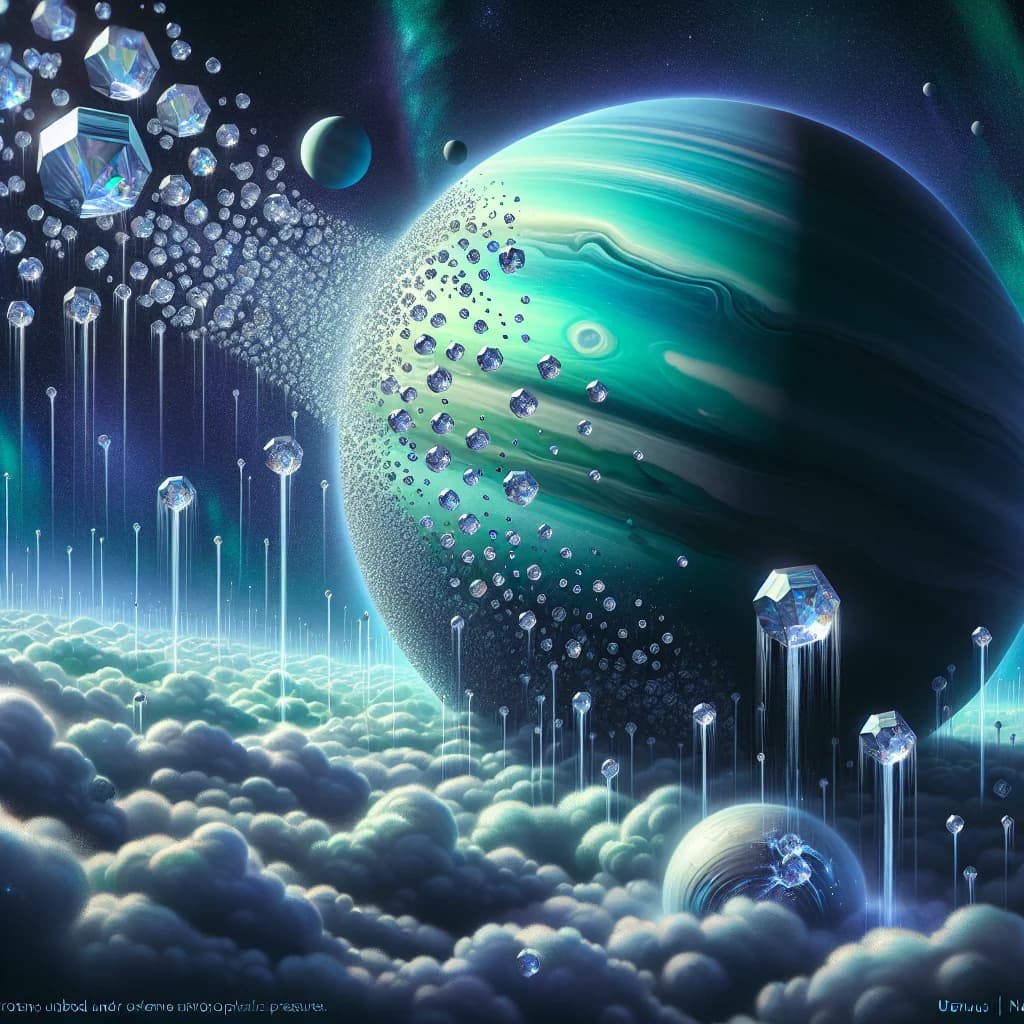
Extreme atmospheric pressure and intense heat on Neptune and Uranus break down methane gas, stripping away hydrogen and compressing the remaining carbon into solid diamonds. These diamonds then sink toward the planets cores in a phenomenon known as diamond rain.
Could It Actually Rain Diamonds? Exploring the Sparkling Skies of Neptune and Uranus
Imagine a world where the weather forecast doesn’t involve umbrellas for rain or shovels for snow, but rather a hard hat for falling gemstones. In the deep, crushing atmospheres of our solar system’s "ice giants," Neptune and Uranus, scientists believe a phenomenon occurs that sounds like the plot of a science fiction novel: it rains diamonds. While this sounds like a cosmic treasure chest, it is actually a rigorous consequence of extreme planetary physics. By examining the intersection of high-pressure thermodynamics and carbon chemistry, we can peel back the teal-colored clouds of these distant worlds to understand how a simple gas like methane transforms into a girl’s best friend.
The Chemistry of a Cosmic Pressure Cooker
To understand diamond rain, we must first look at what these planets are made of. Unlike Jupiter and Saturn, which are mostly hydrogen and helium, Neptune and Uranus are "ice giants." They possess thick atmospheres rich in water, ammonia, and—most importantly—methane.
Methane is a simple molecule consisting of one carbon atom bonded to four hydrogen atoms ($CH_4$). In the upper reaches of these planets, methane is just a gas. However, as you descend deeper into the planetary mantle, the environment changes drastically. The atmospheric pressure increases to millions of times the pressure we experience at sea level on Earth.
Breaking Bonds: From Gas to Gemstone
When methane molecules are subjected to the intense heat and pressure found thousands of kilometers beneath the cloud tops, the chemical bonds holding them together begin to fail. This process, known as "dissociation," releases the carbon atoms from their hydrogen anchors.
The environment at these depths is staggering:
- Pressure: Estimates suggest pressures reaching up to 600 GigaPascals (GPa), which is roughly 6 million times Earth's atmospheric pressure.
- Temperature: Internal temperatures can soar between 2,000 and 5,000 Kelvin.
Under these conditions, the liberated carbon atoms find themselves squeezed so tightly together that they can no longer exist as a gas or even a liquid. Instead, they crystallize into the most stable form of carbon under high pressure: diamond.
The Mechanics of the "Rain"
Once these diamond crystals form, they don't simply float. Because diamonds are significantly denser than the surrounding hydrogen and helium "soup," they begin to sink toward the planet's core. This is the "rain" in question—a slow-motion descent of glittering stones through the planetary interior.
- Nucleation: Carbon atoms cluster together to form microscopic diamond seeds.
- Growth: These seeds accumulate more carbon as they fall, potentially growing into sizable gemstones over thousands of years.
- Descent: The diamonds sink through the liquid mantle, essentially "raining" toward the solid core.
- Accumulation: Scientists hypothesize that these diamonds might eventually form a thick layer or "diamond iceberg" floating atop the planet’s core.
Proving the Impossible: Laboratory Recreations
Since we cannot yet send a probe into the crushing depths of Neptune, scientists use the next best thing: high-powered lasers and "diamond anvil cells" here on Earth. Researchers at the SLAC National Accelerator Laboratory have used X-ray lasers to shock-compress plastic materials (which contain carbon and hydrogen, similar to methane) to mimic the conditions inside an ice giant.
During these nanosecond-long experiments, researchers observed the carbon atoms instantly rearranging themselves into tiny "nanodiamonds." This empirical evidence confirms that the transition from hydrocarbons to diamonds isn't just a mathematical theory—it is a physical reality in high-pressure environments.
Conclusion
The reality of diamond rain on Neptune and Uranus is a testament to the transformative power of physics. When extreme pressure and intense heat act upon simple molecules, the results are nothing short of spectacular. This phenomenon is driven by the fundamental laws of thermodynamics and the unique chemical composition of the ice giants, turning common methane into a descending shower of crystals.
While we may never be able to harvest these celestial gems, understanding their formation helps us unlock the mysteries of planetary magnetic fields and the evolution of our solar system. It reminds us that even in the cold, dark reaches of space, nature finds a way to create something brilliant and unexpected. Drawing the line between the mundane and the magnificent is often just a matter of enough pressure.