Why does the Kawah Ijen volcano in Indonesia appear to flow with bright blue lava at night
Forget everything you know about red-hot eruptions; at Indonesia’s Kawah Ijen, the earth bleeds a haunting electric blue under the cover of night. Discover the surreal science behind this otherworldly glow and why this "blue lava" is actually one of nature’s most breathtaking illusions.

Too Long; Didn't Read
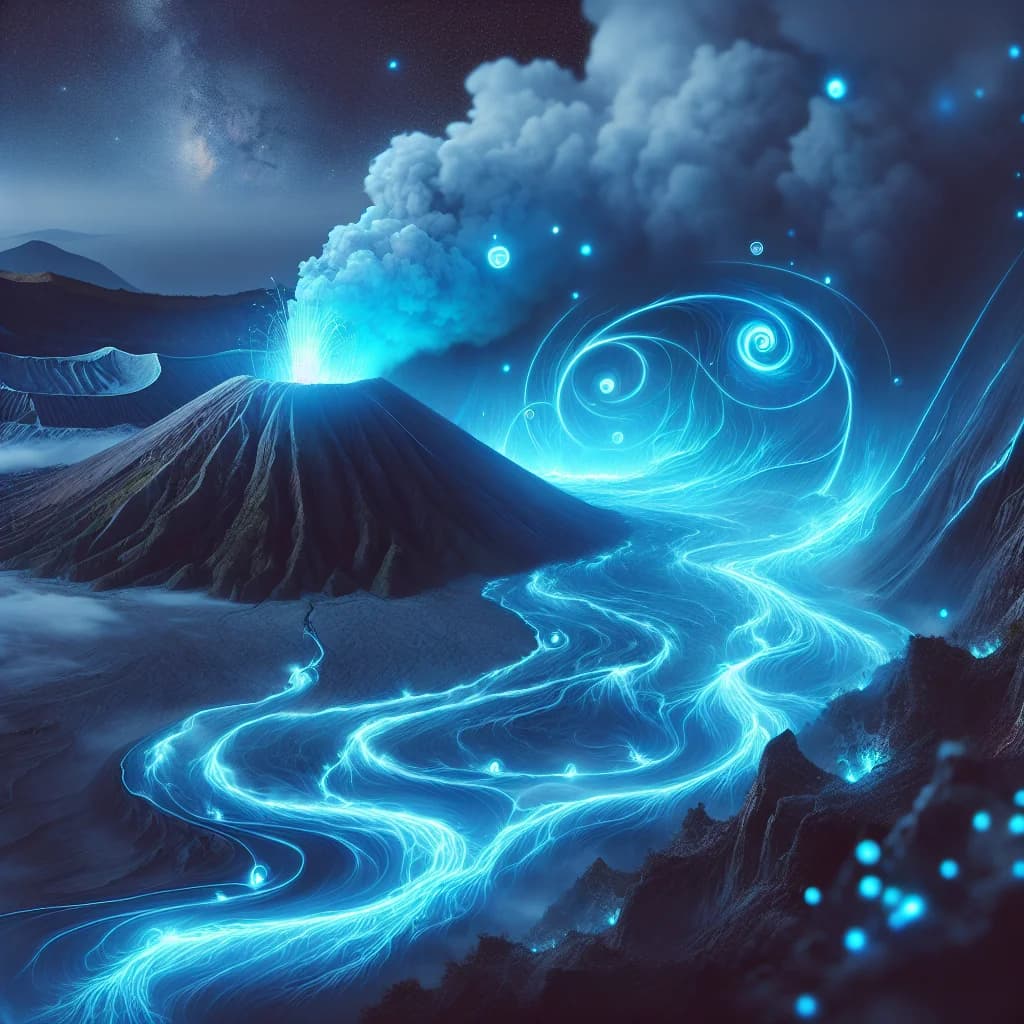
Kawah Ijen glows blue because high-pressure sulfuric gases ignite upon contact with oxygen-rich air at extreme temperatures. This chemical reaction creates brilliant blue flames, while condensing liquid sulfur flows down the mountainside, giving the illusion of electric blue lava.
Beyond the Red: Why Does Kawah Ijen Flow with Electric Blue "Lava" at Night?
Imagine standing on the rim of a massive volcanic crater in the dead of night, expecting the traditional, ember-red glow of molten rock. Instead, you are greeted by a scene from a high-budget science fiction film: rivers of electric blue light cascading down the jagged slopes, illuminating the darkness with an eerie, neon brilliance. This is the reality of Kawah Ijen in East Java, Indonesia. While it looks like a glitch in the geological matrix, this phenomenon is a masterclass in chemistry and physics. To understand why this volcano trades the classic crimson for a ghostly sapphire, we must look beyond the surface of the rock and dive into the high-pressure world of elemental sulfur and the specific mechanics of combustion and light.
The Great Misconception: It’s Not Actually Blue Lava
Before we analyze the physics, we must clarify the foundational chemistry. Despite its popular nickname, the "blue lava" is not lava at all. In geological terms, lava is molten rock (magma) that has reached the Earth’s surface. The temperature of most basaltic lava ranges from 700 to 1,200 degrees Celsius (1,300 to 2,200 degrees Fahrenheit). At these temperatures, molten rock glows red or orange due to black-body radiation.
The blue glow at Kawah Ijen is actually the result of sulfuric gases igniting the moment they contact the oxygen-rich atmosphere. Kawah Ijen is home to some of the highest concentrations of sulfur on the planet. When these gases escape the volcanic vents under immense pressure and heat, they don't just drift away—they burst into flames.
The Chemistry of the Sapphire Flame
The primary driver of this spectacle is the combustion of elemental sulfur. When sulfur burns, it undergoes a chemical reaction that releases energy in a very specific way:
- The Reaction: High-pressure sulfuric gases emerge from volcanic cracks at temperatures exceeding 600°C (1,112°F). When these gases meet the air, the sulfur reacts with oxygen ($O_2$) to create sulfur dioxide ($SO_2$).
- The Blue Light: Unlike a wood fire, which glows yellow or orange due to soot particles, the combustion of sulfur releases energy that manifests in the blue-to-violet end of the visible light spectrum.
- The Flowing Effect: What creates the "flowing lava" illusion is the fact that some of the sulfur gas condenses into liquid form while it is still burning. This creates a literal stream of liquid fire that trickles down the mountainside, mimicking the movement of traditional lava but with a radically different chemical signature.
Physics and the Visible Spectrum
To put the intensity of this light into perspective, we can look at the energy levels involved. Light color is determined by wavelength; blue light has a shorter wavelength and higher energy than red light.
- Thermal Radiation (Red): Standard lava glows because it is hot enough to emit visible light through incandescence.
- Chemical Excitation (Blue): The blue at Kawah Ijen is an example of chemiluminescence. The chemical reaction provides the specific energy needed to excite electrons in a way that they emit blue photons.
This is why the effect is only visible at night. During the day, the blue flames are significantly fainter than the ambient sunlight, making the volcano look like a standard, smoking crater. It is only when the sun sets that the high-energy blue photons dominate the visual field.
A Landscape of Extremes: The Acid Lake and Atmospheric Output
The blue fire is just one part of Kawah Ijen’s unique environmental profile. The volcano also hosts the world’s largest highly acidic crater lake.
- The pH Scale: While a neutral substance like pure water has a pH of 7, the lake at Kawah Ijen has a pH near 0. This is roughly equivalent to the acidity of battery acid.
- Volume and Mass: The lake contains approximately 36 million cubic meters of acidic water, held in place by the volcanic crater.
- Atmospheric Impact: The "blue fire" reaction produces massive amounts of sulfur dioxide. While this creates a stunning visual, it creates a localized atmosphere that is highly corrosive, requiring specialized equipment for any researchers exploring the site.
Conclusion
The mesmerizing blue "lava" of Kawah Ijen is a spectacular reminder that nature is not limited to a single color palette. By applying the principles of thermodynamics and chemical combustion, we can see that the phenomenon is actually a massive, naturally occurring gas fire fueled by deep-earth sulfur deposits. While it mimics the flow of molten rock, it is the unique result of high-pressure gases and chemical excitation.
Ultimately, Kawah Ijen demonstrates the incredible diversity of our planet's geological processes. It bridges the gap between the familiar world of volcanic activity and the exotic chemistry usually reserved for laboratory experiments, proving that the Earth still holds plenty of surprises for those willing to look into the dark.