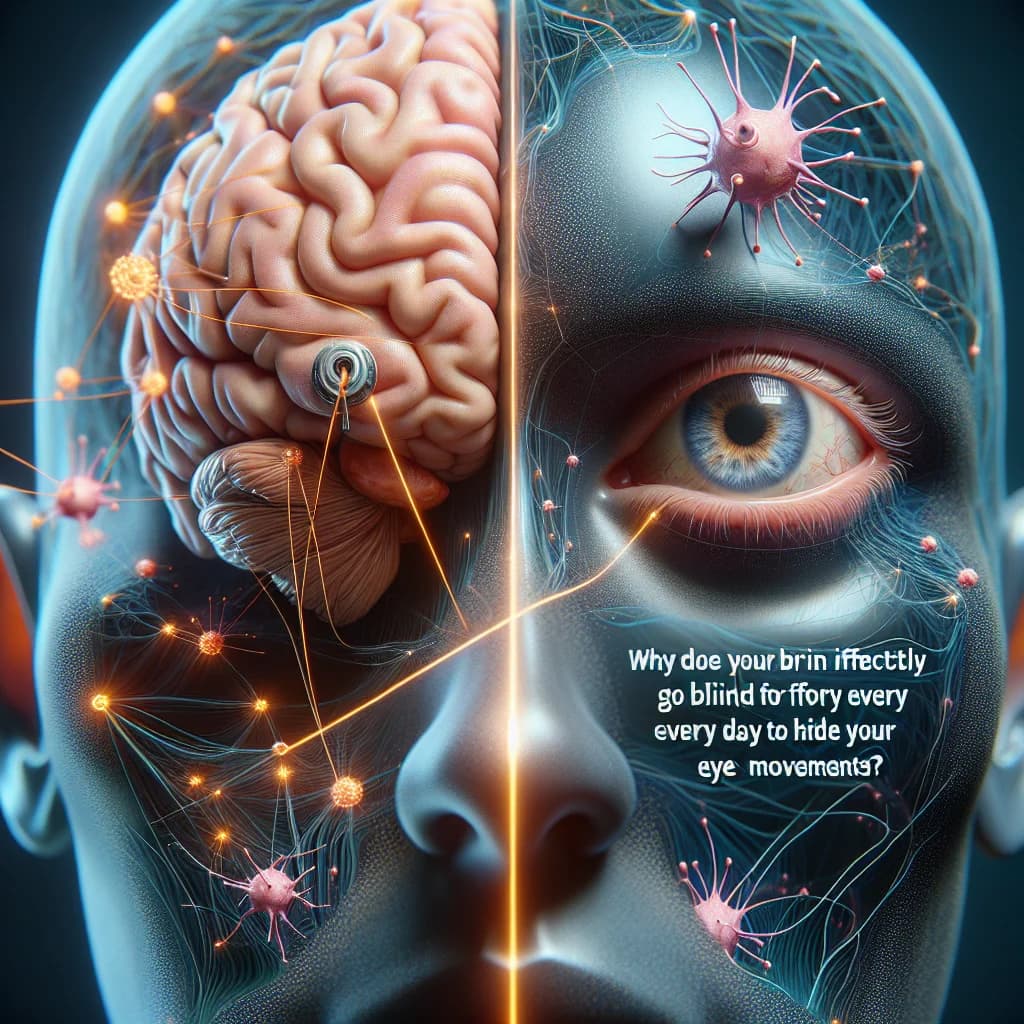
Why does your brain effectively go blind for forty minutes every day to hide your own eye movements
Your brain is constantly "editing" your reality by deleting nearly forty minutes of visual data every single day to protect you from a dizzying blur. Discover the fascinating science behind these hidden moments of total blindness and how your mind stitches your world back together without you ever noticing.

Too Long; Didn't Read
Your brain suppresses visual processing during rapid eye movements known as saccades to prevent motion blur. These micro-blackouts occur thousands of times daily, totaling about 40 minutes of functional blindness to ensure you perceive a stable and clear environment.
Where Does the Time Go? The Mystery of Why Your Brain Deletes Forty Minutes of Your Vision Daily
Have you ever looked at a second hand on an analog clock and felt like it stayed still for just a fraction of a second too long? You aren’t losing your mind; you are experiencing a glitch in the biological "video editing" software of your brain. Every single day, you spend approximately forty to ninety minutes effectively blind. Despite your eyes being wide open and functioning perfectly, your brain chooses to discard huge chunks of visual data. This phenomenon, known as saccadic masking, is a fascinating neurological survival strategy. By examining the mechanics of ocular motion and the processing speed of the visual cortex, we can uncover how our brains stitch together a seamless reality from a fragmented stream of information.
The Rapid-Fire Mechanics of Saccades
To understand why we go blind, we first have to look at how our eyes move. Unlike a smooth cinematic camera pan, human eyes move in jerky, high-speed bursts called saccades. These are the fastest movements the human body is capable of producing.
When you shift your gaze from one side of a room to the other, your eyes don't glide; they snap. During these snaps, your eyes can reach angular speeds of up to 900 degrees per second. If your brain actually processed the visual input during that movement, your world would look like a nauseating, motion-blurred mess. To prevent this, the brain simply "mutes" the signal from the optic nerve during the transit.
Doing the Math: The Forty-Minute Blackout
While a single saccade lasts only a tiny fraction of a second, they add up quickly. Let’s look at the metrics of a typical day:
- Frequency: The average human performs about 3 to 5 saccades per second.
- Duration: Each individual movement lasts between 20 and 200 milliseconds.
- Daily Accumulation: If we take an average of 150,000 saccades per day at approximately 50 milliseconds each, we reach a staggering total.
Mathematically, this equates to roughly 7,500 seconds of total visual suppression. When calculated against a 16-hour waking day, you are effectively "offline" for about 40 to 60 minutes. Essentially, while you think you are seeing a continuous live feed of the world, you are actually watching a highlight reel with nearly an hour of "boring" footage edited out.
Why the Brain Prefers "Blindness" over Blur
Why would evolution choose to make us blind rather than just letting us see the blur? It comes down to cognitive load and physical stability.
- Motion Sickness Prevention: Processing high-speed motion blur is incredibly taxing and can lead to vestibulocochlear confusion (vertigo).
- Object Recognition: Our brains are optimized to identify static or predictably moving objects. The chaotic streak of light during a saccade offers zero useful survival data.
- The "Snapshot" Theory: Your brain functions more like a high-end digital camera taking rapid stills rather than a continuous analog tape. It prioritizes "fixations"—the moments when your eyes are still—to build its map of the world.
Chronostasis: The Brain’s Time-Editing Trick
If we are blind for forty minutes a day, why don't we notice the black gaps? This is where the brain gets creative through a process called chronostasis.
When your eye finishes a movement and lands on a new target, your brain "backdates" the new image to fill the time gap during which you were blind. It effectively stretches the first moment of the new image backward in time. This is why a clock’s second hand seems to freeze momentarily when you first look at it. Your brain is lying to you to ensure your perception of time feels continuous and uninterrupted.
Conclusion: The Master Editor in Your Head
The ultimate scientific outcome of saccadic masking is a perfectly stabilized, though technically incomplete, perception of reality. Our brains prioritize a functional and steady narrative over the raw, messy data provided by our eyes. Guided by the principles of neural suppression and temporal masking, our minds ensure that the "video" of our lives never suffers from motion blur or dropped frames.
This extraordinary biological hack serves as a reminder that what we perceive as "reality" is often a highly curated and edited version of the truth. We are all living in a world where our brains are constantly working behind the scenes to hide the seams of our own biological limitations, proving that sometimes, what you don't see is just as important as what you do.