Why is it mathematically impossible for the wind to be blowing everywhere on Earth at the same time
From the mind-bending "Hairy Ball Theorem" to the geometry of our planet, discover why there is always at least one secret spot on Earth where the air is perfectly still. Explore the fascinating mathematical law that proves a global breeze is a physical impossibility.

Too Long; Didn't Read
According to the Hairy Ball Theorem in topology, a continuous vector field on a sphere must contain at least one point where the vector is zero. In meteorology, this means there is always at least one location on Earth where the wind speed is exactly zero, as it is mathematically impossible to have a perfectly smooth flow of air across the entire planet simultaneously.
Could the Entire Earth Be Windy at Once? The Mathematical Secret of the "Still Spot"
Imagine a world where every leaf on every tree across the globe is rustling simultaneously. From the peaks of the Andes to the Saharan dunes and the streets of Tokyo, a universal breeze flows across every square inch of the planet’s surface. It sounds like a poetic, unified moment for our atmosphere. However, according to the rigid laws of mathematics, this scenario is not just unlikely—it is physically and theoretically impossible.
The Earth is a massive, complex system, but when we strip away the clouds and the terrain, we are left with a fundamental geometric shape: a sphere. By applying the principles of algebraic topology—specifically a fascinating concept known as the Hairy Ball Theorem—we can prove that there must always be at least one place on Earth where the wind is perfectly still.
The Geometry of Airflow: Mapping the Wind
To understand why the wind cannot blow everywhere, we first have to look at wind through the lens of physics. Meteorologists treat wind as a "vector field." In simple terms, every point on Earth has a wind vector associated with it, which tells us two things:
- Magnitude: How fast the air is moving (wind speed).
- Direction: Which way the air is headed.
If the wind were blowing everywhere at once, every single point on the surface of our spherical planet would need a vector with a magnitude greater than zero. However, the Earth’s surface is a "manifold" that curves back on itself. This curvature creates a mathematical boundary that the wind simply cannot escape.
The Hairy Ball Theorem
The most famous proof for this phenomenon is the humorously named Hairy Ball Theorem (proposed by Henri Poincaré and proved by Luitzen Egbertus Jan Brouwer).
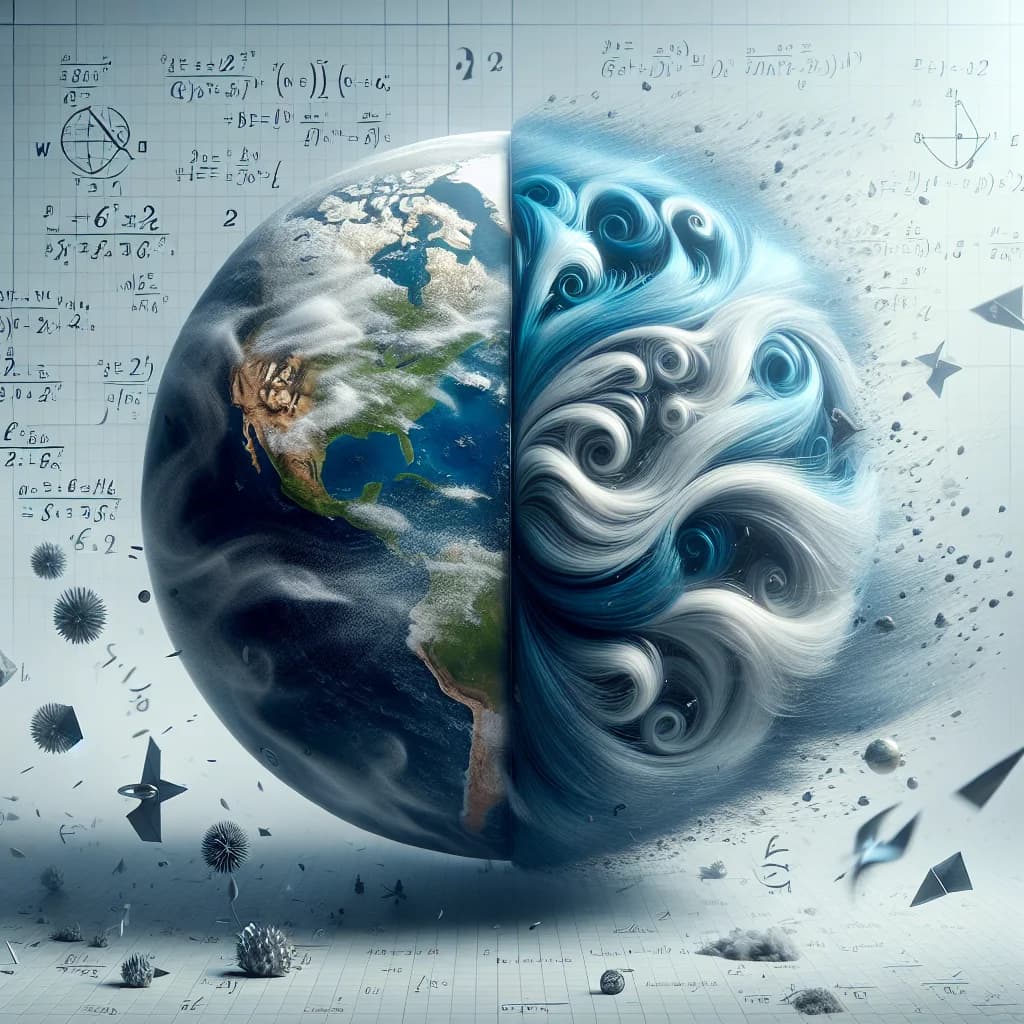
Imagine a ball covered in hair—like a tennis ball or a coconut. If you try to comb all the hair perfectly flat so that every hair lies tangentially against the surface, you will inevitably run into a problem. No matter how hard you try, you will always end up with at least one "cowlick," a swirl, or a tuft where the hair sticks straight up or bunches together.
How This Applies to Wind
In this mathematical analogy:
- The ball is the Earth.
- The hair represents the wind vectors moving across the surface.
- The flat combing represents a continuous flow of wind.
The theorem states that a continuous tangent vector field on a sphere must have at least one point where the vector is zero. In meteorological terms, this "zero vector" is a place where the wind speed is exactly zero.
The Physics of the "Still Spot"
Mathematically, the Euler characteristic of a sphere is 2. This value dictates that the "indices" of the wind’s singular points must add up to 2. This usually manifests in our atmosphere in very specific ways:
- Cyclones and Anticyclones: The "swirls" we see in satellite imagery are physical manifestations of this theorem. At the very center of a massive hurricane (the eye) or a high-pressure system, the horizontal wind speed drops to zero.
- Stagnation Points: Even if we didn't have massive storms, the geometry of the sphere forces the air to "pile up" or "thin out" at specific coordinates, creating a point of calm.
Scaling the Scenario
If we consider the Earth’s surface area—approximately 197 million square miles (510 million square kilometers)—the idea that a single point must be still seems like a tiny exception. However, if you were to try and force the wind to blow at 20 mph at every single coordinate, the atmospheric pressure would have to reach impossible infinite values at the poles to resolve the "tangle" of vectors, effectively breaking the laws of fluid dynamics.
Atmospheric Consequences of Spherical Topology
The necessity of "zero points" isn't just a quirk of math; it drives our global weather patterns. Because the wind cannot flow in a single, unified direction across a sphere, the atmosphere breaks into smaller, manageable loops.
- Hadley Cells: These are large-scale atmospheric circulations that create the trade winds.
- Vorticity: The tendency of the atmosphere to "spin" is a direct result of trying to move air across a curved surface.
Without these breaks and still points, the atmosphere could not circulate heat from the equator to the poles. The "still spots" are effectively the hinges upon which the entire door of global weather swings.
Conclusion
The next time you step outside and find the air perfectly still, you might be standing in the very spot that satisfies the Hairy Ball Theorem. Mathematics dictates that even in the most turbulent storms or the breeziest seasons, the Earth must maintain a point of absolute calm.
This intersection of algebraic topology and meteorology shows us that the world is governed by hidden geometric rules. We often think of the weather as chaotic and unpredictable, but it is bound by the elegant, inescapable reality of the shape of our world. The wind can chase itself around the globe forever, but it will always have to stop somewhere.