Why would a living frog float in midair when placed inside a sufficiently powerful magnetic field
Forget science fiction—discover the mind-bending physics that allow a living creature to drift weightlessly in midair. Uncover the secrets of diamagnetism and find out why every living thing has the hidden potential to fly.

Too Long; Didn't Read
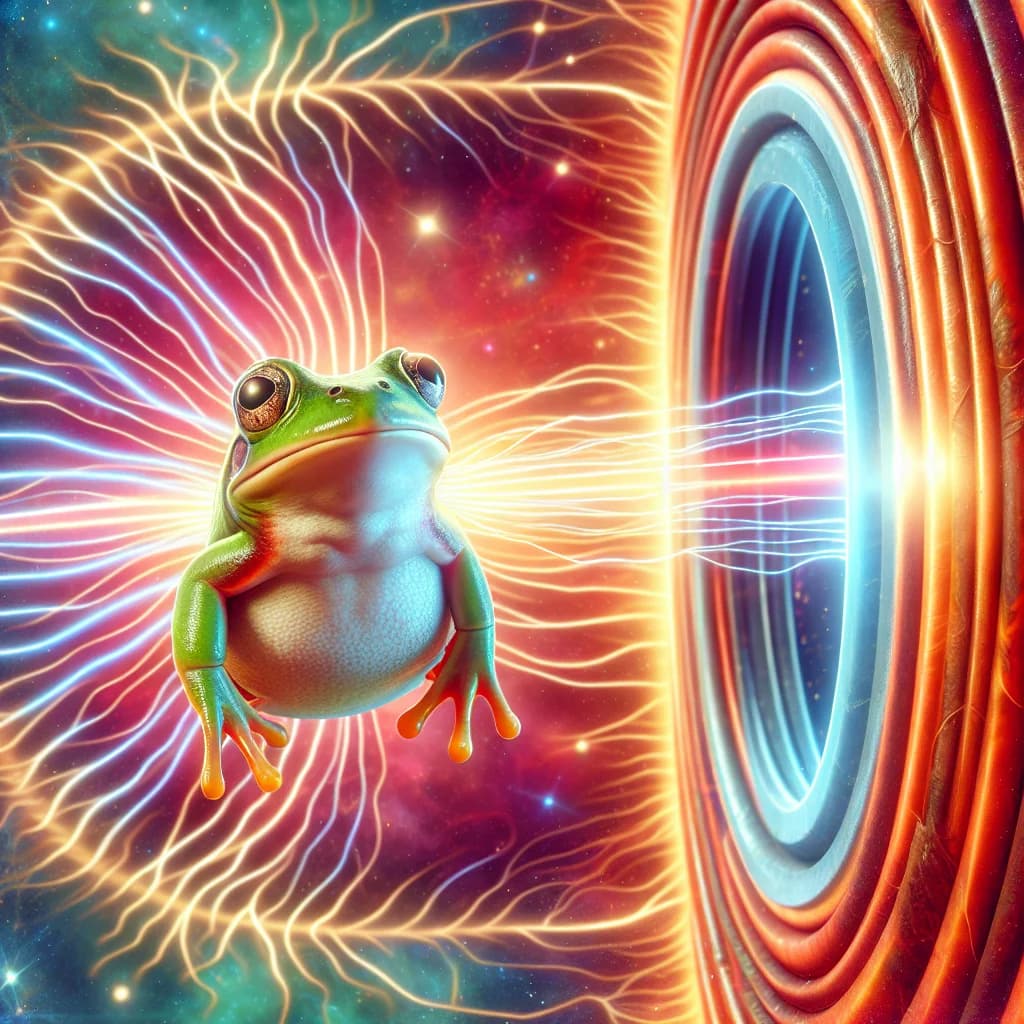
Frogs can levitate because they are mostly made of water, a diamagnetic material. In an extremely strong magnetic field, the frog's atoms create a weak opposing magnetic field that generates an upward force. When this force is strong enough to counteract gravity, the frog floats safely in midair.
How Can a Living Frog Defy Gravity? The Fascinating Science of Diamagnetic Levitation
Imagine stepping into a high-tech laboratory and witnessing a small, green frog suspended effortlessly in midair. There are no hidden wires, no rushing jets of air, and no sleight of hand. The frog simply drifts in the center of a vertical tube as if it has forgotten that gravity exists. This sounds like a scene from a science fiction film, but it is a real, documented physical phenomenon. In 1997, researchers used a powerful Bitter electromagnet to achieve this feat, proving that biological organisms can indeed fly—provided you have enough magnetic "oomph." To understand how a living creature can hover in place, we must look beyond traditional "refrigerator magnet" physics and explore the realms of diamagnetism, molecular orientation, and the delicate balance of fundamental forces.
The Secret Property of Everything: Diamagnetism
Most people associate magnetism with iron or nickel—materials that are "ferromagnetic" and stick to magnets with great strength. However, magnetism is a universal property. Every material, including the water, proteins, and DNA that make up a living frog, possesses a much subtler trait called diamagnetism.
What is Diamagnetism?
When a material is placed in a powerful magnetic field, the electrons within its atoms slightly alter their motion. This change creates a tiny, internal magnetic field that points in the opposite direction of the external magnet. Because these fields oppose one another, the material is pushed away from the magnet. While this effect is usually too weak to notice in everyday life, it exists in almost all substances, particularly water. Since a frog is composed of roughly 75% to 80% water, it effectively acts as a giant, biological "diamagnet."
The Physics of the Hover: Balancing the Scales
To make a frog float, we must satisfy a simple but demanding equation: the upward magnetic force must exactly equal the downward pull of gravity.
- The Gravity Metric: A typical small frog might weigh about 50 grams (0.05 kg). Gravity pulls on this mass with a force of approximately 0.5 Newtons.
- The Magnetic Requirement: Because diamagnetism is incredibly weak, you need an immense magnetic field to generate 0.5 Newtons of lift. To levitate water-based life, physicists use a field strength of approximately 16 Tesla.
To put that number into perspective:
- A standard refrigerator magnet is about 0.005 Tesla.
- A clinical MRI machine is roughly 1.5 to 3 Tesla.
- The Earth’s magnetic field is a tiny 0.00003 Tesla.
The magnetic field required to lift the frog is over 3,000 times stronger than a common fridge magnet. When the field reaches this threshold, the diamagnetic repulsion from the frog's water molecules becomes strong enough to cancel out its weight entirely.
Why the Frog Stays Safe and Still
One might worry that such a powerful force would be stressful for a living creature. However, the beauty of diamagnetic levitation lies in its uniformity.
A "Weightless" Experience
Unlike a mechanical lift that pushes on the frog’s skin, the magnetic force acts on every single atom inside the frog simultaneously. This creates a state of "total body lift." Because every cell is being pushed upward at the same time, there is no internal pressure or crushing force. From the frog’s perspective, the experience is virtually identical to the weightlessness felt by astronauts in orbit.
Stability in the Field
The experiment requires a specific type of magnetic field known as a "gradient field." The magnetic strength must change as you move vertically. By carefully tuning this gradient, scientists create a "potential well"—a sweet spot where the frog is pushed back toward the center if it tries to drift away. This ensures the frog remains stably tucked in the air rather than being ejected from the machine.
Conclusion
The sight of a floating frog is a spectacular demonstration of how the fundamental laws of physics can produce seemingly impossible results. By harnessing the universal property of diamagnetism and balancing it against the constant pull of gravity, scientists can temporarily grant any living thing the power of flight. This experiment relies on the fact that at a molecular level, we are all slightly "magnetic," even if we don't stick to the fridge. Ultimately, the levitating frog serves as a profound reminder that the world around us is governed by invisible forces that, when understood and mastered, can turn the most whimsical thought experiments into reality. Whether it is a frog today or perhaps something larger tomorrow, the science of levitation continues to pull us toward a more "uplifting" understanding of our universe.