Why is the Earth’s core technically two years younger than its surface due to the warping of time
Deep beneath your feet, time is moving slower than it is on the surface, leaving the Earth’s core over two years younger than the crust we walk upon. It sounds like science fiction, but the mind-bending physics of gravitational time dilation has turned our very planet into a massive, ticking time machine.

Too Long; Didn't Read
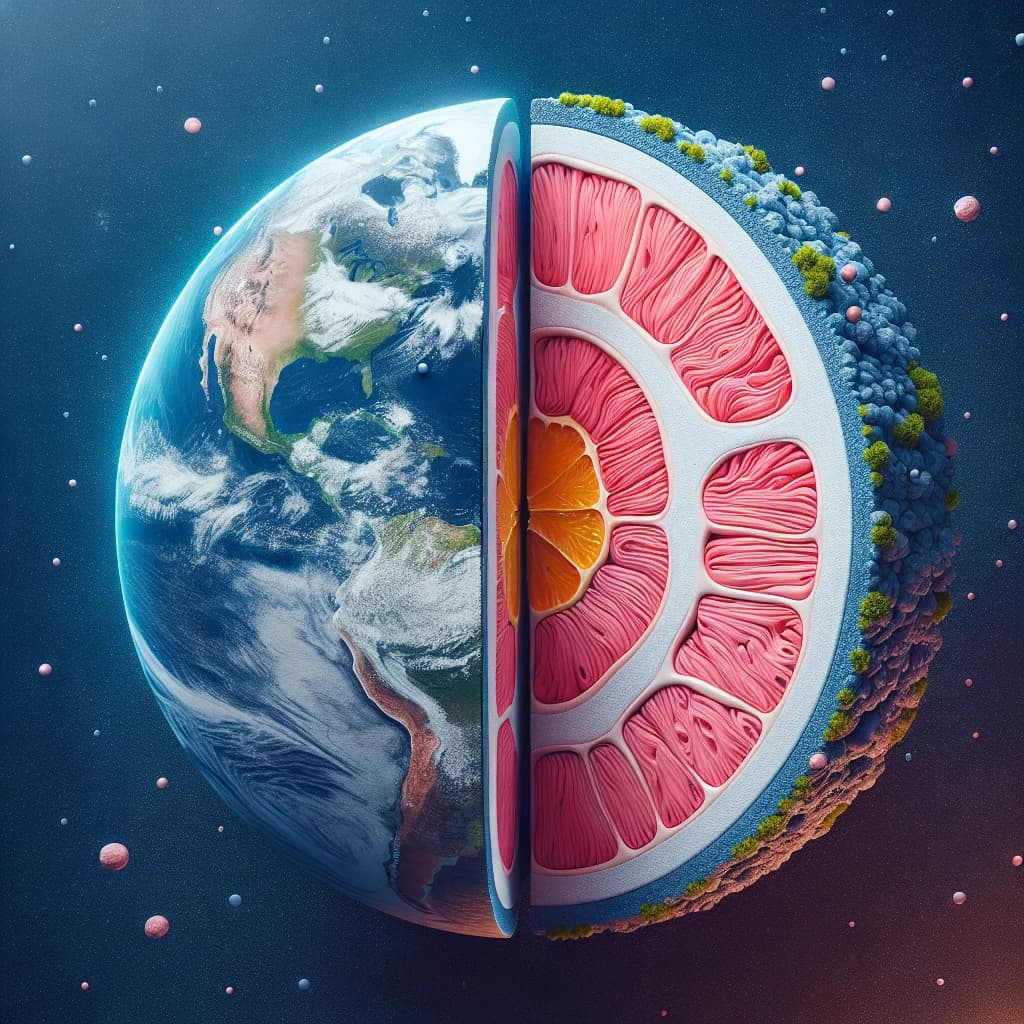
According to Einstein’s theory of general relativity, gravity warps time, causing it to move more slowly closer to a massive object's center. Because the Earth’s core is deeper within the planet’s gravitational well than the surface, time passes at a slightly slower rate there. Over the Earth’s 4.5-billion-year history, this cumulative effect of gravitational time dilation has left the core approximately two years younger than the crust.
Is the Center of the Earth Younger Than Its Surface? The Surprising Physics of Gravitational Time Dilation
Have you ever considered the Earth as a giant, ticking clock where the gears at the center move more slowly than the gears on the outside? While it sounds like the premise of a science fiction novel, it is a staggering physical reality. According to the laws of General Relativity, the center of our planet is technically younger than its crust. Specifically, if you could have placed a stopwatch at the Earth's center the moment the planet formed 4.5 billion years ago, that clock would currently lag behind a surface clock by roughly two and a half years.
This phenomenon isn't due to mechanical failure or geological shifts, but rather the fundamental way mass warps the fabric of the universe. This post explores the principles of gravitational time dilation and the fascinating calculations that reveal why the Earth’s core has "saved" two years of time compared to the world we inhabit.
Einstein’s Masterpiece: Gravitational Time Dilation
To understand why the core is younger, we must look to Albert Einstein’s General Theory of Relativity. Einstein proposed that gravity is not simply a force pulling objects together, but a curvature of spacetime caused by mass and energy. The more mass an object has, the more it warps the space and time around it.
One of the most mind-bending consequences of this warping is gravitational time dilation. In simple terms: the stronger the gravitational pull, the slower time passes. Because the Earth is a massive sphere, the gravitational potential changes as you move from the surface toward the center.
- At the Surface: You are sitting on top of the Earth's mass, experiencing standard "Earth time."
- At the Core: You are at the very bottom of the "gravity well." While the net gravitational force at the exact center is zero (because the Earth's mass is pulling you equally in every direction), the gravitational potential—the amount of energy required to move from the center to infinity—is at its peak.
The Feynman Correction: Calculating the Gap
The idea that the Earth’s core is younger was famously mentioned by physicist Richard Feynman during a lecture in the 1960s. He estimated the difference was a few days. However, in 2016, physicist Ulrik Uggerhøj and his team published a paper titled "The Young Centre of the Earth," which utilized more precise calculations to reveal that Feynman had actually underestimated the effect.
By applying the Schwarzschild metric (a solution to Einstein’s field equations), the researchers determined the following:
- The Time Ratio: The difference in the rate of time between the center and the surface is approximately $3 \times 10^{-10}$.
- The Accumulation: While a fraction of a second per day seems negligible, Earth has been spinning for roughly 4.5 billion years.
- The Total Lag: When you multiply that tiny daily difference by 4.5 billion years of days, you arrive at a total time "savings" of about 2.49 years.
To put this into perspective, 2.5 years out of 4.5 billion is like losing one second every century. It is an incredibly subtle effect, but over the lifespan of a planet, it adds up to a meaningful human timespan.
Real-World Comparisons: Satellites and Mountains
If the idea of a "younger core" feels too abstract, we can look at technology we use every day. Global Positioning System (GPS) satellites orbit about 20,000 kilometers above the Earth. Because they are further away from the Earth's mass, they experience less gravitational time dilation than we do on the ground.
- Atomic Clocks: GPS satellites use ultra-precise atomic clocks. Because of their distance from Earth, their clocks run about 45 microseconds faster per day than clocks on the surface.
- Correction Factors: If engineers didn't program the satellites to compensate for this time warping, your phone's GPS would be off by several kilometers within a single day!
Similarly, a person living at the top of Mount Everest is technically aging slightly faster than someone living at sea level. The differences are measured in nanoseconds, but they confirm that the closer you are to the center of a mass, the slower your "personal clock" ticks.
The Consequences of a Warped Earth
What does this mean for the Earth itself? Physically, very little changes in terms of geology or chemistry. The atoms at the core aren't "slower" in their movements; they simply exist in a region of spacetime where the metric of time is stretched. There is no atmospheric or environmental catastrophe resulting from this lag; rather, it is a silent, invisible feature of how our universe is constructed.
It serves as a reminder that "time" is not a universal constant. It is a local experience dictated by where you are and how much mass is nearby. The Earth’s core isn't "running late"—it is simply traveling through the fourth dimension at a slightly different pace than the crust.
Conclusion
The revelation that the Earth’s core is two years younger than its surface is a beautiful marriage of geology and theoretical physics. It proves that Einstein’s theories aren't just for black holes or distant galaxies; they are active right beneath our feet. Through the lens of General Relativity, we see that mass dictates the flow of time, and the Earth’s own bulk has acted as a temporal brake for its interior for billions of years.
While two years is a drop in the bucket compared to the age of the solar system, the fact that we can measure and understand this discrepancy is a testament to human curiosity. It reminds us that even the solid ground we stand on is part of a dynamic, warping spacetime fabric that continues to surprise us with its complexity.