Why is there a chemical so reactive that it can set even asbestos, sand, and glass on fire
Think glass and sand are fireproof? Discover the terrifying substance so reactive it turns the world’s most stable materials into fuel for an unstoppable inferno.

Too Long; Didn't Read
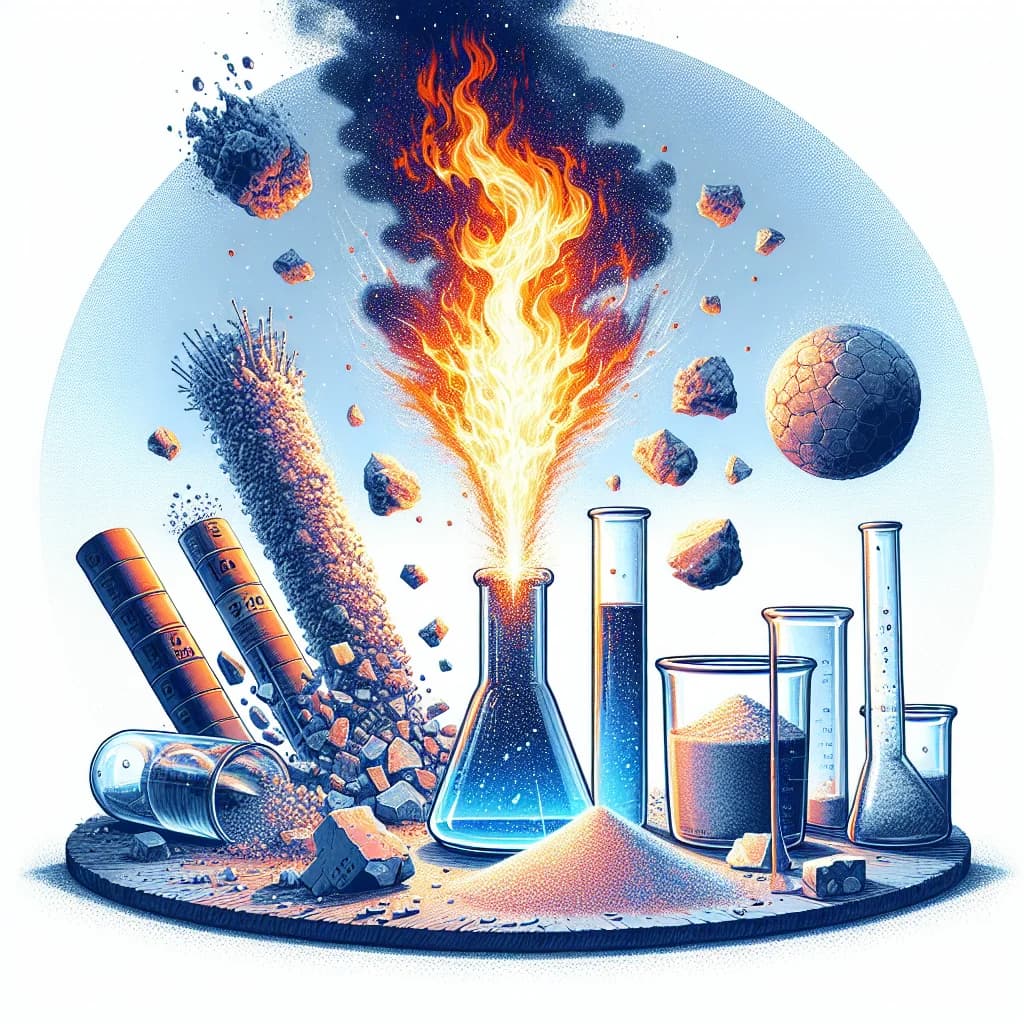
Chlorine trifluoride is a hyper-reactive oxidizer so powerful it ignores traditional fireproofing. It chemically dismantles substances like glass, sand, and asbestos, causing them to burst into flames on contact without any external ignition source. While it was once researched for rocket fuel and weaponry, its extreme volatility and lethal toxicity make it nearly impossible to handle safely.
The Substance That Burns the Unburnable: What Is the Chemistry Behind Chlorine Trifluoride?
In the world of fire safety, we have a reliable list of "safe" materials. We use sand to smother flames, asbestos to insulate against heat, and glass to contain volatile reactions. These substances are considered chemically "satisfied"—they have already reacted with oxygen and have no desire to burn further. However, there exists a substance so chemically aggressive that it treats these fireproofing staples like dry kindling. This substance is Chlorine Trifluoride ($ClF_3$). Known in the mid-20th century by the code name "N-Stoff," this pale green liquid defies our standard understanding of combustion. To understand how something can set fire to a brick, we must dive into the world of high-energy thermodynamics and the extreme "greed" of specific atoms.
The Chemistry of Hyper-Oxidation
To understand why $ClF_3$ is so reactive, we first have to redefine what it means to "burn." Typically, fire is a reaction where a fuel source combines with oxygen. However, in chemistry, burning is more broadly known as an oxidation-reduction reaction. An "oxidizer" is a substance that hungrily strips electrons away from other atoms.
While oxygen is a great oxidizer, fluorine is the undisputed heavyweight champion of the periodic table. Fluorine is the most electronegative element, meaning it has the strongest pull for electrons of any known element. Chlorine Trifluoride contains three fluorine atoms and one chlorine atom, creating a molecular "cocktail" that doesn't just want to react—it demands it.
Why It Ignites "Unburnable" Materials
Most things we call "fireproof" are actually just materials that are already fully oxidized.
- Sand ($SiO_2$): Silicon has already given its electrons to oxygen. It’s "burnt" silicon.
- Glass: Much like sand, its molecular structure is stable and saturated with oxygen.
- Asbestos: A silicate mineral that is remarkably resistant to heat because its bonds are incredibly strong.
$ClF_3$ is such a powerful oxidizer that it can displace the oxygen already bound to the silicon in sand or glass. It effectively "re-burns" the material by swapping out the oxygen atoms for fluorine atoms. This process releases a staggering amount of energy, resulting in a fire that cannot be extinguished by traditional means.
The Scale of the Reaction: Energy and Consequences
The energy released during these reactions is exceptional. When $ClF_3$ contacts a standard "inert" material, the reaction is nearly instantaneous. There is no "ignition source" or spark required; the mere physical contact provides enough kinetic energy to trigger a vigorous exothermic transition.
A Metric of Volatility
In a famous industrial accident in the 1950s, a spill of approximately 900 kilograms (about one ton) of $ClF_3$ occurred. The results provided a clinical look at its potency:
- Concrete Penetration: The chemical dissolved 30 centimeters (12 inches) of concrete floor.
- Gravel Substrate: It proceeded to react with nearly a meter of gravel underneath the concrete.
- Atmospheric Release: The reaction produced a cloud of hydrofluoric and hydrochloric acid, which are highly corrosive byproducts of the molecular disassembly of the surrounding environment.
To put this in perspective, while a gallon of gasoline requires a spark and oxygen to burn, a gallon of $ClF_3$ would turn the glass container holding it, the metal shelf beneath it, and the floor below that into a roaring chemical torch the moment the seal was breached.
The Thermodynamics of "Angry" Molecules
The reason $ClF_3$ is so much more dangerous than pure fluorine gas is largely due to its state of matter. At room temperature, $ClF_3$ is a dense liquid (boiling at just $11.7^\circ C$). This means that in a single drop, there are far more reactive atoms packed together than in a similar volume of gas. When it touches a surface, the density of the liquid allows for a concentrated "attack" on the chemical bonds of the target material.
Furthermore, the reaction is "hypergolic" with almost everything. In rocket science, a hypergolic fuel is one that ignites the moment it touches an oxidizer. For $ClF_3$, the entire world—including things we consider wet or cold—acts as a fuel. It reacts with water to produce a violent release of heat and toxic steam, making traditional firefighting methods not only useless but hazardous.
Conclusion
The existence of Chlorine Trifluoride serves as a fascinating reminder of the extreme ends of the periodic table. It dictates its own rules of engagement, proving that "fireproof" is a relative term that only applies in an oxygen-rich environment. Through the lens of electronegativity and thermodynamics, we see that $ClF_3$ isn't just "evil" chemistry; it is simply a molecule following the laws of physics to reach a lower energy state as quickly and violently as possible. While it remains too dangerous for most practical applications today, its study allows scientists to understand the limits of chemical bonding and the incredible energy stored within the fundamental building blocks of our universe.