Why would a beam of light traveling through a Bose-Einstein condensate slow down to a human walking speed
Imagine the fastest thing in the universe slowing down to the pace of a casual stroll. Discover the mind-bending quantum phenomenon that allows a Bose-Einstein condensate to put the brakes on light, turning a cosmic sprint into a human walking speed.

Too Long; Didn't Read
Light slows to a walking pace in a Bose-Einstein condensate because it interacts intensely with ultra-cold atoms, forming a hybrid light-matter state that moves significantly slower than light in a vacuum.
The Cosmic Speed Trap: How Can Light Slow Down to a Human Walking Speed?
Light is the undisputed champion of the universal speed limit. In the vacuum of space, it hurtles along at a blistering 299,792,458 meters per second—fast enough to circle the Earth seven and a half times in a single heartbeat. However, in the late 1990s, scientists achieved the seemingly impossible: they slowed light down to a leisurely 38 miles per hour, roughly the speed of a car in a school zone or a very determined cyclist.
This feat wasn’t accomplished with mirrors or brakes, but through the bizarre world of quantum mechanics. By utilizing a "Bose-Einstein Condensate" (BEC), researchers can create a medium so optically dense and biologically cold that photons—the particles of light—find themselves navigating a cosmic traffic jam. This phenomenon relies on the principles of quantum interference and Electromagnetically Induced Transparency (EIT) to redefine our understanding of velocity.
The Ultimate Deep Freeze: What is a Bose-Einstein Condensate?
To understand how light slows down, we must first look at the medium it travels through. A Bose-Einstein Condensate is a state of matter that occurs when a gas of bosons (like rubidium or sodium atoms) is cooled to temperatures incredibly close to absolute zero (0 Kelvin, or -459.67°F).
At these extreme temperatures, the individual atoms lose their distinct identities. According to the laws of quantum mechanics, they begin to overlap and behave as a single, giant "super-atom."
- Wave-Particle Duality: In a BEC, the wave nature of the atoms dominates.
- Uniformity: The atoms occupy the same quantum state, moving in perfect unison like a single synchronized unit.
- Density: While the gas is extremely dilute, its quantum properties make it an ideal "laboratory" for manipulating light.
The Science of the "Refractive Index"
When light enters any medium—like water or glass—it slows down. This is measured by the Refractive Index ($n$), defined as $n = c/v$, where $c$ is the speed of light in a vacuum and $v$ is the speed in the medium.
- Water: $n \approx 1.33$ (Light slows to 75% of its vacuum speed).
- Diamond: $n \approx 2.4$ (Light slows to 41% of its vacuum speed).
- BEC with EIT: The refractive index becomes so high and changes so rapidly that light can be slowed by a factor of over 20 million.
In a Bose-Einstein Condensate, scientists don't just rely on the material itself; they use a secondary laser to "tune" the atoms, creating a specific environment where light can barely crawl forward.
Electromagnetically Induced Transparency (EIT)
The secret sauce to the "walking speed" light beam is a technique called Electromagnetically Induced Transparency. Normally, a dense cloud of atoms would simply absorb a beam of light, turning it into heat or scattering it.
To prevent this, scientists use a "coupling laser" to manipulate the energy levels of the atoms in the BEC. This creates a state of quantum interference where two different paths for the light to be absorbed cancel each other out. This makes the opaque cloud suddenly transparent to a very specific frequency of light.
The "Dark State" Effect
When the probe light enters the BEC, it becomes "entangled" with the state of the atoms. This mixture of light and atomic excitation is called a polariton. Because the polariton is part-matter, it carries the massive "inertia" of the atoms, moving much more slowly than a pure photon ever could.
Putting It in Perspective: Human Walking Speed vs. Light
In the landmark 1999 experiment led by Dr. Lene Hau at Harvard University, light was slowed to 17 meters per second. To visualize how dramatic this reduction is, consider these comparisons:
- Vacuum Light Speed: 300,000,000 m/s (Fast enough to reach the Moon in 1.3 seconds).
- Commercial Jet: ~250 m/s.
- World Record Sprint (Usain Bolt): 12.4 m/s.
- Light in a BEC: 17 m/s (A brisk bicycle ride).
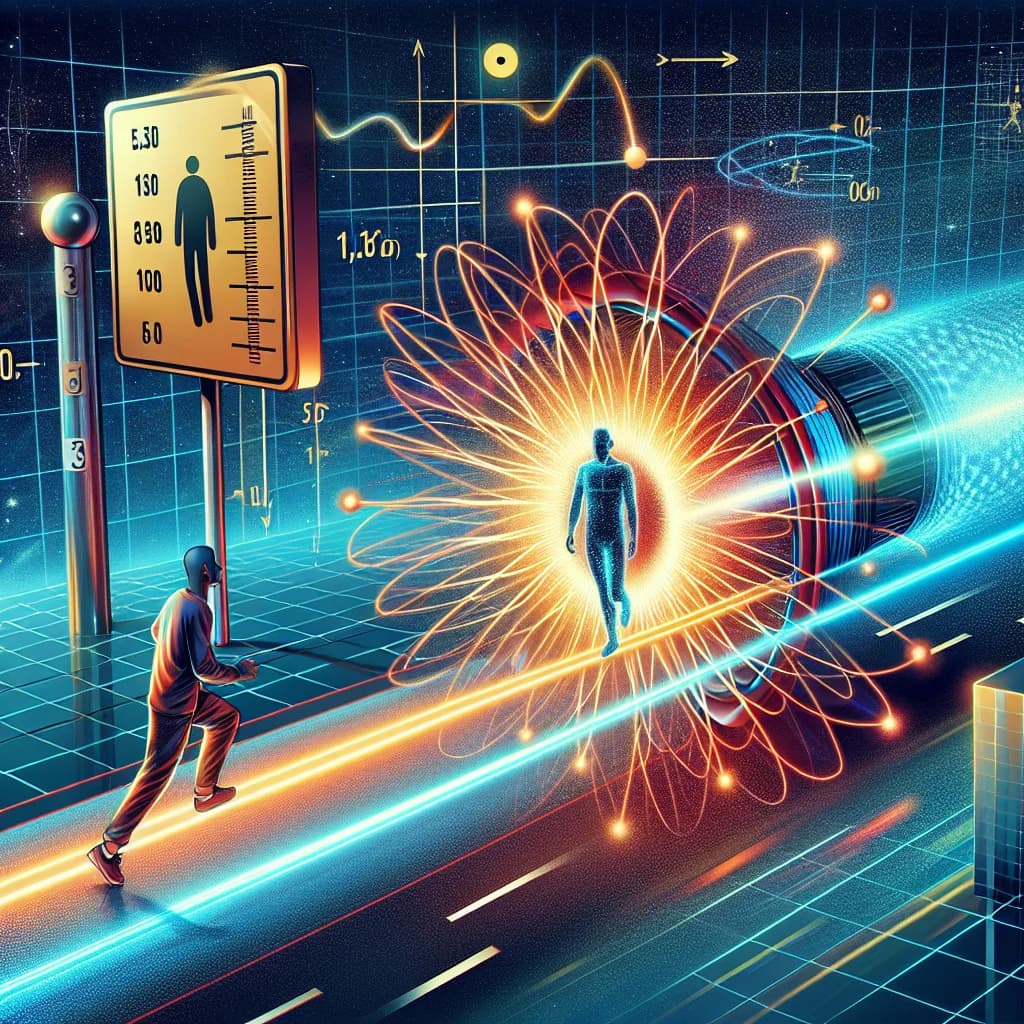
If you were standing next to a BEC chamber, a pulse of light would enter the cloud and take a noticeable amount of time to exit—long enough for you to take a few steps alongside it!
Conclusion
The ability to slow light to a human walking speed is one of the most profound demonstrations of quantum control in modern physics. By chilling atoms to the brink of absolute zero and using the precision of lasers to create Electromagnetically Induced Transparency, scientists have turned the fastest phenomenon in the universe into something we can practically race on foot.
This isn't just a curiosity of the lab; it has massive implications for the future. By slowing light, we can "store" its information, a key requirement for developing quantum computers and ultra-secure communication networks. This experiment reminds us that the "laws" of the universe are often more flexible than they appear, provided we have the right tools to navigate the strange, cold world of the quantum realm.